
Orang National Park: A Sanctuary for Endangered Hog Deer
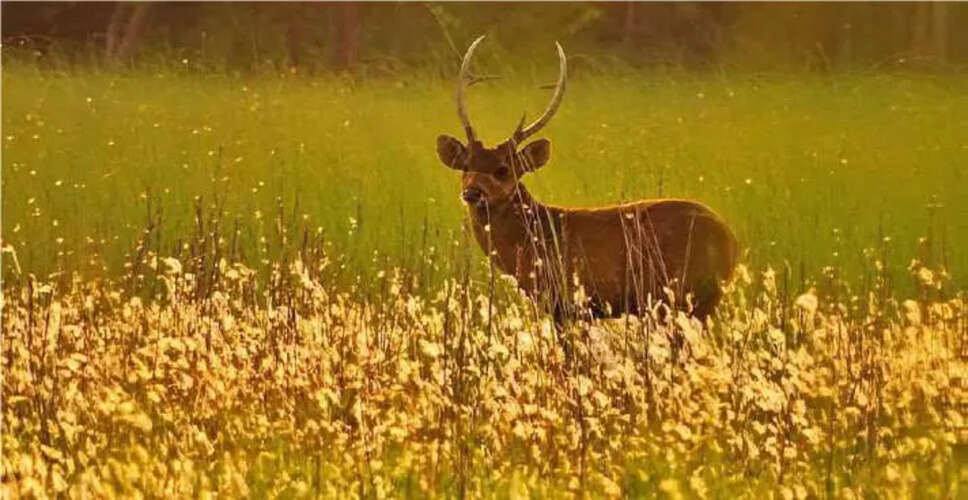

Significant Hog Deer Population in Orang National Park
Researchers noted that this may suggest a relatively low level of hunting activity in the park.
GUWAHATI, Oct 9: Recent findings indicate that Orang National Park has become a crucial habitat for the endangered hog deer, with researchers documenting remarkable population densities of up to 121.58 individuals per square kilometer in grassland areas.
These figures surpass those recorded in other regions of India, Nepal, and Cambodia, as highlighted in a recent study published in the Journal of Wildlife Science.
A team from the Wildlife Institute of India (WII), in collaboration with the Assam forest department, employed 123 camera traps and conducted 120 kilometers of line-transect surveys to evaluate the distribution, density, and behavioral patterns of hog deer within the park.
The research revealed that hog deer are extensively spread throughout Orang and are primarily active during the day, a behavior that contrasts with findings from various other locations in Northeast India. Researchers suggested that this might reflect a lower hunting pressure in the area.
Peak activity was observed in the early morning and late evening, with deer densities significantly higher in grasslands compared to woodlands.
The researchers attributed this disparity to the abundant forage and improved visibility found in grassland habitats. They also utilized elephant-back line transects to systematically survey tall-grass areas and other locations that are challenging or hazardous to access on foot due to the presence of rhinos and elephants.
“The high densities are likely due to a mix of ecological and management factors specific to the Brahmaputra floodplain ecosystem,” the researchers stated.
Seasonal flooding enhances soil nutrients, sustains early to mid-successional grasslands, and promotes high primary productivity, creating ideal conditions for grazing herbivores. The diverse landscape of tall, moist grasslands and perennial wetlands also alleviates food and water shortages during the dry season for species like hog deer.
Effective protection measures have also played a crucial role. Rigorous anti-poaching efforts and habitat management have minimized human interference and poaching threats, enabling hog deer to better utilize suitable habitats, as noted by the researchers referencing previous studies.
Management of invasive plant species may also contribute positively. While invasive species can diminish grassland quality in other protected regions of Assam, their control in Orang likely aids in maintaining forage availability and suitable habitat structure in the park’s core grasslands.
Hog deer are typically found in tall grasslands and floodplain habitats, although they are quite adaptable and can thrive in riverine woodlands, cultivated lands, and agricultural areas within floodplains.
Currently, grasslands make up about 44-67 percent of Orang's area, while woodlands cover approximately 19-26 percent.
However, the researchers warned that sustaining the park’s unusually high hog deer population will rely on preserving productive grasslands. Encroachment by woodlands could reduce available grassland and force deer into less suitable environments.
The results emphasize the conservation significance of Orang National Park and its floodplain grasslands, not only as a refuge for hog deer but also as a vital part of the broader Brahmaputra floodplain ecosystem.
The hog deer is classified as Endangered on the IUCN Red List and has historically inhabited regions from Pakistan through the Indian subcontinent to Southeast Asia.
This study was carried out by researchers Himangshu Borah, Govindan Veeraswami Gopi, and Varun Kher from the Wildlife Institute of India, along with Sandeep Bendi from the Assam forest department.