
Operation Sindoor: Indian Forces Showcase Dominance Over Pakistani Mirage
Indian Army Unveils Operation Sindoor Highlights
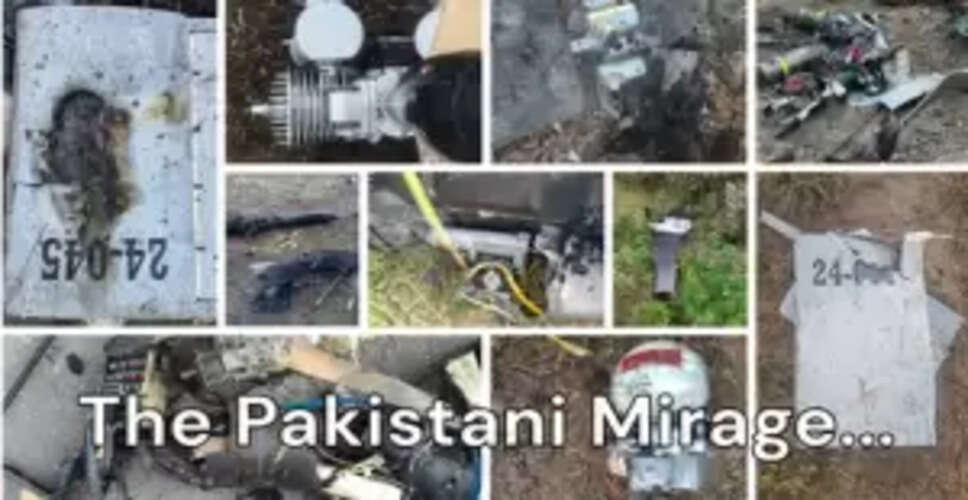
New Delhi: On Monday, the Indian Army released a compelling video titled 'Destroy the Enemy in the Sky' during a briefing attended by senior defense officials. This video highlighted the collaborative efforts of the Army, Navy, and Air Force during the recently executed Operation Sindoor. A notable part of the footage featured a collage of images depicting what is believed to be the wreckage of enemy military assets, with one image prominently labeled: 'The Pakistani Mirage... Shattered', emphasizing the confirmed downing of a Pakistani fighter jet during the operation.
During a joint press conference in New Delhi, high-ranking officials from the Indian Army, Air Force, and Navy provided an in-depth overview of the operation. The briefing was led by Lt Gen Rajiv Ghai, Director General of Military Operations (DGMO), Air Vice Marshal AK Bharti, Director General Air Operations, and Vice Admiral AN Pramod, Director General of Naval Operations.
Air Vice Marshal Bharti praised the effectiveness of India's homegrown air defense systems during the conflict, stating, 'Our battle-tested systems proved their reliability and faced the enemy directly. The exceptional performance of the indigenous air defense system, particularly the Akash system, was made possible due to the financial and policy support from the Government of India over the past decade.'
Operation Sindoor, which lasted around 25 minutes, targeted nine locations associated with terrorism—four within mainland Pakistan and five in Pakistan-occupied Kashmir (PoK). Defense Minister Rajnath Singh previously confirmed that the operation resulted in the elimination of over 100 terrorists and inflicted significant damage on infrastructure linked to Pakistan-based terrorist organizations, including Lashkar-e-Taiba, Jaish-e-Mohammed, and Hizbul Mujahideen.
In response, Pakistan launched a series of drone and missile attacks across Indian territory, targeting military installations and civilian areas in Jammu and Kashmir, Punjab, and Rajasthan. Cities such as Chandigarh, Jaisalmer, and Pathankot experienced power outages and air raid alerts.
India faced minimal damage in Udhampur, Adampur, Pathankot, and Bhuj. Civilian injuries were reported in Punjab's Ferozepur district, along with the death of a government employee in Rajouri, Jammu and Kashmir.
Air Vice Marshal Bharti emphasized the importance of domestic counter-drone technologies in mitigating threats, stating, 'Multiple waves of drones and unmanned combat aerial vehicles deployed by Pakistan were effectively countered by our indigenously developed soft and hard kill counter-UAS systems, along with the expertise of our Indian Air Defence personnel.'