
Operation Sindoor: Indian Air Force's Bold Message to Adversaries
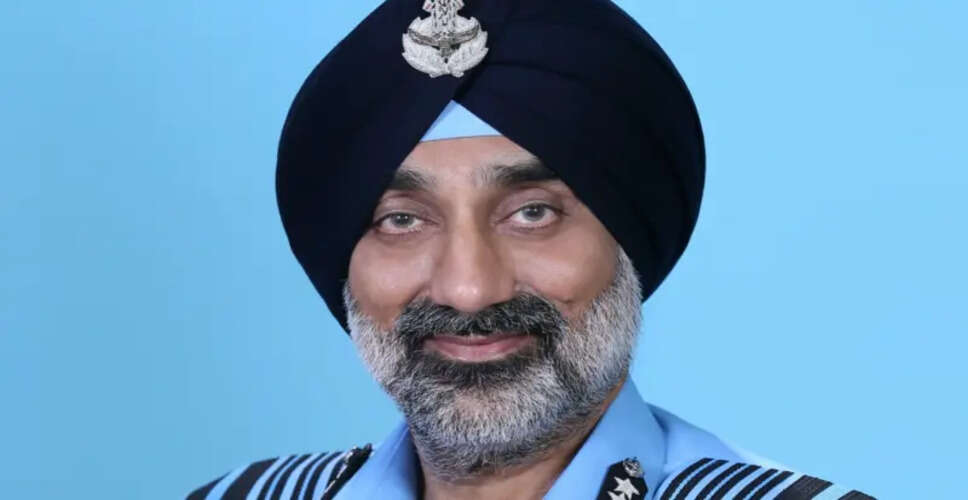

IAF's Strategic Demonstration
New Delhi: The Indian Air Force (IAF) showcased its operational prowess during Operation Sindoor, which spanned a significant 1,200 kilometers in width and 200 kilometers in depth, signaling to Pakistan that no target is unreachable, stated Air Chief Marshal AP Singh on Sunday.
In a detailed interview, the Air Chief highlighted that this operation validated the IAF's focus on capability, underscoring the crucial role of air power as both a primary responder and a strategic deterrent for the nation.
He also emphasized that while the operation confirmed the IAF's approach, it should not lead to complacency; instead, there is a need to enhance and expand these capabilities throughout the force.
"A key takeaway is the necessity to maintain multiple options and the agility to adapt as adversaries alter their strategies," remarked the Chief of Air Staff, who oversaw the four-day operation.
"A capability-centric force is inherently more adaptable, allowing us to utilize various tools rather than relying on a single approach. This flexibility enabled us to calibrate our responses and manage escalation effectively," he added.
Initiated in response to the Pahalgam terror attack, Operation Sindoor involved precise strikes against terrorist infrastructure in Pakistan and Pakistan-occupied territories last May, marking India's most audacious cross-border military action since the 1971 Bangladesh Liberation War.
"Operation Sindoor confirmed that our chosen path is correct. We will pursue it with even greater determination, ensuring that if called upon again, the IAF will respond more swiftly, accurately, and decisively on the nation's terms," he stated.
The Air Chief also pointed out that several indigenously developed weapon systems performed exceptionally well, inflicting significant damage deep within enemy territory while adhering to a commitment of zero collateral damage throughout the operation.
"This operation was fundamentally a testament to the capability-centric strategy the IAF has adopted. We have transitioned from focusing on individual platforms to a broader capability perspective, integrating every aircraft, sensor, weapon, and network to achieve a combined effect far exceeding the sum of its parts," he explained.
"The operation tested this philosophy in real-world scenarios, and it proved effective. It reaffirmed the critical role of air power as the nation's primary responder and strategic deterrent, highlighting the importance of speed, precision, integration, and adaptability," he added.
In response to inquiries about the IAF's lessons learned from Operation Sindoor regarding operational tactics, strategic options, setbacks, and firepower, the Chief noted that the operation's success stemmed from a collective effort rather than any single weapon or platform.
"The success was due to accurate intelligence, networked operations, precision weapons, electronic warfare, layered air defense, and counter-UAS capabilities all functioning as a cohesive unit," he stated.
"Calibrated targeting across the entire front, covering 1,200 kilometers in width and 200 kilometers in depth, demonstrated that no location is beyond the IAF's reach," he affirmed.
"Our indigenous networked air defense effectively countered the numerous drones and stand-off weapons launched by the Pakistan military, allowing us to operate with confidence," he noted.
"The synergy between offense and defense is precisely what a capability-centric force aims to achieve," he remarked.
Air Chief Marshal Singh emphasized that Operation Sindoor also highlighted the significance of joint and multi-domain integration, stating that collaboration across air, land, maritime, space, cyber, and electromagnetic domains facilitated quicker decision-making and enhanced operational effectiveness.
Looking ahead, the IAF must concentrate on bolstering combat mass, ISR (intelligence, surveillance, and reconnaissance) capabilities, electronic warfare, counter-UAS capabilities, resilient networks, and AI-enabled decision support. "We must also develop the capacity to sustain high-intensity operations over time through robust logistics, maintenance, infrastructure, and, crucially, indigenous production. Progress is already underway in these areas," he said.
Air Chief Marshal Singh aligned the IAF's vision with the broader national vision of Viksit Bharat 2047, asserting that a developed India must also be secure and resilient.
"The Defence Forces Vision 2047 envisions an integrated, multi-domain, and technologically advanced military to support this national ambition," he stated.
For the IAF, this means evolving into a multi-domain aerospace force capable of safeguarding India's expanding economic, technological, and strategic interests across all conflict spectrums.
"We have established a clear, structured path toward this goal. The IAF's Capability Perspective Plan-2047 outlines long-term priorities based on emerging technologies, feeding into ten-year plans that are periodically updated," he explained.
In the space domain, the Air Chief Marshal indicated that the broader direction is encapsulated in the IAF Space Vision 2047.
"Our focus will be on 'Aatmanirbharta', advanced aerospace technologies, artificial intelligence, autonomous systems, space, cyber capabilities, precision weapons, and resilient networks. Equally important is building the industrial ecosystem necessary to sustain these capabilities," he concluded.
The IAF Chief asserted that a secure India fosters an environment conducive to economic growth, while a technologically and economically robust India lays the groundwork for enhanced strategic power.
"Achieving this vision will necessitate a whole-of-nation approach, and the IAF is committed to fulfilling its role," he stated.
"By 2047, we aspire to be among the world's most capable, innovative, and technologically self-reliant aerospace forces, serving as both a guardian and a catalyst for a developed India," he emphasized.