
Omar Abdullah's Independence Day Address: A Call for Statehood Amidst Turmoil
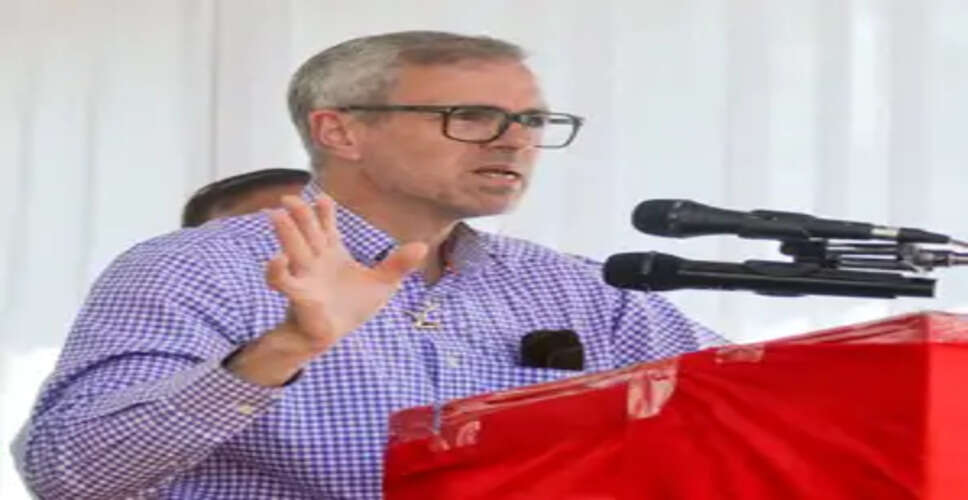
Omar Abdullah's Defiant Speech on Independence Day
Srinagar: On Friday, Chief Minister Omar Abdullah delivered a passionate speech for Independence Day, condemning the tendency to associate terrorist activities with the political landscape of Jammu and Kashmir. He emphasized that Pakistan should not be permitted to sway the region's political destiny through acts of terror.
This marked his first address since Jammu and Kashmir was reclassified as a union territory. Abdullah announced plans for a signature campaign aimed at advocating for the restoration of statehood.
His comments followed a Supreme Court ruling, led by Chief Justice B R Gavai, which suggested that events like the Pahalgam attack should be factored into discussions about statehood.
On April 22, Pakistani terrorists were responsible for the deaths of 26 civilians, primarily tourists, in the Baisaran meadow of Pahalgam.
During his speech at Bakshi Stadium, Abdullah described the reference to Pahalgam as 'unfortunate' and directly opposed the notion of allowing terrorism to dictate the political future of the region.
He questioned, 'Will the perpetrators of Pahalgam and their backers in the neighboring country determine our status as a state?'
'Whenever we approach the possibility of statehood, they intervene to thwart it. Is this just? Why are we being penalized for actions we did not commit?' Abdullah pointed out that residents from Kathua to Kupwara protested the Pahalgam incident voluntarily.
He asserted that previous administrations in Jammu and Kashmir had effectively reduced militancy.
'Elected governments, whether mine or others, have prevented such occurrences. We have consistently lowered the metrics related to militancy. Today, it is claimed that we cannot manage the situation. We have succeeded in the past and will continue to do so in the future. You must trust us,' he stated.
To address recent legal and political challenges, Abdullah revealed a strategy to bring the people's voices directly to Delhi. 'The Supreme Court has given us eight weeks,' he noted, referring to the timeline set before the next hearing regarding statehood.
'My colleagues and I will utilize these eight weeks to visit all 90 assembly constituencies in Jammu and Kashmir.'
As part of this grassroots campaign, he mentioned that they would seek signatures or thumbprints from the public to answer a singular question: 'Do you want Jammu and Kashmir to regain its statehood?'
He pledged to gather signatures from millions and present them to the central government and the Supreme Court as a clear expression of public will.
An emotional Abdullah acknowledged that his political reputation has been affected by the dual power structures in Jammu and Kashmir. He revealed that after much thought, he chose to speak candidly during his Independence Day address rather than recite a prepared government statement.
'Had I read that, the people of Jammu and Kashmir would have believed everything was fine. There would be no indication of change,' he remarked.
The Chief Minister also expressed disappointment over the lack of significant announcements from New Delhi regarding the future of Jammu and Kashmir. He shared that his supporters had suggested he could anticipate a major change, but he admitted that his optimism was waning.
'We awaited that speech,' he said, referring to Prime Minister Narendra Modi's Independence Day address.
'I was even informed that preparations were underway... We waited. It did not materialize. The reality is that the glimmer of hope is beginning to fade,' he added.
Nevertheless, Abdullah insisted he is not 'helpless' and will not accept the current status quo.
Reflecting on the past 11 years since he last spoke from the same venue, Abdullah noted the significant changes.
'When I stood here 11 years ago, I was the Chief Minister of J&K state. We had our own identity, special status, flag, and constitution. Today, none of that remains.'
He highlighted the stark contrast between governing a state and a union territory during his previous term from 2009 to 2014.
'I am uniquely positioned to understand this difference,' he stated, describing the current governance model as one 'not designed for success' but rather 'for failure.'
Abdullah compared his government to a horse with its front legs bound, expected to run.
'It may walk, but it won't reach its destination as swiftly as desired,' he explained, adding, 'We have a government with powers, yet our hands are metaphorically tied behind our backs.'
Addressing the bureaucracy, Abdullah criticized its failure to respond to the elected government, despite the government's accountability to the assembly and the assembly to the people.
This disconnect undermines the 'triple chain of accountability' vital for a thriving democracy, he asserted.
He lamented that many cabinet decisions are altered or halted without proper consent.
He questioned the purpose of having an elected government if it lacks the authority to govern effectively. 'Regrettably, I must say that we lack that power,' he emphasized, asserting that a 'new Jammu and Kashmir' cannot be realized without full statehood.
Despite the obstacles, he declared he would not accept the current circumstances and would continue to strive for justice. 'We will achieve justice... and we will not rest until that is accomplished, by God's will,' he concluded.