
Omar Abdullah Expresses Doubts on Jammu and Kashmir's Statehood Restoration
Chief Minister's Concerns on Statehood
Omar Abdullah, the Chief Minister of Jammu and Kashmir, expressed on Friday that his optimism regarding the restoration of statehood for the region is diminishing, as reported by a news agency.
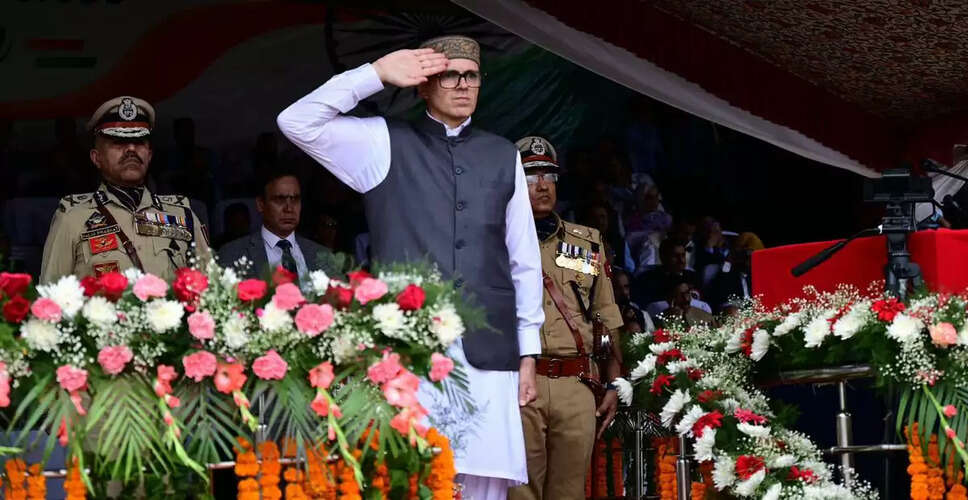
During his Independence Day speech in Srinagar, Abdullah mentioned, “My supporters had informed me that a significant announcement regarding Jammu and Kashmir would come from Delhi on Independence Day.” He added, “I was even told that preparations for statehood were underway. We waited, but nothing materialized.”
VIDEO | Independence Day 2025: Addressing a gathering at Bakshi Stadium in Srinagar, J&K Chief Minister Omar Abdullah says, “More than six years have passed since the people of Jammu and Kashmir last heard their representative address them from here. When I last spoke from this… pic.twitter.com/R5m4vSNPnX
— Press Trust of India (@PTI_News) August 15, 2025
Abdullah also revealed plans to visit all 90 Assembly constituencies over the next two months to gather signatures advocating for the restoration of statehood, as reported by another media outlet. He stated that these signatures would be submitted to the Supreme Court.
“We will inquire if the people want Jammu and Kashmir to regain its statehood,” Abdullah remarked. “If they are not in favor, I will concede defeat and accept that the people are content with the current situation.”
He criticized the Supreme Court's recent comments, labeling them as unfortunate. Abdullah pointed out that while Pakistan faced consequences for a few days, the residents of Jammu and Kashmir have endured prolonged suffering for voicing their concerns.
“We do not support the attackers in Pahalgam,” the National Conference leader clarified. “However, the incident is being used as a justification to deny us statehood.”
On Thursday, the court emphasized that the current conditions in the Union Territory, including the terrorist attack in Pahalgam, must be taken into account.
Statehood for Jammu and Kashmir
The Bharatiya Janata Party-led government revoked Article 370, which granted special status to the former state, in August 2019, subsequently dividing it into two Union Territories: Jammu and Kashmir, and Ladakh.
In December 2023, the Supreme Court affirmed the legality of the 2019 decision to abrogate Article 370 and instructed the government to restore statehood to Jammu and Kashmir.
Earlier this year, Chief Minister Omar Abdullah expressed his desire to allow the government the “first opportunity” to reinstate the statehood of the Union Territory before pursuing legal action.
He reminded reporters that Prime Minister Narendra Modi had assured the restoration of Jammu and Kashmir's statehood. “Every government or individual has the option to seek judicial recourse,” Abdullah stated. “However, that was never intended to be our primary course of action.”