
Omar Abdullah Expresses Disappointment Over Delay in Restoring Jammu and Kashmir's Statehood
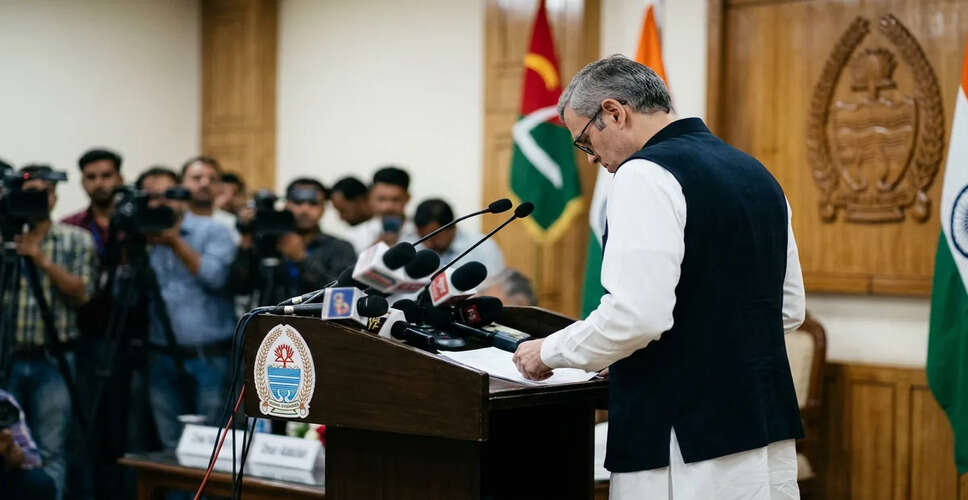

Chief Minister's Concerns on Statehood Delay
On Saturday, Chief Minister Omar Abdullah voiced his profound disappointment regarding the ongoing delay in restoring Jammu and Kashmir's statehood, which was promised. He indicated that the feelings of 'anger and frustration' among the people of the Union Territory are not solely directed at the Modi government but have also resulted in significant political repercussions for him personally. Abdullah noted that the persistent postponement of statehood has led to widespread disillusionment among the residents of Jammu and Kashmir, extending beyond just the central government.
Impact on Political Credibility
Abdullah acknowledged that his own political credibility has suffered greatly, as he continues to pay the price for 'mistakes that are not his own.' He stated that his initial strategy of fostering constructive relations with the central government in hopes of restoring statehood has severely damaged his political standing among the local populace. In an interview with journalist Karan Thapar for 'The Wire,' he remarked, 'I have staked a significant part of my political credibility on this. I am well aware that I have lost a considerable amount.' He added, 'I will bear the consequences for sins that are not mine, and I will once again carry that cross because it is my responsibility.'
Critique of Central Government's Timeline
Criticizing the central government's vague timeline for restoring statehood, Abdullah likened the process to a goal that keeps moving further away. He urged the central government to establish clear criteria so that his administration has a definitive target to aim for. He dismissed the argument that statehood cannot be restored until terrorism is completely eradicated, stating that the security apparatus operating in the Union Territory is beyond the control of his elected government.
Addressing Terrorism and Governance Issues
He pointed out, 'The problem with this argument is that you are punishing a government that has no role in this. Terrorism in Jammu and Kashmir is not due to the presence of an elected government.' He emphasized that the current anti-terrorism mechanisms in place have no connection to his administration. Abdullah argued that by making such claims, the central government is essentially stating that statehood will only be restored when Pakistan ceases its support for terrorism, effectively transferring the decision-making power from New Delhi to Islamabad.
Concerns Over Administrative Challenges
Highlighting the administrative hurdles, Abdullah described the Union Territory with an assembly as a 'contradiction.' He noted that key institutions like the Jammu and Kashmir Energy Development Corporation and Sher-e-Kashmir Institute of Medical Sciences still fall under the jurisdiction of the Lieutenant Governor. He remarked, 'There cannot be a worse form of governance than that of a Union Territory with an assembly. Please keep it as a Union Territory, but do not grant it an assembly.' He pointed out that his cabinet lacks the authority to select its administrative secretaries or appoint the Advocate General.
Response to Allegations on Article 370
In response to accusations of weakening his stance on Article 370, Abdullah stated that restoring statehood is a prerequisite for any division of constitutional powers. He explained, 'Article 370 was fundamentally about the distribution of powers between the central and state governments. If you are not a state, how can there be a state list? Restoring statehood is essential before the reinstatement of Article 370.' Regarding the central government's promises, Abdullah mentioned that Prime Minister Narendra Modi had personally committed to restoring statehood during his visits to the region.
A Personal Commitment from the Prime Minister
He emphasized that this was not just a routine political assurance but was clearly 'Modi's promise.'