
Odisha's Bharat Bandh: What Sparked the Nationwide Strike?
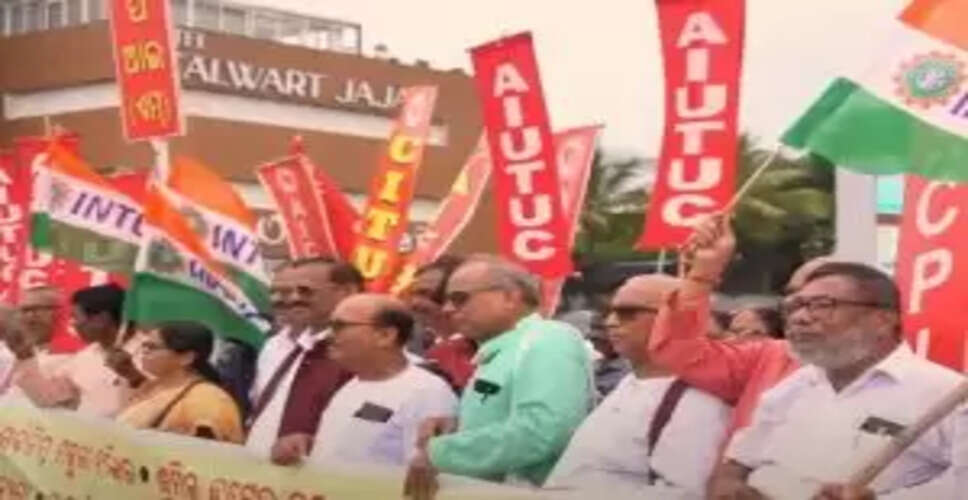
Impact of the Nationwide Strike in Odisha
Bhubaneswar: On Wednesday, various regions in Odisha, including the capital, experienced significant disruptions in vehicular traffic due to a strike organized by trade unions and drivers' associations.
A coalition of ten central trade unions initiated a Bharat Bandh, or nationwide strike, early Wednesday morning. This protest is aimed at opposing the four new labor codes, the trend of contractual employment, and the privatization of public sector units, among other issues.
The participating unions include the All India Trade Union Congress (AITUC), Indian National Trade Union Congress (INTUC), and several others, collectively voicing their concerns against government policies.
Both the Congress party and the Biju Janata Dal (BJD) have expressed their support for the unions' protest.
Additionally, drivers of various transport vehicles, such as buses, taxis, and trucks, began their own strike on Tuesday morning, advocating for better welfare measures for drivers in the state.
Protesters have been actively demonstrating in multiple locations, blocking several roads, including national highways in cities like Bhubaneswar, Cuttack, and others.
According to police reports, the strike has severely hindered vehicular movement across the state, with numerous vehicles stranded on major roads and highways. Protesters have also blocked railway tracks at Bhubaneswar station.
Commuters have found themselves stuck at bus stands throughout the state.
The strike has also impacted several central government offices, banks, and educational institutions in areas such as Rayagada, Berhampur, and Nabarangpur, as reported by authorities.
Fuel stations in Bhubaneswar were closed due to picketing by union members.
However, operations in offices and schools in Bhubaneswar, Cuttack, and some other cities continued as usual.
Sura Jena, a trade union leader, claimed during a protest near the railway station that the central government, led by Narendra Modi, is exploiting workers by enforcing the new Labor Codes.
He criticized the government for privatizing public sector units and failing to address rising inflation and unemployment.
The unions have outlined several key demands, including the immediate repeal of the four Labor Codes, a monthly wage of Rs 26,000 for workers, the reinstatement of the old pension scheme, and enhanced protections for both organized and unorganized sector workers.
Under the banner of the Odisha Drivers' Mahasangha, thousands of drivers of various commercial vehicles have been participating in a 'steering down' protest, as discussions with the state government have yet to yield results.
The drivers held lengthy meetings with Transport Department officials and the Transport Minister, but no decisions were reached.
Aditya Prasad Behera, the association's treasurer, stated, 'No decision has been made yet. Our president will announce if the strike will be called off.'
The drivers are demanding death benefits, rest areas every 100 km on major highways, and compensation for those unable to work due to accidents.
They also seek the inclusion of auto-rickshaw drivers in the Odisha Motor Transport Drivers and Workers' Welfare Board established by the government.
The Transport Minister expressed optimism about the discussions, stating, 'The talks were held in a positive atmosphere, and I hope the drivers will end their protest.'
A meeting will be scheduled soon to address the inclusion of auto drivers and other welfare initiatives, he added, along with assurances of action against those who assault drivers in accidents and preferential hiring of local drivers in mining operations.