
Nobel Prize in Economics 2026 Awarded to Hall and Woodford for Economic Models
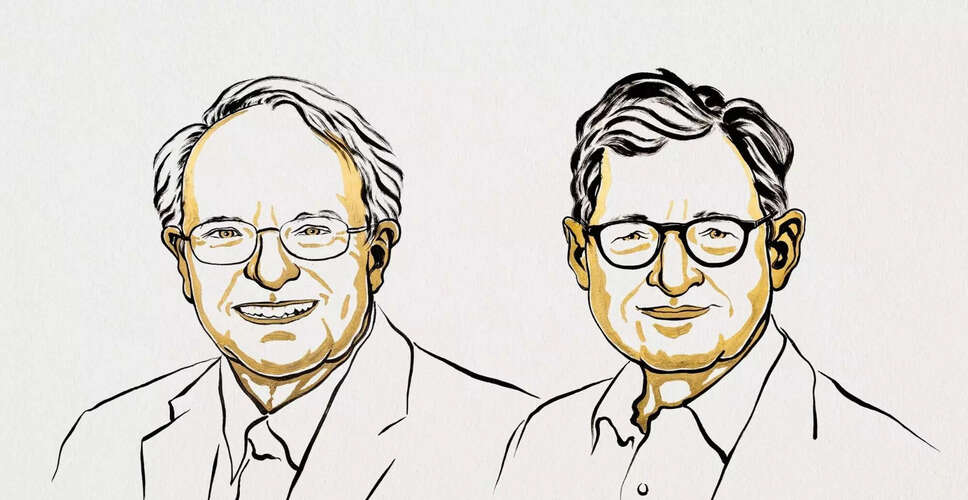

2026 Nobel Prize in Economic Sciences
American economists Robert E. Hall and Michael Woodford win the 2026 Nobel Prize in economic science for models explaining economic fluctuations(Photo: @mcbridetd/X)
New Delhi, Oct 12: The Royal Swedish Academy of Sciences has announced the recipients of the 2026 Sveriges Riksbank Prize in Economic Sciences in Memory of Alfred Nobel, recognizing American economists Robert E. Hall and Michael Woodford for their groundbreaking macroeconomic models. These models have greatly enhanced the ability of policymakers to stabilize economies during both prosperous and challenging times.
The academy highlighted that the contributions of Hall and Woodford have laid a robust theoretical groundwork for fiscal and monetary policies, allowing governments and central banks to effectively manage economic fluctuations through timely interventions.
According to the Nobel Committee, Hall, affiliated with Stanford University, and Woodford from Columbia University, restructured macroeconomic models based on microeconomic principles, emphasizing the decision-making processes of households and businesses and their collective impact on the economy.
Their research gained prominence during a period of skepticism towards traditional Keynesian models, particularly after the oil crises of the 1970s, which saw many developed nations grappling with high inflation, sluggish growth, and rising unemployment.
The Nobel Committee noted that Hall and Woodford illustrated how macroeconomic models could be redesigned to restore faith in stabilization policies by integrating forward-looking behaviors of consumers and businesses.
A central theme of their research is the notion that households and firms consider future economic conditions when making decisions regarding spending, saving, investment, and pricing.
This understanding implies that policy signals from governments and central banks can shape expectations and guide economic activities.
The academy remarked that the models crafted by Hall and Woodford are now extensively utilized by central banks and governments globally, proving instrumental in addressing economic downturns and external shocks.
John Hassler, Chair of the Committee for the Prize in Economic Sciences, stated, "The Laureates' work has provided us with a stable theoretical foundation for the models that are now used by central banks and governments around the world." He further noted that these models have enhanced policymakers' capabilities to respond to disruptions such as energy crises and abrupt changes in household consumption.
Robert E. Hall, born in 1943 in Palo Alto, California, obtained his PhD from the Massachusetts Institute of Technology in 1967 and currently serves as a professor at Stanford University.
Conversely, Michael Woodford, born in 1955 in Chicopee, Massachusetts, earned his PhD from the Massachusetts Institute of Technology in 1983 and is a professor at Columbia University in New York.
The prize includes an award of 12 million Swedish kronor, which will be equally divided between the two laureates.