
Nobel Prize in Chemistry 2026 Awarded to Kagan and Soai for Groundbreaking Discoveries
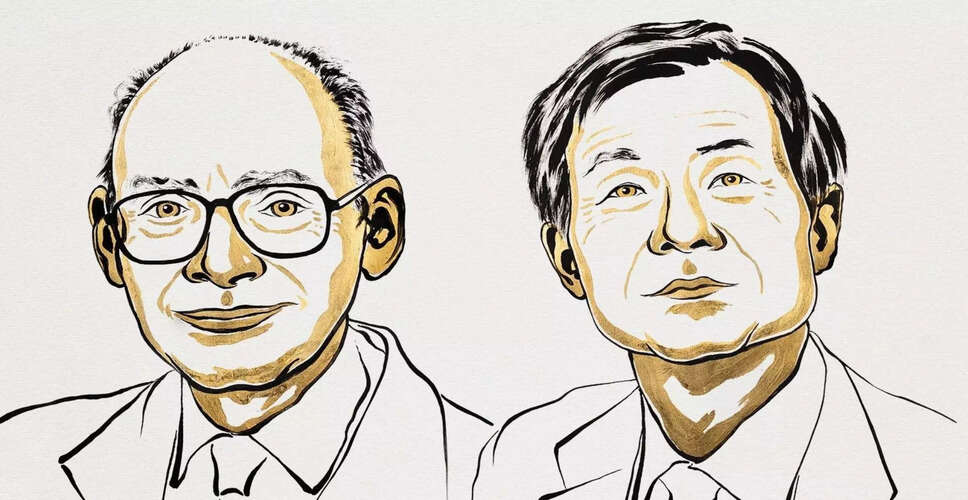

Nobel Prize in Chemistry 2026 Recognizes Pioneering Work
French Chemist Henri B. Kagan and Japanese Chemist Kenso Soai have been awarded with 2026 Nobel Prize in Chemistry for pioneering discoveries and long-standing chemistry mystery in organic synthesis(Photo: @bitturohtak/X)
New Delhi, Oct 7: The Royal Swedish Academy of Sciences announced on Wednesday that the Nobel Prize in Chemistry for 2026 has been awarded to Henri B. Kagan from France and Kenso Soai from Japan. They were recognized for their groundbreaking discoveries related to non-linear effects and autocatalysis in asymmetric organic synthesis.
The Academy highlighted that their work has addressed a significant question in chemistry regarding the origin of molecular asymmetry, also known as homochirality, in nature.
As part of the award, both chemists will share a cash prize of 12 million Swedish kronor.
Many biological molecules, such as amino acids, exist in two mirror-image forms. Despite their chemical similarities, living organisms predominantly utilize only one of these forms.
For many years, researchers have sought to understand how this selectivity occurs naturally.
The Nobel Committee noted that traditionally, chemists produced equal amounts of both mirror-image molecules during synthesis in the lab.
However, the findings by Kagan and Soai revealed methods to direct chemical reactions to favor the production of one mirror image over the other.
Heiner Linke, Chair of the Nobel Committee for Chemistry, stated, "Henri Kagan and Kenso Soai have unraveled a chemical enigma that has persisted for over a century: the spontaneous emergence of homochirality. Their developed chemical reactions are remarkable."
Kagan achieved a significant milestone in 1986 by creating a new technique that allowed for a greater excess of one molecular mirror image than previously achievable.
Soai built upon this in 1995 by demonstrating a revolutionary chemical reaction that could lead to homochirality.
In 2003, he reached a pivotal achievement by presenting a reaction that exclusively produced one of the two mirror-image forms, a phenomenon previously only observed in biological contexts.
The Academy emphasized that the discoveries of these laureates have greatly influenced contemporary chemistry, especially in the pharmaceutical industry, where the correct molecular mirror image is crucial for effective treatment.
Kagan, born in 1930 in Boulogne-Billancourt, France, obtained his PhD from the Collège de France in 1960 and is now a Professor Emeritus at the former Université Paris-Sud.
Conversely, Soai was born in 1950 in Hiroshima, Japan, earned his PhD from the University of Tokyo in 1979, and is a Professor Emeritus at Tokyo University of Science.