
New Judicial Court Complex Launched in Mandi, Himachal Pradesh
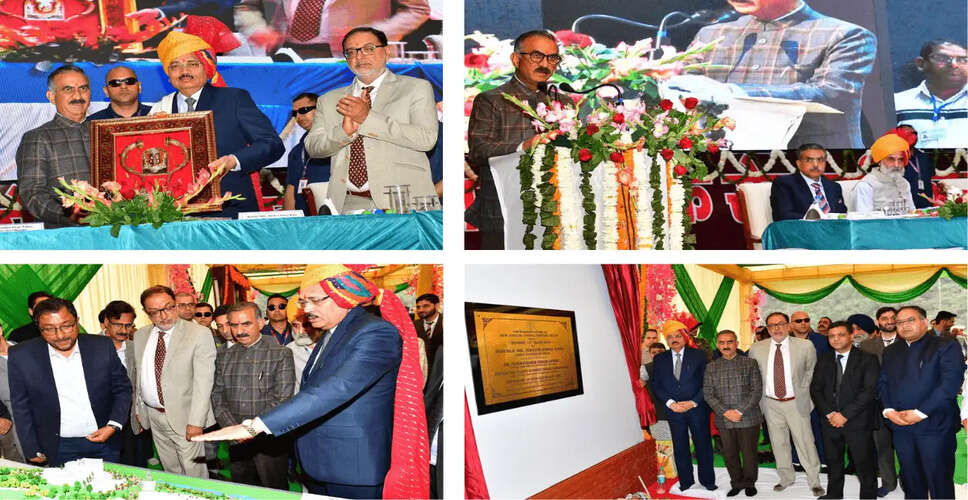
Foundation Stone Laid for Modern Court Complex
Munish Sood
Mandi
On Sunday, Chief Justice of India Surya Kant inaugurated the foundation stone for a new Judicial Court Complex in Mandi, Himachal Pradesh, alongside Chief Minister Sukhvinder Singh Sukhu. This modern facility, estimated to cost ₹152 crore, aims to enhance the judicial infrastructure in the area significantly.
Spanning 9.6 hectares, the complex will feature four blocks designed to offer improved amenities for judges, lawyers, and the public.
During a legal literacy camp at the event, Justice Surya Kant highlighted the need for the judicial system to operate with a service-oriented mindset similar to that of hospitals. He noted that just as individuals seek treatment in hospitals with hope, they should find justice and relief in courts. He acknowledged that with the growth of infrastructure and resources, the judiciary's responsibilities are also expanding.
Justice Surya Kant also acknowledged Mandi's cultural importance, referring to it as 'Chhoti Kashi,' a revered destination for millions of devotees annually. He expressed optimism that this 'temple of justice' would soon be operational.
He emphasized the significance of constitutional values, stating that while fundamental rights are often discussed, fundamental duties are equally crucial and should be upheld. He commended Himachal Pradesh for maintaining its natural beauty and stressed the importance of raising awareness about constitutional rights and responsibilities, especially at the grassroots level.
Chief Minister Sukhvinder Singh Sukhu welcomed the Chief Justice to the state and reaffirmed the government's dedication to ensuring justice and equal rights for all citizens. He mentioned that the state government is focused on inclusive development and social justice, aligning with the Constitution's principles.
The Chief Minister outlined various initiatives by the state government in education, healthcare, social security, and transparent governance aimed at providing equal opportunities and reinforcing democratic values.
Among these initiatives, he highlighted the adoption of nearly 6,000 orphaned children as 'Children of the State' through a special law. He also announced that the legal marriage age for girls has been raised to 21 years to promote gender equality. Furthermore, daughters are now entitled to equal rights in ancestral property up to 150 bighas, a privilege previously reserved for sons.
Additionally, he mentioned the launch of the Indira Gandhi Sukh Shiksha Yojana, which covers the educational expenses for children of widowed women. He noted that through revenue Lok Adalats, approximately 5.5 lakh long-standing cases have been resolved in the state.
Chief Justice of the Himachal Pradesh High Court, Gurmeet Singh Sandhawalia, spoke at the event, emphasizing the collective efforts to ensure justice for all. He pointed out that justice goes beyond the courtroom, encompassing awareness of rights, legal aid, and timely support.
High Court judges Vivek Thakur and Ajay Mohan Goel also addressed the audience, underscoring the importance of fundamental duties and the new judicial complex's significance for the region.
The event was attended by numerous judges from the Himachal Pradesh High Court, senior government officials, legal professionals, members of the Mandi District Bar Association, and other dignitaries.