
New Flowering Plant Species Discovered in Arunachal Pradesh
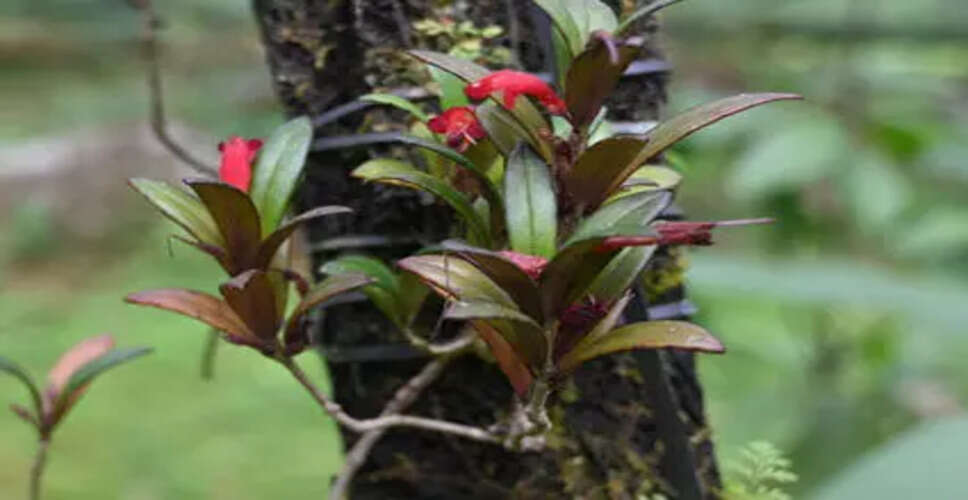

Discovery of Aeschynanthus basarensis
The plant, Aeschynanthus basarensis, belongs to the Gesneriaceae family. (Photo:@Phytotaxa/X)
Itanagar, Nov 7: A new species of flowering plant has been identified in the Leparada district of Arunachal Pradesh, highlighting the area's rich botanical diversity.
This newly discovered plant, named Aeschynanthus basarensis, is part of the Gesneriaceae family and was found during a botanical survey by scientists from the Botanical Survey of India (BSI) in a conservation area located in Soi village.
Researchers have tentatively classified this species as 'critically endangered' according to the International Union for Conservation of Nature (IUCN) Red List, with estimates suggesting that only 20 to 25 mature specimens exist across two locations.
The plant is named in honor of Egam Basar, a conservationist and director of the State Horticulture Research and Development Institute (SHRDI) in Itanagar, who proposed the name as a tribute to his birthplace.
About a year ago, Egam encouraged BSI scientists to explore the conservation site under the EB-Project Nature initiative to document its plant diversity.
"I wanted to honor Basar, my birthplace, by naming this extraordinary plant after it," he stated.
The conservation site is home to numerous indigenous plant species, many of which remain unclassified.
During the survey, scientists also collected samples of a unique epiphytic plant found growing on tree bark.
After thorough examination and comparison with existing scientific records, it was confirmed to be a previously unknown species.
Egam mentioned that this plant can also be observed at a repository maintained by the conservation initiative in Gori village.
The specimen was initially collected approximately eight years ago from a fallen tree within a sacred grove in the project area.
The research paper detailing this new species was co-authored by Dr. Krishna Chowlu, Egam Basar, Chandramohan Kolagani, and Gopal Krishna, with Chowlu and others affiliated with the BSI.
According to the scientific description, Aeschynanthus basarensis is an epiphytic plant characterized by thick, succulent leaves measuring 3-4 cm long.
The leaves are green on the top and reddish-brown underneath, while the flowers are blood-red and approximately 2-2.2 cm in size.
This species bears resemblance to Aeschynanthus micranthus and Aeschynanthus buxifolius but is distinct in terms of leaf size, floral structures, and style length.
Researchers noted that the plant is currently known only from two locations in the Soi village area of Leparada district.
Its habitat is threatened by shifting cultivation practices, known locally as jhum, and landslides.
Arunachal Pradesh is recognized as a significant center for the diversity of the Gesneriaceae family, accounting for nearly 70-80% of the family's documented diversity in India.