
New Flower Species Discovered in Manas National Park, Assam
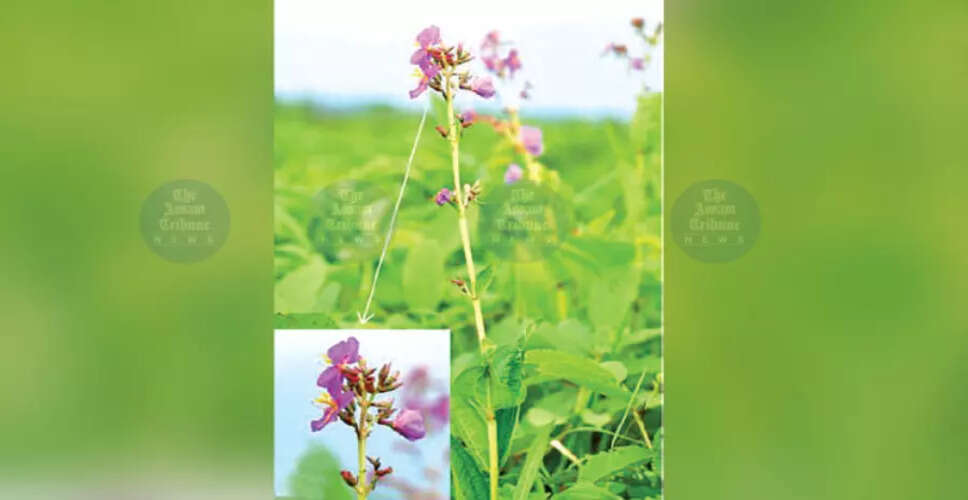

Discovery of Osbeckia assamensis
The new species is morphologically allied to Osbeckia nayarii GS Giri but differs in branching pattern, strigose stem, foliar features
Guwahati, Oct 26: A significant addition to the floral diversity of Assam has been made with the identification of a new species from the Melastomataceae family, named Osbeckia assamensis, by two researchers in Manas National Park.
This newly identified species shares morphological traits with Osbeckia nayarii GS Giri but stands out due to its unique branching structure, hairy stem, distinct leaf characteristics, and inflorescence comprising 30-35 flowers. It also features a hairy calyx margin and intersepalar emergences on the hypanthium, making it notably different from other Osbeckia species that possess tetramerous flowers.
The research was conducted by Prof Namita Nath from Gauhati University and Barnali Das, an assistant professor at Pragjyotish College. Their findings, which include a comprehensive taxonomic description and photographic documentation, have been published in the peer-reviewed journal Phytotaxa.
Osbeckia Linnaeus, which includes 45 recognized species and six varieties, is primarily found in the southeastern regions of Asia. The genus belongs to the tribe Melastomateae Bartl., which is widely distributed across tropical regions, with South America hosting the majority of its species.
“During our ongoing research on the Melastomataceae family in Assam, we discovered this species thriving in large groups across the grasslands of Manas National Park. It bears resemblance to the closely related O nayarii, characterized by its quadrangular stem and tetramerous flowers. After thorough examination of taxonomic literature and morphological characteristics, we confirmed it as a new species, Osbeckia assamensis,” the researchers stated.
Osbeckia can be differentiated from other members of the Melastome family by its unique hair types, bristles, and emergences on the hypanthium surface, as well as its isomorphic stamens and ribbed capsules that dehisce at the apex.
Prof Nath emphasized that extensive field surveys conducted from 2021 to 2025 were crucial in collecting specimens that resembled members of the Osbeckia genus. These specimens were compared with similar species found in India and neighboring countries.
“Following the standard herbarium protocols established by Jain and Rao (1977), we prepared and deposited voucher specimens at GUBH. We also examined voucher specimens from the Osbeckia genus and related genera at ASSAM and GUBH, and digitally reviewed specimens at CAL. Fresh samples were analyzed to assess their morphological features, and the type specimens were submitted to GUBH,” she added.