
Nepal's PM Balendra Shah Addresses Border Dispute with India

Clarification on Border Remarks
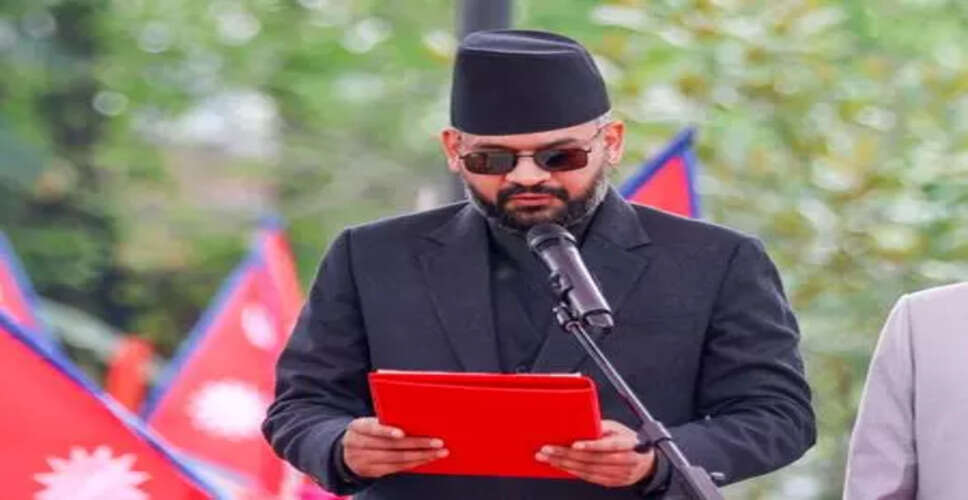
File image of Nepal's PM Balendra Shah
Kathmandu, June 1: The Ministry of Foreign Affairs in Nepal has provided clarification regarding Prime Minister Balendra Shah's comments about the country encroaching on Indian territory, which were made in the context of "cross-border occupation" and land disputes in the no-man's land along the India-Nepal border.
During his inaugural parliamentary session addressing lawmakers, Prime Minister Shah sparked controversy by stating that Nepal had also encroached on Indian land, despite ongoing complaints from Nepal about Indian encroachments.
His statements faced backlash from opposition parties, border analysts, and foreign affairs experts, who argued that such remarks could undermine Nepal's established position on the border dispute and weaken its negotiating power with India.
In a statement released on Sunday evening, the Nepali government clarified that the Prime Minister's comments were based on technical studies in border regions where citizens from both nations have been using land that technically belongs to the other.
"The Prime Minister's remarks were primarily about encroachments in the no-man's land and cross-border occupations," the statement explained.
The Ministry highlighted that due to the "Fixed Boundary Principle" in river boundary areas, there are instances where Nepali citizens occupy land that is technically on the Indian side, while Indian citizens utilize land within Nepal's territory.
Furthermore, the Foreign Ministry reaffirmed that Nepal's official stance on disputed areas, including Limpiyadhura, Lipulekh, and Kalapani, remains unchanged, emphasizing that unresolved border issues will be addressed through diplomatic dialogue and mutual understanding with India.
Currently, technical committees and border mechanisms from both countries are working on repairing border pillars, addressing encroachments in the no-man's land, and compiling records of cross-border occupations in mapped areas along the border.
Nepal and India share a long and open border, largely defined by the 1816 Treaty of Sugauli, although mapping remains incomplete in areas like Susta and Limpiyadhura-Lipulekh-Kalapani.
The ongoing border dispute has been a significant source of tension in bilateral relations.
While Nepal has consistently raised concerns about Indian encroachments, Prime Minister Shah's comments suggested that encroachments have occurred from both sides, despite no formal accusations from India regarding Nepal encroaching on its territory.
"Since taking office, I have learned that not only has India encroached on Nepal's land, but Nepal has also encroached on Indian land in various locations," Prime Minister Shah stated in Parliament.
He urged both nations to engage in discussions to resolve the matter but did not specify where Nepal had allegedly encroached on Indian territory.
Opposition leaders quickly called for clarification on the specifics of Nepal's alleged encroachments, with some lawmakers requesting that the Prime Minister's comments be removed from the official parliamentary record.
In response to a separate inquiry about the India-China agreement allowing Indian pilgrims to travel to Kailash Mansarovar through the disputed Lipulekh area, Prime Minister Shah mentioned that Nepal had sent an official diplomatic note to India and received a reply.
Shah indicated that disputes over Lipulekh, Limpiyadhura, and Kalapani would be settled through diplomatic discussions, sharing details about India's response.
"The response indicates that both governments will establish teams of historians, surveyors, and experts familiar with the territory to seek a resolution through negotiations," PM Shah noted.
He also revealed that Nepal has engaged in diplomatic talks with China and the United Kingdom regarding the border dispute with India, marking a notable first in openly discussing UK involvement in the matter.
“We have communicated not only with India and China but also with the UK government. Our perspective is that the UK should take an interest, as this issue dates back to the time of British control over India," PM Shah concluded.