
Nepal's Flash Floods: Scientific Insights Reveal Avalanche as Cause

Understanding the Cause of the Catastrophe
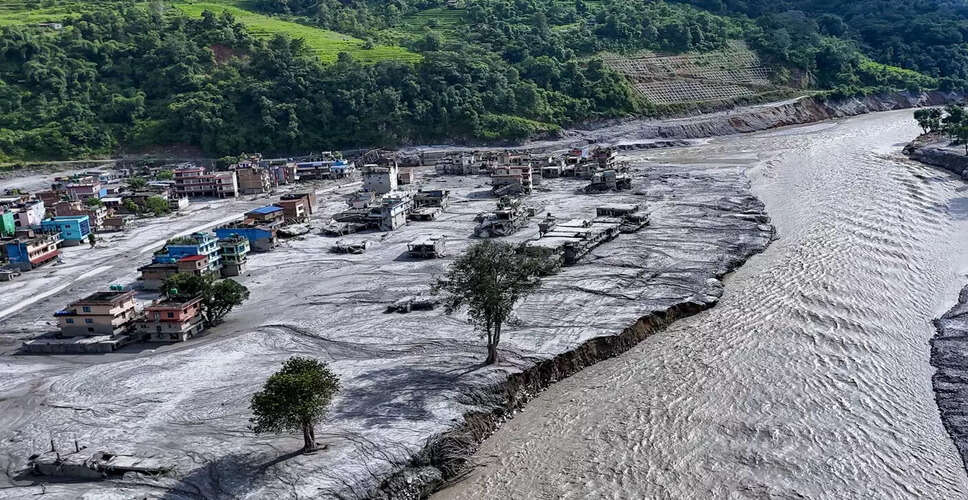
An aerial view of damaged structures covered in thick mud and debris in the aftermath of flash floods. (Photo:PTI)
Kathmandu, Aug 31: Recent research indicates that the severe flash floods that impacted the Bhotekoshi-Trishuli corridor in Nepal were instigated by a significant ice-rock avalanche in the Himalayas, rather than typical rainfall or a glacial lake outburst flood (GLOF).
A preliminary report, commissioned by the Nepal Environment Society (NES) and published on Sunday, revealed that a massive mass of ice, rock, and debris detached from the Langtang-Lirung area in Rasuwa, crashing into the Lhende River and generating a powerful surge of debris downstream.
As of Monday, the death toll from this disaster has tragically reached 903, with nearly 4,250 individuals still unaccounted for six days post-flood, as reported by Nepalese officials.
The study detailed that the ice-rock mass began its descent from the northern Langtang-Lirung region at approximately 8:37 AM on Wednesday, plummeting from an altitude of around 5,200 meters to the Lhende River at about 2,930 meters.
Satellite images indicated significant geographical alterations over an area of roughly 10 square kilometers, with a glacier section of about 0.56 square kilometers breaking off, according to the report.
The researchers utilized satellite imagery, hydrological and meteorological data, and terrain analysis to conclude that there was no evidence supporting a GLOF as the cause of the disaster.
Additionally, the report noted that there was no record of unusually heavy rainfall in the upper watershed on the day of the incident, challenging the notion that the floods were solely due to extreme rainfall or a cloudburst.
The avalanche reportedly traveled approximately 22 kilometers to Rasuwagadhi in just over seven minutes, averaging a speed of 46.3 meters per second, equivalent to about 167 km/h. Its speed decreased to around 73 km/h between Rasuwagadhi and Betrabati, and further to about 22 km/h downstream, yet it continued to carry substantial amounts of rock, sediment, and soil.
Researchers also noted unusual fluctuations in the river system hours before the floods occurred, with water levels and flow in the Rasuwagadhi and Syafrubesi regions declining several hours prior.
The disaster has resulted in extensive economic and infrastructural damage. A preliminary government assessment estimated the economic impact at around Rs 3 trillion, although detailed evaluations are still ongoing.
Hydropower infrastructure has been particularly hard hit, with preliminary data from the Nepal Electricity Authority indicating that 13 hydropower projects and one solar project were affected, resulting in a loss of approximately 431 MW of generation capacity.
Rescue teams are actively searching across all eight affected districts as authorities work tirelessly to locate missing individuals and assist those stranded by the floods.
So far, 272 bodies have been recovered from Chitwan, 207 from Nawalparasi East, 151 from Nawalparasi West, and 62 from Gorkha. Additionally, 95 bodies were found in Nuwakot, 55 in Dhading, 37 in Tanahu, and 24 in Rasuwa, according to official reports.