
Nepal PM Balendra Shah's First Official Visit to India: Strengthening Bilateral Ties
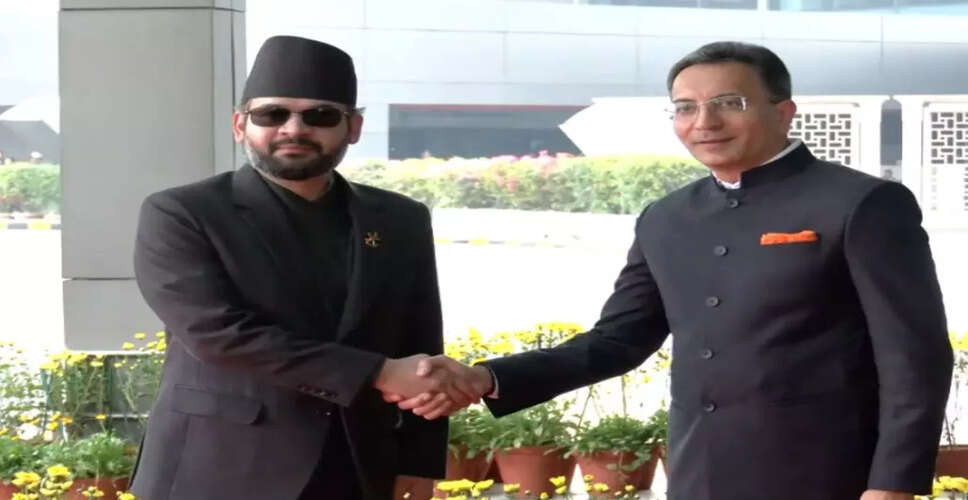

Nepal's Prime Minister Arrives in New Delhi
Nepal PM Balendra Shah (left) arrives in New Delhi, received by Union Minister Jitin Prasada at Indira Gandhi International Airport. (Photo: Media House)
New Delhi, Nov 22: Balendra Shah, the Prime Minister of Nepal, landed in New Delhi on Sunday for his inaugural visit to India since assuming office in March. His agenda focuses on enhancing collaboration in sectors such as energy, hydropower, railways, connectivity, and infrastructure development.
Shah traveled on a regular commercial flight operated by Nepal Airlines, leading a delegation of 34 members, which includes his Chief Advisor Kumar Byanjankar, Finance Minister Swarnim Wagle, and Foreign Minister Shisir Khanal.
Upon arrival, he was welcomed by Union Minister Jitin Prasada at Indira Gandhi International Airport.
In addition to the official delegation, a separate business group is accompanying the Prime Minister to India.
On Monday, Shah is set to meet with Prime Minister Narendra Modi, with discussions anticipated to pave the way for a new phase of cooperation between India and Nepal, enhancing economic ties between the two nations, according to sources.
Key topics for discussion will include energy and economic collaboration, cross-border connectivity, and infrastructure projects during Shah's meetings with India's leadership.
The two leaders are also expected to virtually inaugurate several initiatives in Nepal and exchange various forward-looking bilateral agreements across multiple sectors.
India serves as Nepal's largest export market, accounting for roughly 80% of the country's goods exports. Furthermore, it is the primary source of foreign investment in Nepal, contributing nearly one-third of the total foreign direct investment received by the nation.
The partnership between India and Nepal encompasses a comprehensive development framework, which is a cornerstone of their bilateral relationship, featuring numerous ongoing projects and initiatives.
In the fiscal year 2025-26, Nepal generated around Rs 1,800 crore in net revenue from electricity exports to India.
Energy cooperation is a significant aspect of the relationship, with long-term supply agreements crucial for fulfilling Nepal's energy needs.
On the connectivity front, discussions are underway regarding new opportunities, including the proposed Raxaul-Kathmandu railway link, which could facilitate cross-border passenger and freight transport.
A new passenger train service is also set to launch between Ayodhya and Janakpur Dham, connecting two prominent sites in the Ramayana tradition, as per sources.
Nepal holds strategic importance for India, with leaders from both nations frequently emphasizing their historical 'Roti Beti' relationship.
This visit follows a period of tension in bilateral relations after Shah's comments in May, which suggested involving China and the UK in resolving the longstanding border dispute between India and Nepal.
New Delhi has since dismissed any third-party involvement in the border issue, asserting that both countries have a well-established bilateral mechanism to address all aspects of the dispute.
India and Nepal have a historical boundary disagreement concerning Lipulekh, Limpiyadhura, and Kalapani, with India consistently asserting that these territories belong to Uttarakhand.
Shah received an invitation from Modi to visit India following the formation of his government led by the Rastriya Swatantra Party in March, about six months after a youth-led protest resulted in the ousting of K P Sharma Oli's government in September of the previous year.
It has been a long-standing diplomatic tradition for newly elected Nepali prime ministers to select India for their first official foreign visit, highlighting the significance of their relationship with the southern neighbor.
However, this convention is not obligatory; for instance, Oli broke from tradition in 2024 by choosing China for his initial foreign visit.
Shah is expected to return to Nepal on November 23.