
Nepal Launches Its First Road Tunnel, Ushering in a New Era of Infrastructure
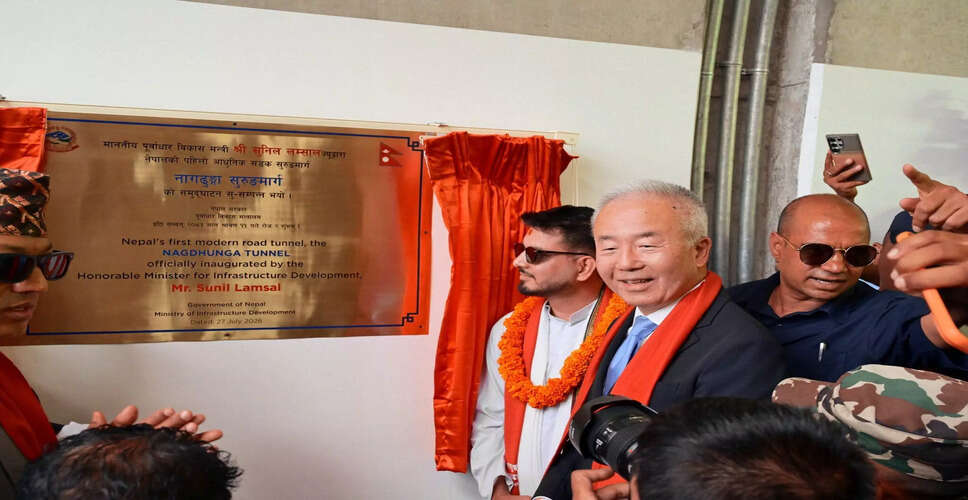

Inauguration of the Nagdhunga-Sisneri Tunnel
Photo: @OliKomal/X
Kathmandu, July 27: Nepal has officially inaugurated its first road tunnel, marking a significant milestone in the country's infrastructure development.
The Nagdhunga-Sisneri Tunnel, a 2.68-kilometer segment of the Prithvi Highway located at the western entrance of the Kathmandu Valley, was inaugurated by Minister for Infrastructure Development Sunil Lamsal. The ceremony was attended by various government officials and diplomats.
This tunnel, constructed with financial support from the Japanese government, is anticipated to cut travel time by 20 to 30 minutes. Currently, vehicles must navigate a winding mountain road at Nagdhunga to reach Kathmandu, which can be quite slow and cumbersome.
After the inauguration, Lamsal expressed intentions to construct additional tunnels across the nation. He stated, "We will build more tunnels like this throughout the country. We have learned many lessons during the construction of this project. We have now formally entered the tunnel era."
Another significant project, the Siddhababa Tunnel in Palpa District, is under construction, and the Nepali government is exploring feasibility for around two dozen more tunnel projects nationwide, as reported by the Department of Roads.
During the inauguration, Japanese Ambassador to Nepal Maeda Toru highlighted the collaboration between Japanese technical expertise and the skills of Nepali professionals. He noted that nearly 98% of the workforce involved in the project were Nepali, whose dedication was crucial for its successful completion.
Maeda emphasized that Japanese experts worked closely with Nepali engineers, enhancing their technical skills and safety management practices. He added, "The experience gained through this tunnel will enable these engineers to play a leading role in Nepal's future infrastructure development."
The ambassador also announced a new technical cooperation initiative between Nepal and Japan aimed at improving Nepal's capabilities in tunnel planning, construction, maintenance, and operation.
Although the tunnel was opened on Monday, it will initially be restricted to emergency vehicles, including ambulances and fire engines, for the first ten days, as per the Nagdhunga Tunnel Project Office. The government plans to gradually allow other vehicles access, with a three-month testing phase before full operation.
A joint venture between China's Yusin and Nepal's ART, selected through a competitive bidding process, will manage the tunnel's operation and maintenance, including traffic management and toll collection, for the next five years. This decision was made despite some reservations from the Japanese side regarding the involvement of the Chinese company.
Given Nepal's lack of experience with toll road tunnels, the government opted to hire a foreign company for the initial management of the facility.
The construction of the Nagdhunga Tunnel Project commenced after the foundation stone was laid by then Prime Minister K P Sharma Oli on October 21, 2019. Although initially expected to be completed within 42 months, the project faced delays due to the Covid-19 pandemic, land compensation disputes, and local community conflicts over water resources.
According to the project office, the total expenditure for the project reached approximately 24 billion Nepali rupees.