
Neha Bora's Resilience: From Hunger Strike to Activism for Student Rights
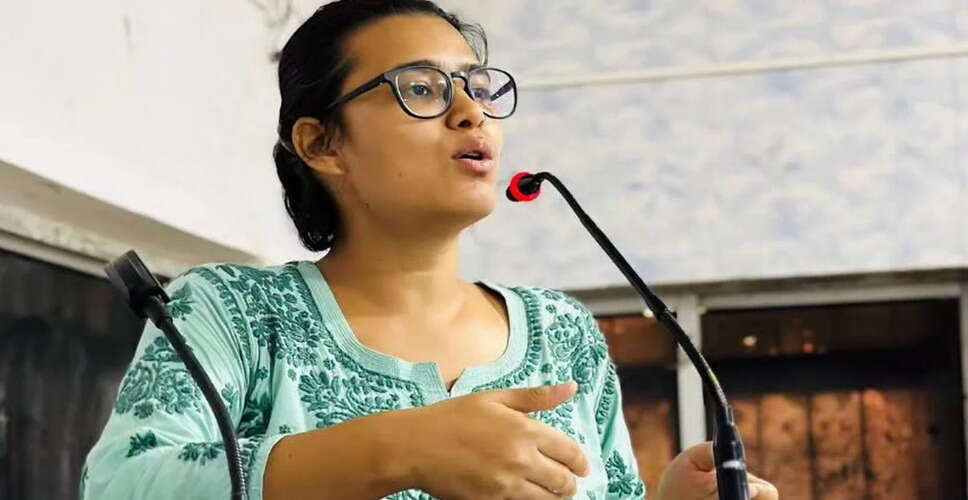

Neha Bora's Journey Post-Hunger Strike
New Delhi: Days after concluding a 23-day hunger strike, Neha Bora, the president of AISA, is still adjusting to food intake as her body relearns how to digest.
Despite her weakened condition, she has been actively traveling between states to advocate for the release of protesters who were detained during the demonstrations at Jantar Mantar.
Bora participated in the hunger strike to protest against the NEET controversy, demanding the resignation of former education minister Dharmendra Pradhan.
For the PhD student from Uttarakhand, the mobilization of youth has been a significant positive outcome of the protests, along with a noticeable change in her mother's perspective on her political involvement.
"My body got used to surviving without food during the hunger strike, and now it needs to readjust to eating again," Bora shared in an interview.
"My digestive system is still struggling with food and can't handle much. I'm steering clear of spicy dishes and red meat as they upset my stomach. Overall, I'm recovering slowly and my body is beginning to accept the food I'm consuming," she explained.
Following the protests, Bora traveled to Bihar to support those arrested, despite prior assurances that charges against them would be dropped.
"It was challenging, but it was necessary," she stated. "Over 600 students were detained, with some facing serious charges like attempted murder. We visited Patna, met injured protesters in Siwan, and even spoke with the DGP. If we hadn't acted, they might not have been released."
Bora felt it was crucial to stand by those who supported her during the protests.
Due to her weakened state from the hunger strike, she could not participate in the march on July 20 and remained at the protest camp with medical personnel as injured protesters returned.
"Our hunger strike had just ended, and we were not in a condition to join the march. If we had faced police violence, we could have ended up in the ICU," she remarked.
"We were in our tent with three doctors and medical supplies. About 30 to 45 minutes after the march began, we heard tear gas being deployed. Then, injured protesters started coming back," she recounted.
"The injuries we witnessed were shocking," she added.
Bora described a student who arrived with a broken arm, treated with a makeshift sling, and another who had been struck on the neck, resulting in severe swelling.
She also mentioned a female protester who suffered a severe leg injury and another who was hit in the chest by a male officer, leading to swelling and ligament damage.
Bora alleged that protesters were caught between multiple barricades, facing tear gas from one side and baton charges from the other, creating chaos.
"People were forced to run in different directions, and the stampede that ensued trapped elderly individuals and children. It was a terrifying situation," she claimed.
Later, she met a Delhi University student who lost vision in one eye due to a pellet injury and another student still carrying pellets in their body.
"We witnessed all of this firsthand," she stated.
Bora believes that the police's aggressive actions only served to strengthen the movement.
"They thought they could break our spirits, but after July 20, the turnout at Jantar Mantar was incredible. People came with injuries and stayed from morning till evening," she noted.
Reflecting on her speech after returning to the protest site, Bora emphasized that the scars on their bodies would serve as a testament to their struggle.
"We will ensure future generations know how the government treated its citizens," she vowed.
The protests also had a profound impact on her family dynamics.
Her mother, who previously disagreed with her political stance, attended the protests on July 19 and witnessed the events that unfolded.
"When Dharmendra Pradhan resigned, she called me to say I should congratulate my colleagues for our achievement. The change in attitudes among parents nationwide reached my home as well. This movement is a personal victory for me," Bora expressed.
Regarding her father, a former Indian Army officer, Bora mentioned she had not yet spoken to him since the protests.
"I haven't had a chance to talk to my father yet. Hopefully, when I return home..." she said, smiling.