
Nagaland's Five-Tribes Committee to Boycott Government Events Over Reservation Policy Review
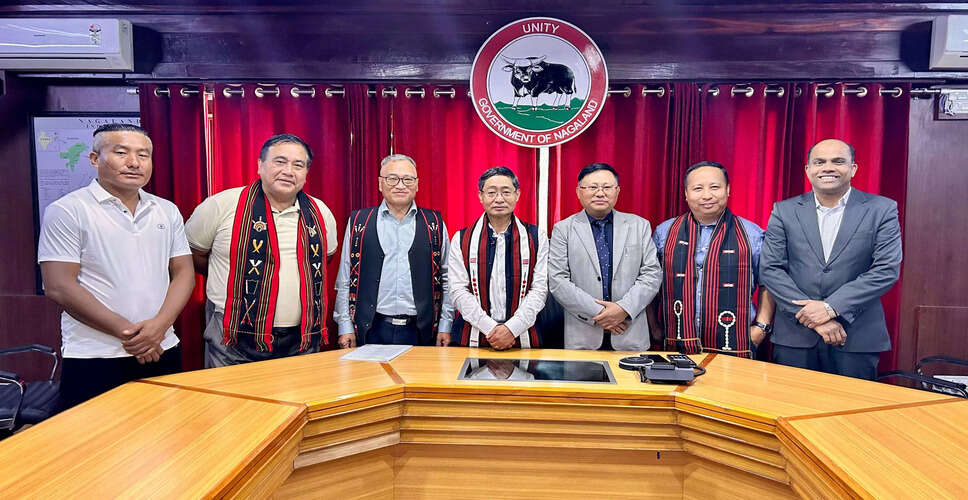
Protest Against Reservation Policy Review Commission
Kohima, Aug 9: The Five-Tribes Committee on the Review of Reservation Policy (CORRP) announced on Saturday its decision to boycott all state government functions, including the upcoming Independence Day celebrations, in response to the composition of the commission established to evaluate Nagaland’s reservation policy.
This decision came after a three-hour closed meeting in Kohima, which involved the committee and the leading bodies of the Angami, Ao, Lotha, Rengma, and Sema tribes.
Following the meeting, CORRP convener Tesinlo Semy expressed that while the committee acknowledges the government's initiative to create a review commission, it is firmly against the current makeup of the panel.
"The presence of civil society organizations (CSOs) compromises the commission's independence and neutrality," Semy stated.
He further insisted that the commission should consist solely of government officials, whether current or retired bureaucrats, to ensure an unbiased evaluation.
CORRP member secretary GK Zhimomi pointed out that the committee had not originally requested the review commission; rather, it was a result of a meeting with the state government on June 3, led by Deputy Chief Minister Y Patton.
"The commission must operate independently. Involving CSOs in a decision-making body intended to objectively evaluate the reservation policy jeopardizes its fairness," he asserted.
In response to a state minister's comments suggesting that 64% of government positions are occupied by the five advanced tribes, while over 10 backward tribes account for only 34%, Zhimomi dismissed these figures as "wildly imaginary."
He mentioned that CORRP possesses its own data, which will be disclosed at the appropriate time.
Regarding discussions with tribes benefiting from the backward quota, CORRP stated that such dialogues fall under the purview of the government-appointed commission.
"The government should seek input from all parties to arrive at a fair resolution," he added.
Zhimomi warned that if the government tries to tie the implementation of the commission's recommendations to the national census results, CORRP would demand a halt to the current reservation policy until that time.
"This is not a boycott; it is a deliberate choice of non-participation," Zhimomi clarified.
The call for a review of Nagaland's reservation policy gained momentum after the five tribal apex bodies, under CORRP, submitted a joint memorandum to the state government, arguing that the policy, established in 1977, no longer reflects the current socio-economic and educational conditions of the state's diverse communities.