
Mehbooba Mufti Advocates for Dignified Return of Kashmiri Pandits
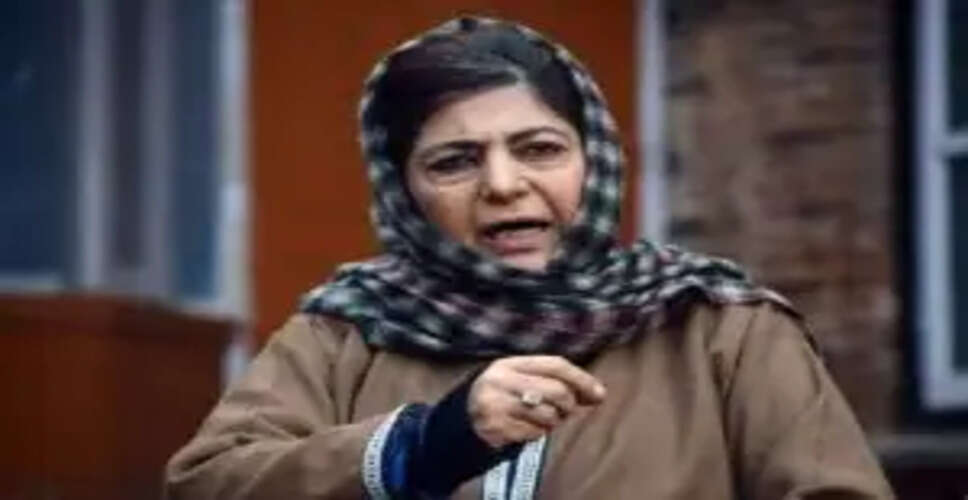
PDP President Calls for Inclusive Rehabilitation of Displaced Community
Srinagar: Mehbooba Mufti, the president of the People's Democratic Party (PDP), emphasized the need for a dignified return and rehabilitation of Kashmiri Pandits. She stated that their reintegration should not be seen as a mere symbolic gesture but as a chance to foster a shared and inclusive future for Jammu and Kashmir.
In her first direct meeting with Lieutenant Governor Manoj Sinha in nearly five years, Mufti presented a comprehensive 'inclusive and phased roadmap' aimed at facilitating significant progress on this matter.
The PDP leader also shared her proposal with Union Home Minister Amit Shah and former Chief Minister Omar Abdullah.
Her plan suggests that each displaced Kashmiri Pandit family should receive half a kanal (approximately 252.93 square meters) of land in their original district, contingent on their willingness to return.
For families whose homes still exist but are in poor condition, she proposed targeted financial assistance or interest-free loans for repairs and modernization.
Additionally, she called for the creation of two reserved Assembly constituencies for the Pandit community.
Mufti highlighted that this issue transcends politics and is a moral obligation to ensure that displaced Pandits are given a dignified, secure, and sustainable opportunity to return to their homeland.
She noted that all political factions in the union territory have consistently supported the return of the Pandit community.
The shared grief over their displacement and the desire for reconciliation unite everyone in the belief that Kashmir can once again be a harmonious place for all communities. To promote meaningful progress, she attached an inclusive and phased roadmap for consideration.
The proposal advocates for an all-inclusive approach, ensuring that any policies developed are grounded in empathy, mutual trust, and the realities on the ground.
Mufti urged the Lieutenant Governor's office to initiate a dialogue involving community representatives, civil society, local leaders, and relevant administrative bodies. Only through inclusive discussions can a future be envisioned where no community feels alienated in their own land.
She described the mass displacement as one of the largest internal migrations since independence, necessitating a comprehensive, justice-oriented, and sustainable policy framework.
The return of Kashmiri Pandits is not just a demographic or administrative issue but a matter of historical justice, reconciliation, and restoring Kashmir's pluralistic identity.
Mufti emphasized that the return process must ensure security for government employees who are vital in rebuilding community trust.
She called for amendments to the Prime Minister's Special Rehabilitation Package to include a clear mechanism for the secure transfer and redeployment of Pandit employees.
Employees in high-risk areas should have the option to transfer to safer locations without affecting their career progression or benefits.
The PDP leader insisted that rehabilitation should extend beyond physical return, actively working to mend the human and emotional connections disrupted by years of separation and mistrust.
She proposed an annual 'Return & Reconnect' summit to unite displaced Kashmiri Pandit families, local communities, government officials, civil society organizations, and academic experts.
This summit would provide a platform to share experiences of displacement, discuss return challenges, develop collaborative solutions, and offer feedback on policies.
Mufti also called for the appointment of dedicated officers in each district to assist displaced families as single-window facilitators.
She advocated for the establishment of a Reconciliation and Reintegration Commission to coordinate long-term reintegration efforts, ensuring transparency and upholding the rights and dignity of displaced individuals.
The reintegration of Kashmiri Pandits should not be viewed merely as a symbolic return but as an opportunity to create a shared, inclusive, and forward-looking future for Jammu and Kashmir.
This process represents not only the restoration of rights and dignity for a displaced community but also the revitalization of the region's rich cultural heritage, which once exemplified coexistence and harmony.
Mufti concluded that the roadmap offers a series of balanced, actionable, and empathetic policy recommendations aimed at facilitating reintegration through a multi-dimensional approach that addresses the needs of returnees and the sensitivities of the existing population.
Later, while addressing reporters, she stated that no political process is complete without the involvement of Kashmiri Pandits.
She emphasized that this responsibility lies not only with the government but also with the people and political parties.
Mufti also discussed the Amarnath Yatra with the Lieutenant Governor, expressing concerns from Kashmiris following the Pahalgam attack. She highlighted the importance of ensuring safety for the yatra and offered the PDP's assistance in this regard.
Additionally, she mentioned discussions about the release of political prisoners with minor charges in light of the upcoming Eid celebrations.