
Meet Admiral Krishna Swaminathan: India's New Naval Chief Ready to Tackle Maritime Challenges
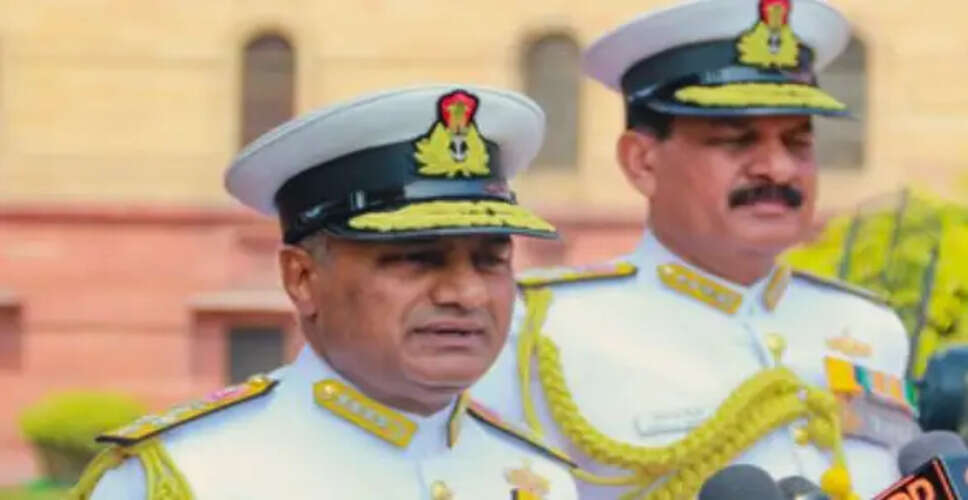

Admiral Swaminathan Takes Command
New Delhi: On Sunday, Admiral Krishna Swaminathan officially took over as the new Chief of Naval Staff of India, stepping into the role during a time of rapidly changing maritime security dynamics in the region.
He succeeds Admiral Dinesh Kumar Tripathi, who has recently retired. Before this appointment, Admiral Swaminathan was the Flag Officer Commanding-in-Chief of the Western Naval Command.
In a statement to the press, Admiral Swaminathan characterized the regional security landscape as "challenging, complex, and unpredictable," emphasizing that ensuring operational readiness will be his top priority.
"The Indian Navy remains vigilant in safeguarding national interests wherever they may be, actively engaged in a regional security environment that is fraught with challenges and uncertainties," he remarked.
"My foremost goal is to guarantee that the Indian Navy achieves the highest standards of operational readiness and combat effectiveness to protect our nation's security and economic interests," he added.
He also mentioned that the Navy is on a path of capability enhancement and modernization.
"I aim to maintain the Navy's growth momentum, consolidate ongoing initiatives, and enhance our operational capabilities through the integration of advanced technologies," he stated.
"Every day, I will strive to make the Navy a more effective, robust, and impactful force to serve our national security, development, and economic prosperity," he concluded.
Admiral Swaminathan expressed a strong commitment to joint operations, self-reliance, and indigenization. He also acknowledged Admiral Tripathi, calling him one of the "finest" military professionals in the world.
Commissioned into the Indian Navy on July 1, 1987, Admiral Swaminathan specializes in communication and electronic warfare.
He is an alumnus of several prestigious institutions, including the National Defence Academy, the Joint Services Command and Staff College in the UK, the College of Naval Warfare, and the US Naval War College.
He has received numerous accolades, including the Param Vishisht Seva Medal, Ati Vishisht Seva Medal, and Vishisht Seva Medal, and has held various significant operational, staff, and training roles throughout his career.
His command experience includes leading missile vessels like INS Vidyut and INS Vinash, the missile corvette INS Kulish, the guided missile destroyer INS Mysore, and the aircraft carrier INS Vikramaditya.
Upon being promoted to Rear Admiral, he served as the Chief Staff Officer (Training) at the Southern Naval Command in Kochi. He played a key role in establishing the Indian Naval Safety Team, which oversees operational safety across the Navy.
Following this, he served as the Flag Officer Sea Training and later as the Flag Officer Commanding Western Fleet. He also held positions as Flag Officer Offshore Defence Advisory Group and Advisor for Offshore Security and Defence to the Government of India.
After being promoted to Vice Admiral, he took on roles such as Chief of Staff of the Western Naval Command, Controller of Personnel Services, and Chief of Personnel at Naval Headquarters.
Before leading the Western Naval Command, he served as the Vice Chief of Naval Staff.
Admiral Swaminathan's academic credentials include a BSc from Jawaharlal Nehru University, an MSc in Telecommunications from Cochin University of Science and Technology, and an MA in Defence Studies from King's College, London.
He also holds an MPhil in Strategic Studies and a PhD in International Studies, both from Mumbai University.