
Mass Detention in Delhi: What Sparked the Controversial Clampdown on Protesters?

Security Measures Lead to Widespread Detentions
New Delhi: A significant security operation unfolded on Saturday, resulting in the detention of over 7,000 individuals, including prominent figures like CJP leader Abhijit Dipke, four former chief ministers, and YouTuber Dhruv Rathee. This action was taken to prevent a large-scale protest at Jantar Mantar, where demonstrators aimed to demand the resignation of Chief Election Commissioner Gyanesh Kumar.
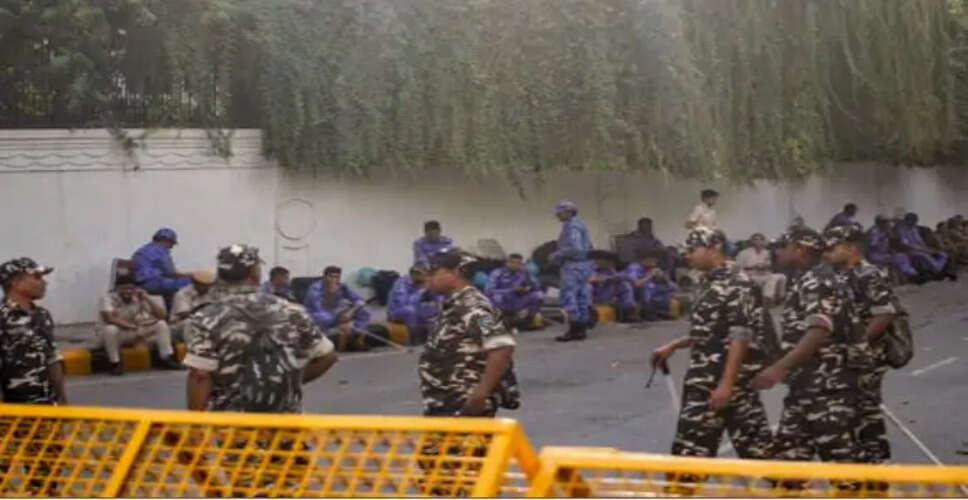
The protest site, Jantar Mantar, remained largely empty throughout the day, as more than 30,000 security personnel and numerous barricades were deployed in Lutyens' Delhi to deter protesters from accessing the area.
Opposition leaders criticized the government's actions, comparing the situation to conditions worse than during the Emergency. Congress leader Rahul Gandhi encouraged the youth to continue protesting, asserting that they would work to defeat those undermining the Constitution.
Several leaders from the INDIA bloc, including Arvind Kejriwal, Mamata Banerjee, Pinarayi Vijayan, and Manik Sarkar, were apprehended at various locations in the capital while attempting to join the protest organized by the Cockroach Janta Party (CJP) against the Special Intensive Revision (SIR) of electoral rolls.
Banerjee remarked, "This has gone beyond an Emergency; it has become a Super Emergency."
Other notable figures detained included CPI(M) general secretary M A Baby, veteran Left leader Brinda Karat, and activist Yogendra Yadav.
While in Chennai for an event, Gandhi described the core traits of Prime Minister Narendra Modi and the RSS as "cowardice."
Despite the Congress party's ongoing protests demanding the CEC's resignation over alleged electoral fraud, they distanced themselves from the CJP's demonstration.
Dipke and two other CJP leaders were detained by Delhi Police immediately upon their arrival from Mumbai. In a video shared by the CJP, Dipke was heard inviting police officers to arrest them.
Prior to their detention, police informed the CJP leaders that they lacked permission for the protest at Jantar Mantar.
Dipke criticized the treatment of CJP leaders, likening it to criminalization, and stated that even former Prime Minister Indira Gandhi did not resort to such measures, calling it a form of dictatorship.
Rathee, who had traveled from abroad to participate in the protest, was detained at his residence in Gurugram.
Around 1 PM, clashes erupted near Akashwani Bhawan when protesters attempted to breach barricades, resulting in injuries to two police officers. Security personnel quickly detained the protesters.
A similar incident occurred later near Hanuman Temple in Connaught Place, where seven police officers were injured during the detentions.
Deputy Commissioner of Police (South) Anant Mittal also sustained injuries while managing the situation.
Authorities are expected to file multiple FIRs related to the alleged assaults on police during the protest, according to a senior officer.
New Delhi was heavily fortified on Saturday, with over 30,000 police and paramilitary personnel deployed in anticipation of the CJP protest. Barricades lined the streets, 45 metro stations were closed, and extensive checks were conducted at various transport hubs, leading to significant traffic disruptions.
Reports indicate that more than 7,000 protesters were detained across Delhi, with over 2,000 in the New Delhi area alone.
In a video message released after his detention, CJP leader Dipke announced that Ajinkya Shinde would lead the protest at Jantar Mantar, asserting that the movement would persist nationwide regardless of the leaders' detentions.
Police informed Dipke of his grandmother's passing in Maharashtra and offered assistance for his travel back home on humanitarian grounds.
Dipke's grandmother, Savitribai Shankarrao Dipke, 85, passed away after a prolonged illness.
The BJP criticized the protest as an attempt to hold the city "hostage," labeling it a "flop show" and accusing Rahul Gandhi of inciting chaos with foreign support.
BJP leader Sambit Patra declared it a triumph of democracy over "mob rule," as numerous youths and politicians were detained.
Police apprehended groups of protesters from various locations, including Hanuman Temple and Akashwani Bhawan.
Regular announcements were made at Jantar Mantar, instructing individuals and media personnel not to congregate.
The police also detained a few protesters who managed to reach Jantar Mantar, effectively thwarting their attempts to gather.
BJP president Nitin Nabin accused opposition leaders of trying to destabilize the country with foreign backing.
He asserted that the government would respond firmly to their "ill intentions," while party workers would counter their plans on the ground. The ruling party held multiple press conferences throughout the day.
Delhi Chief Minister Rekha Gupta stated that the capital would not be held hostage and accused Gandhi and Kejriwal of attempting to turn the city into a "battleground" in collaboration with the CJP.
Several journalists reported being detained despite showing their press credentials, with police seizing their phones before taking them to detention buses.
Visuals circulated on social media showed journalists displaying their press IDs from inside the buses.
Top Aam Aadmi Party (AAP) leaders, including Kejriwal, who had expressed support for the CJP, were also unable to reach Jantar Mantar.
Kejriwal, who had previously announced plans to join the protest with his family, claimed that the security measures in central Delhi were "worse than the Emergency."
He called for a "Delhi chalo" movement, urging youth nationwide to come to the capital to demand the resignation of the chief election commissioner over allegations of "vote theft," shortly before his own detention.
Congress president Mallikarjun Kharge criticized the Modi government for the detentions, claiming it has transformed the "mother of democracy" into a "muzzled democracy," highlighting the BJP-RSS's cowardice.
Over 120 companies of Central Armed Police Forces assisted Delhi Police in managing the security situation, with personnel deployed at strategic locations and mock drills conducted to assess readiness.
Authorities monitored social media for mobilization attempts related to the protest, scrutinizing over 200 content creators for posts linked to the gathering.
As a precaution, liquor shops across Delhi were closed, and commuters were advised to check official announcements due to the restrictions affecting major transport hubs.