
Maharashtra's Civic Polls: How the BJP's 'Double Engine' Strategy is Reshaping Urban Politics
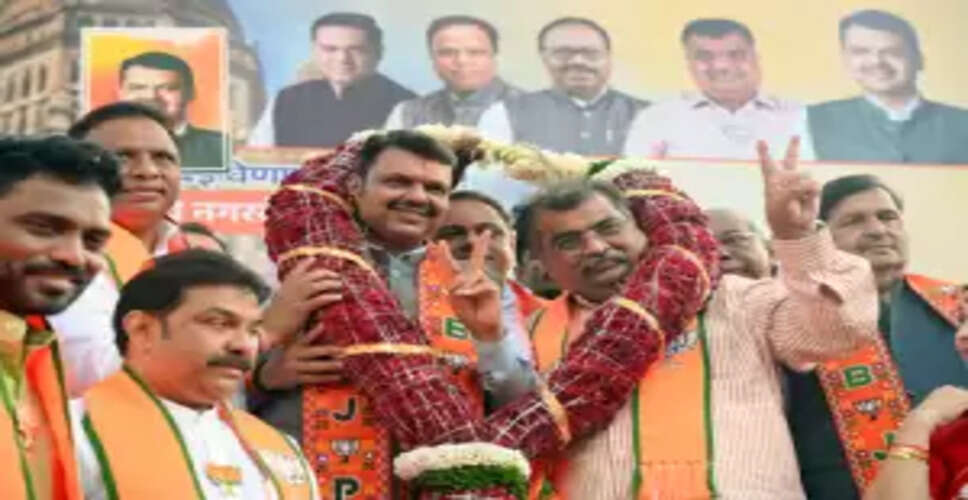
BJP's Urban Dominance in Maharashtra
Mumbai: The 'double engine' leadership model of Maharashtra, combining state and central governance, appears to have paved the way for the ruling Bharatiya Janata Party (BJP) and its Mahayuti alliance to achieve significant victories in the recent civic body elections, reinforcing their momentum following the Assembly elections.
These civic elections suggest that the ruling coalition continues to enjoy widespread support across the state, despite facing challenges from the reunited Thackeray cousins and the Congress party's attempts to regain influence with Rahul Gandhi's 'vote theft' campaign.
The Mahayuti has made substantial inroads in major municipal corporations, diminishing the presence of both the Thackeray faction and Congress in critical urban areas. The BJP is poised to claim a majority in the Brihanmumbai Municipal Corporation (BMC), marking the end of the long-standing reign of the previously unified Shiv Sena, with the BJP emerging as the leading party.
Similar trends have been observed in cities like Pune, Thane, and Nashik.
Prime Minister Narendra Modi expressed gratitude to the people of Maharashtra through a social media post, stating in Marathi: 'Thank you, Maharashtra! The enthusiastic citizens have endorsed the NDA's commitment to public welfare and effective governance!'
He further remarked, 'The outcomes of various municipal elections indicate that the bond between the NDA and the people of Maharashtra has strengthened. Our performance and vision for development have resonated with the populace. I sincerely thank the people of Maharashtra. This mandate will propel progress and celebrate the rich culture of the state.'
By midday, preliminary results indicated that the BJP was leading in numerous wards, while the Eknath Shinde-led Shiv Sena also showed strong performance. Initial trends revealed that the Shiv Sena was performing well in Kalyan-Dombivli, Navi Mumbai, and Ulhasnagar, leading in several wards within those municipalities.
In Pune and Pimpri-Chinchwad, the BJP made significant gains.
The elections, held on January 15, covered 2,869 seats across 893 wards, with over 1.03 crore voters participating. These elections were delayed since 2017 due to COVID-19, legal challenges, and ward delimitation.
Counting took place at 23 designated centers in Mumbai, under strict security measures and police presence, with each center supervised by an Election Returning Officer.
The November 2024 Maharashtra Assembly elections, where the ruling coalition solidified its power, set the stage for these municipal contests, viewed as a test of continuity for the government. The civic victories also reflect an urban shift, effective local organization, targeted campaigning on development issues, and a fragmented opposition.
The alliance between Shiv Sena (Uddhav Balasaheb Thackeray) and Raj Thackeray’s Maharashtra Navnirman Sena (MNS), along with Congress's attempts to reinvent itself, did not translate into significant ground support in many wards.
The civic results follow the Mahayuti's strong performance in the November 2024 Assembly elections, where the BJP secured 132 seats, gaining 27 from 2019, while its allies, the Eknath Shinde-led Shiv Sena and Ajit Pawar’s Nationalist Congress Party (NCP), won 57 and 41 seats, respectively, after splitting before the elections.
This contrasts with the April-May Lok Sabha elections, where the BJP faced a 14-seat loss, winning only nine of the 48 parliamentary constituencies in Maharashtra. The Congress managed to consolidate its position, winning 13 seats compared to just one in the 2019 Lok Sabha elections.
The recent civic sweep enhances the Mahayuti's control over urban governance, providing leverage over municipal budgets, appointments, and local service delivery. For the opposition, these results highlight organizational weaknesses and the necessity for clearer local narratives.
The outcome also indicates that urban voters are prioritizing perceived administrative effectiveness and visible civic improvements over identity or regional appeals.