
Madras High Court Raises Concerns Over Political Party Switching by Legislators
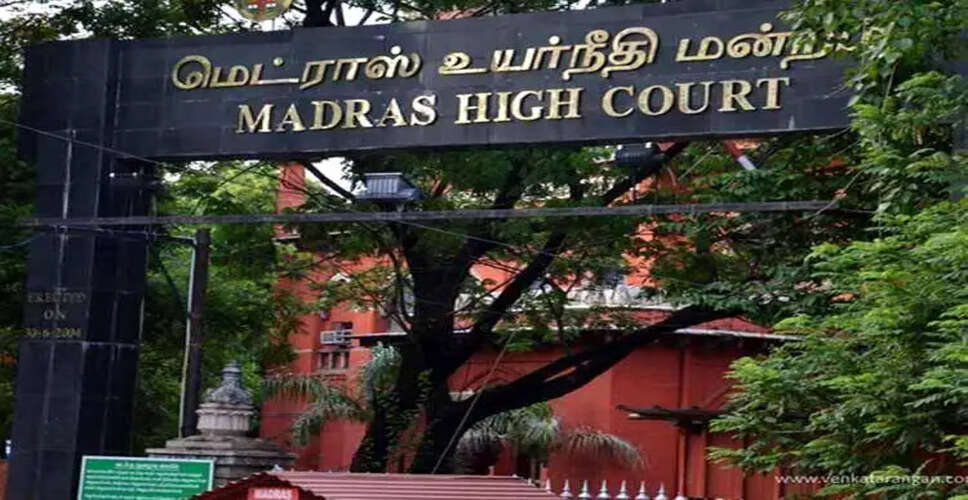

Court Questions Legislators' Party Switching Practices
Chennai: On Wednesday, the Madras High Court expressed its concerns regarding the trend of elected officials resigning from their positions, switching to different political parties, and then running in subsequent by-elections from the same constituency. The court highlighted that such actions could potentially disrespect the voters and their original choices.
Justice S.M. Subramaniam remarked that when a Member of the Legislative Assembly (MLA) resigns merely to seek re-election under a different party's banner, it could be seen as undermining the principles of democracy.
He questioned why the Election Commission of India (ECI) should not investigate this matter and establish relevant guidelines using its authority under Article 324 of the Constitution.
These comments were made by the court's second Division Bench, which included Justice Subramaniam and Justice K. Govindarajan, during the hearing of a public interest litigation (PIL) presented by Chennai lawyer K. Suthan.
The petitioner advocated for measures to prevent elected officials from resigning after changing parties and subsequently contesting the resulting bye-elections from the same seat. He argued that this practice undermines the voters' decisions made during the general elections and imposes unnecessary financial burdens on the public.
Senior counsel R. Singaravelan, representing the petitioner, informed the Bench that six AIADMK legislators in Tamil Nadu had resigned following this year's Assembly elections and later joined the ruling Tamilaga Vettri Kazhagam. Among them, Maragatham Kumaravel and P. Sathyabama have been nominated by the TVK to contest in Madurantakam and Dharapuram, respectively.
The court was informed that bye-elections had only been announced for these two constituencies, despite other legislators also vacating their seats.
Singaravelan argued that permitting elected representatives to resign and immediately seek re-election under a different party's banner, without any restrictions, diminishes democratic accountability.
He pointed out that voters who chose a candidate based on a specific party affiliation are now being forced to vote again due to the legislator's political maneuvering.
He cautioned that if this practice remains unregulated, it could lead to mass resignations in the future, resulting in frequent bye-elections and significant financial losses for the public treasury.
The Bench acknowledged that this issue warranted further scrutiny, given the Election Commission's constitutional duty to oversee elections. It urged the poll body to explore potential safeguards to deter resignations driven solely by party switching and immediate re-election.