
Limestone Mining Projects Threaten Great Indian Bustard Habitat in Jaisalmer

Environmental Concerns Rise Over Mining Near Bustard Habitat
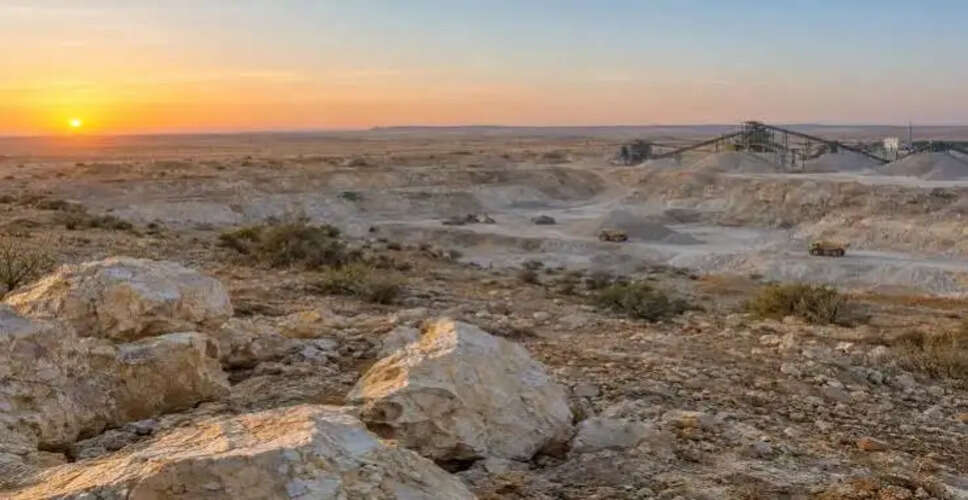
New Delhi: Since July, a total of six limestone mining initiatives near the Great Indian Bustard (GIB) priority zone in Jaisalmer have progressed through various stages of environmental clearance.
These priority zones serve as vital habitats for the GIB, providing essential foraging and breeding grounds for this critically endangered species.
Recently, two limestone projects located in Jaisalmer's Joga village received initial approval in November. One of these projects is situated just 3.8 kilometers from the GIB priority area, while the other is 5.7 kilometers away.
In October, environmental clearance was granted to two additional limestone mining projects in Parewar and Ramgarh villages of Jaisalmer. The Parewar project partially overlaps with the GIB priority area, whereas the Ramgarh project is located over a kilometer from the habitat.
Earlier in September, another project in Joga, located 5.8 kilometers from the GIB priority area, also cleared the first stage of approval.
In July, a limestone mining project was approved, with over 280 hectares (29 percent) of its mining lease area within the GIB habitat in the same village.
Dr. Devesh Gadhavi, a former member of an expert committee appointed by the Supreme Court regarding the GIB population, expressed concerns about the potential landscape changes due to these projects.
He noted that such alterations could lead to significant habitat loss for the species and stated in his dissenting opinion that mining should not be allowed in the GIB priority area.
In December 2025, the Supreme Court accepted recommendations to expand the GIB priority area, increasing it from 13,163 square kilometers to 14,013 square kilometers in Rajasthan, and from 500 square kilometers to 740 square kilometers in Gujarat.
The current projects include the 368-hectare Joga-IV Limestone Block by Shree Cement East Private Limited, located 3.8 kilometers from the GIB habitat, and the 376-hectare Joga-II Limestone Block by Ambuja Cements Limited, which is 5.7 kilometers away.
These projects were recommended for terms of reference (ToR) by the Union environment ministry's expert appraisal committee (EAC) during a meeting held from November 2 to November 4.
The ToR is a formal document outlining the scope, objectives, methodology, and reporting requirements for an environmental impact assessment study for proposed projects.
Both projects propose a transportation route of approximately 12 kilometers from the mining blocks to the Sanu railway siding, with around 3.5 kilometers passing through the GIB habitat.
The project developers have proposed an alternative route that is 250 kilometers long, leading to the Phalodi railway station and avoiding the GIB priority area.
The EAC has instructed the project proponents to explore feasible alternative routes for mineral transportation, emphasizing the need to avoid the GIB habitat.
If the route through the GIB priority area is selected, the proponents must implement various measures, including developing a specific conservation and mitigation plan for the transportation corridor.
Previously, the EAC recommended environmental clearance for mining at the Parewar SN1 Limestone Block in Jaisalmer by Wonder Cement Limited and at the Ramgarh Auctioned Block in Ramgarh village on October 8.
The Parewar project has a mining lease area of 960 hectares, with 0.29 hectares falling within the habitat, and is located 7.34 kilometers from the Mokla Parewar Conservation Reserve.
During discussions, the EAC advised that no mining should occur on the 0.29 hectares within the GIB habitat, and Wonder Cement Limited should relinquish this area after receiving environmental clearance and executing the mining lease deed.
The environmental impact assessment (EIA) report for the project highlighted that mining activities could disrupt the feeding, resting, and movement patterns of the GIB population in the area.
The 256-hectare Ramgarh project by Dalmia Bharat Green Vision Limited is situated 1.77 kilometers from the GIB priority area. The Wildlife Institute of India (WII) noted that new above-ground transmission lines could increase collision and electrocution risks for both raptors and GIB populations.
Overall, while the proposed mining and cement plant sites do not directly impact critical GIB habitat, implementing mitigation measures for habitat restoration will be vital to preserve the ecological integrity of the broader Ramgarh landscape.
On September 10, the EAC recommended the limestone mining project by UltraTech Cement Limited in Joga for the grant of ToR.
This proposed mining project spans over 400 hectares and includes a stone crushing unit, located 5.8 kilometers from the GIB priority area.
In July, the EAC also recommended Star Cement North East Limited's limestone mining project in Joga for the grant of ToR, which encompasses a 960-hectare area with 280 hectares within the GIB habitat.