
Lessons from the Execution of Bab: A Historical Reflection

The Circumstances Surrounding Bab's Execution
The execution of Bab offers numerous lessons worth contemplating.
On July 9, 1850, the Armenian regiment received orders to execute Bab and his companion Anis by firing squad, but they failed to carry out their mission. This was largely due to their Christian commander, Sam Khan, who began to doubt the morality of the task. He perceived the prisoners as compassionate and questioned the justification for their death sentence. Unable to suppress his conscience, Sam Khan approached Bab and confessed that, as a Christian, he harbored no malice towards him, yet felt obligated to fulfill his duty. Bab responded, saying, 'Follow your orders, and if your intention is sincere, the Almighty will surely help you find a way out of your dilemma.'
After receiving this reassurance, Sam Khan commanded his regiment of 750 soldiers to proceed with the execution. They lined up in three rows and fired 750 shots. To their astonishment, when the smoke cleared, both prisoners remained unharmed. Witnessing this miracle, Commander Sam Khan refused to order a second attempt. Consequently, a second regiment was summoned, led by Aga Jan Khan-e-Khamsih. The first regiment consisted of Armenian Christians, while the second was made up of Muslim soldiers known as the Nasiri regiment.
The Nasiri regiment opened fire, resulting in the bodies of Bab and his disciple being mutilated and their flesh mingled. Remarkably, Bab's face remained untouched. Following this, a storm struck Tabriz, with fierce winds and dust obscuring the sky. The darkness lingered until day turned into night, reminiscent of the events surrounding Jesus' crucifixion.
Nabil later recounted the fate of the Nasiri regiment: that same year, 250 of its members, including their officers, perished in a devastating earthquake. They had been resting in the shade of a wall on a hot summer day, engaged in leisure activities, when the entire wall collapsed, leaving no survivors.
The remaining 500 soldiers met a similar fate to that which they had inflicted on Bab. Three years after their execution of Bab, the regiment revolted, and its members were mercilessly shot under the orders of Mirza Sadiq Khan-e-Noori. Unsatisfied with the first volley, they ordered a second to ensure no rebels survived. Their bodies were pierced with spears and left exposed for the people of Tabriz to see.
On that day, many residents of the city expressed astonishment at the fate of those who had executed Bab, reflecting on the circumstances of his martyrdom.
'Could it be that this is divine retribution?' some were overheard whispering, 'Why would such a severe punishment befall his executioners if he were a false claimant?'
These doubts reached the ears of the city's leading Mujtahids, who were alarmed and ordered severe penalties for anyone harboring such thoughts. Some were beaten, others fined, and all were warned to cease their whispers, which could rekindle the memory of a formidable adversary and reignite enthusiasm for his faith.
(Adapted from 'The Bab, the Herald of the Day of Days' by H.M. Balyuzi and 'The Dawn-Breakers' translated and edited by Shoghi Effendi)
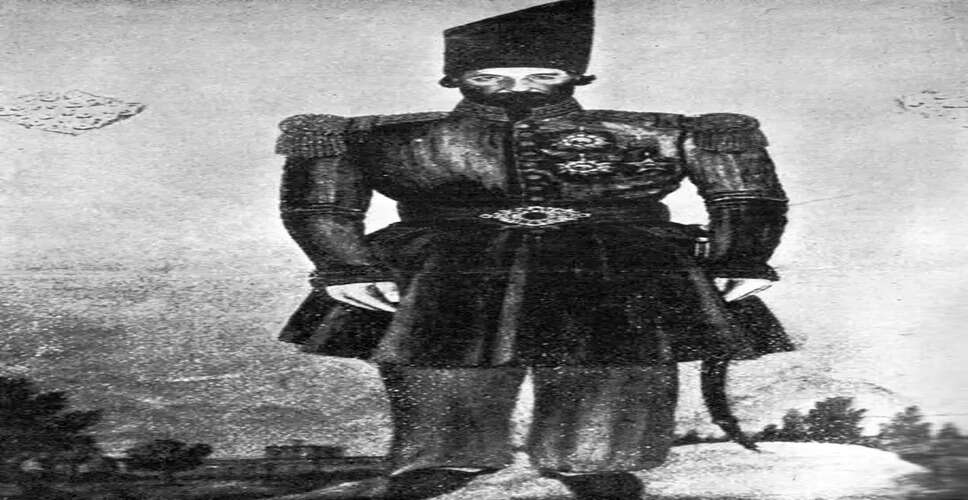
- Aga Jan Khan-e-Khamsih, who executed Bab's death sentence.