
Ladakh's Quest for Constitutional Safeguards: Recent Developments

Recent Discussions on Ladakh's Constitutional Status
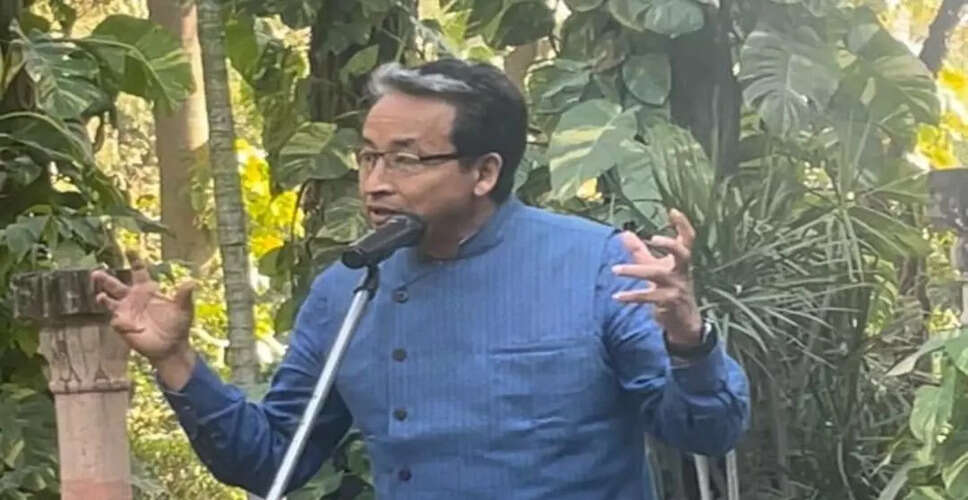
File image of Ladakhi rights activist, Sonam Wangchuk(Photo:@SPV_Prakriti/X)
New Delhi, May 23: Activists from Ladakh reported that the central government has proposed constitutional protections under Article 371 instead of the Sixth Schedule, along with the establishment of a legislative body for the region. They emphasized that discussions are ongoing and no conclusive agreement has been finalized.
During a meeting on Friday, representatives from the Leh Apex Body (LAB), Kargil Democratic Alliance (KDA), and a sub-committee from the Ministry of Home Affairs (MHA) discussed the need for constitutional safeguards, democratic representation, and the long-standing demand for statehood.
In a joint statement following the meeting, both LAB and KDA expressed that they have reached an "in-principle understanding" with the Indian government regarding the restoration of democracy in Ladakh and the provision of constitutional protections similar to those in Nagaland, Sikkim, and Mizoram under Article 371.
Activist Sonam Wangchuk, speaking to the media after the meeting, noted that the government has suggested safeguards for Ladakh akin to Articles 371A and 371G, and has agreed in principle to a governance framework that encompasses the entire region rather than limiting authority to district councils.
Wangchuk explained that discussions revolved around Ladakh's request for inclusion under the Sixth Schedule and statehood, while the government proposed protections under Article 371. "The government expressed concerns regarding the Sixth Schedule but is open to considering protections under Article 371," he stated. No formal announcement has been made by the central government.
He highlighted that previous proposals had restricted powers to district councils in Leh and Kargil, with significant decisions remaining under the control of the Lieutenant Governor and bureaucratic structures. "They agreed that any constitutional arrangement should apply to all of Ladakh, not just at the district level," he remarked, calling this a notable shift from earlier proposals.
Under the suggested framework, an elected body representing all of Ladakh would have the authority to legislate, manage administration, and exercise financial powers. "This represents a substantial change," Wangchuk noted, emphasizing that currently, elected officials have limited influence over Ladakh's budget, with most decisions made by bureaucrats and the Lieutenant Governor.
"The ideal arrangement in India is statehood. We are progressing towards a Union Territory with a legislature or statehood," he added.
Wangchuk also indicated that the central government's primary concern regarding statehood is Ladakh's financial sustainability and its capacity to manage administrative costs through its own revenue.
However, he cautioned against interpreting the latest discussions as a final resolution. "There is no cause for either disappointment or excitement. This is an ongoing process. We have an in-principle understanding, but not a formal agreement," he stated.
Kargil Democratic Alliance member Sajjad Kargili mentioned that the government has also proposed legislative, executive, administrative, and financial powers for Ladakh and has been asked to provide a formal draft for review by legal and constitutional experts.
"A proposal has been submitted by the government, indicating that safeguards will be provided to Ladakh under Articles 371A and 371G, along with legislative, executive, administrative, and financial powers," he said.
Article 371A, which applies to Nagaland, stipulates that Parliament cannot legislate on matters concerning Naga religion, social customs, land rights, and civil and criminal justice without the consent of the state assembly. Similar protections are afforded to Mizoram under Article 371G.
No date has been set for the next round of discussions, although Kargili mentioned that the delegation has requested the government to share the draft before scheduling another meeting.
The Leh Apex Body (LAB) and Kargil Democratic Alliance (KDA), two prominent civil society organizations from Ladakh, have been advocating for statehood, constitutional protections for land and employment, and enhanced democratic powers since Ladakh was designated a Union Territory without a legislature in 2019.