
Kiren Rijiju Discusses Women's Reservation Bill Implementation Process

Implementation of Women's Reservation Bill Explained
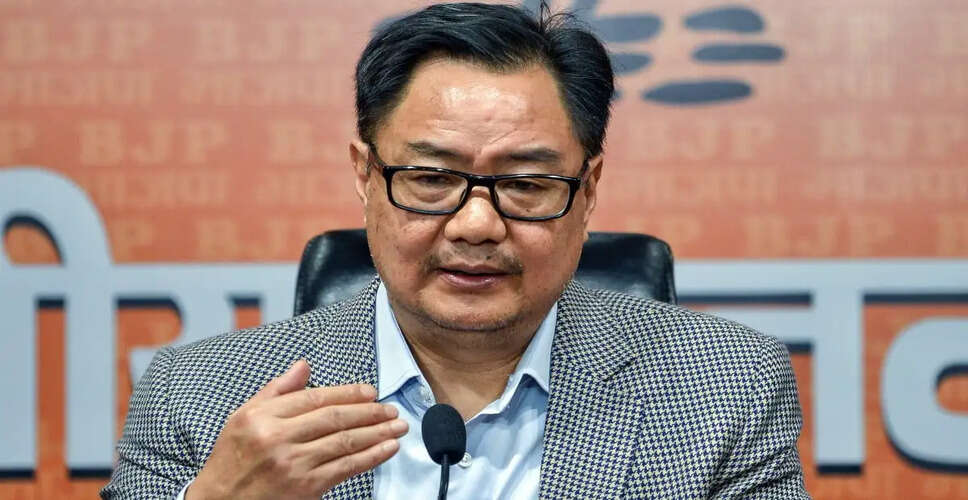
On Friday, Kiren Rijiju, the Union Minister for Parliamentary Affairs, emphasized that the implementation of the Women's Reservation Bill is a procedural matter and urged against politicizing it. He mentioned that the government is currently working on the necessary legal amendments and that the initial notification was issued as part of the law's implementation process. Speaking to reporters, Rijiju stated, 'This is a process. We are in the process of presenting amendments to the law. The previous law was not enacted, hence the initial notification was issued. Let’s not make this process a contentious issue.'
Upcoming Legislative Discussions
His remarks came at a time when the Lok Sabha is set to discuss and vote on the Constitution (One Hundred Thirty-First Amendment) Bill, 2026, which aims to provide 33% reservation for women in Parliament and state assemblies. Additionally, there will be discussions on the Union Territory Laws (Amendment) Bill, 2026, which extends this reservation to Delhi and Jammu & Kashmir. The delimitation bill, which proposes to increase the number of Lok Sabha constituencies to 850, will also be on the agenda.
Recent Legislative Session Highlights
Earlier on Thursday, the Lok Sabha held an extensive 12-hour session to discuss amendments to the Women's Reservation Bill, which has removed the requirement for the bill's implementation to occur only after a census. According to the final division, out of 333 votes, 251 were in favor and 185 against. With a majority of 251 votes, the Constitution (One Hundred Thirty-First Amendment) Bill, 2026, along with the delimitation bill, was presented in the Lok Sabha.
Political Reactions and Concerns
Prime Minister Narendra Modi and Union Home Minister Amit Shah, among other leaders, participated in the discussions regarding the bill. Several opposition leaders, including Akhilesh Yadav from the Samajwadi Party, Asaduddin Owaisi from AIMIM, and KC Venugopal from Congress, also took part. Opposition MPs expressed concerns about the constitutional amendment for delimitation based on the 2011 census, arguing that it could reduce representation from southern states in the House.