
Kiren Rijiju Advocates Unity Among Northeastern States for Development

Call for Unity in the Northeast
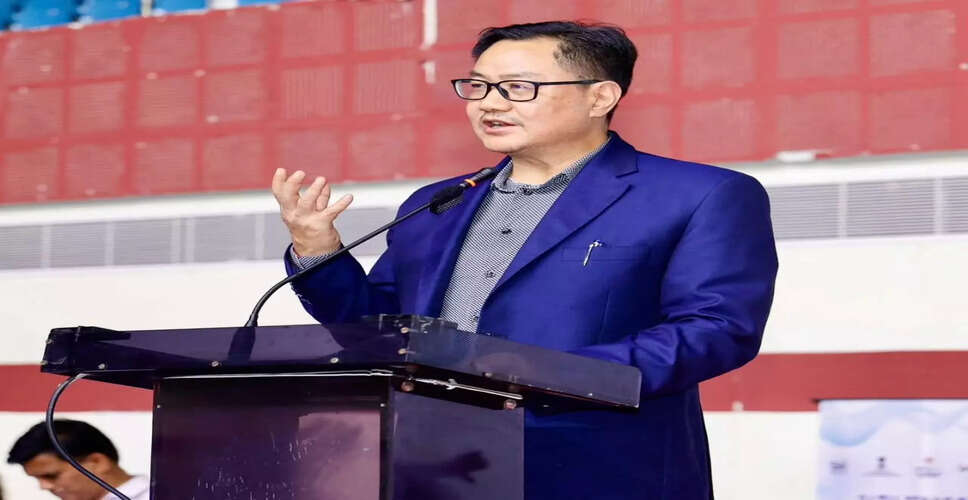
A file image of Union Minister Kiren Rijiju (Photo: @KamakhyaTasa/X)
New Delhi, Aug 19: Union Minister for Parliamentary Affairs, Kiren Rijiju, emphasized the need for enhanced solidarity among the Northeastern States, asserting that the region can only achieve its full potential by resolving differences through dialogue instead of conflict.
In a recent interview in New Delhi, Rijiju expressed that the people of the Northeast have a deep emotional connection to the region's progress and aspire for it to become a thriving, developed, and peaceful area within the nation.
“The Northeastern region, which includes Sikkim, comprises eight states. We are passionate individuals who desire prosperity, development, and happiness in our region,” he stated.
Rijiju, hailing from Arunachal Pradesh, noted that the Northeast lagged in various sectors during the previous UPA-led administration due to what he termed as the Centre's neglect.
“The region suffered in many areas because the previous Central government viewed the Northeast as a remote part of the country,” he remarked.
He highlighted that the landscape shifted post-2014, with the Modi administration prioritizing the Northeast in its policies and development initiatives. “Prime Minister Modi has made the Northeast a focal point,” he added, while expressing concern over ongoing disputes among states and communities in the area.
Rijiju pointed out that issues between Assam and Meghalaya, Mizoram and Nagaland, Assam and Arunachal Pradesh, and Nagaland and Manipur should be resolved through constructive dialogue. He lamented the unfortunate trend of local disputes escalating into state-versus-state conflicts.
“We must recognize that we are all part of the same region and nation,” he emphasized.
The minister noted that land and boundary disputes are not exclusive to the Northeast or even to states, as similar disagreements can arise within families, villages, and communities, and should not be allowed to escalate into larger conflicts.
“Disputes exist even within families and between villages. It is not uncommon. However, turning these into state conflicts is regrettable,” he stated.
Addressing the recent tensions along the Assam-Arunachal Pradesh border, Rijiju mentioned that MPs from both states united to urge citizens to prevent differences from escalating into violence.
He asserted that local disputes could be amicably resolved and cautioned that various groups often exaggerate local issues, each presenting their own narrative and blaming the other side entirely.
“While perceptions may differ, a solution must be sought. One group's viewpoint may not align with another's, necessitating a middle ground,” Rijiju explained.
He also criticized social media and certain local media outlets for sometimes inflaming sensitive disputes. He noted that narratives portraying one state as “anti” can quickly stir public emotions without a proper understanding of the underlying issues.
Such narratives can particularly sway the youth, potentially leading them towards violent actions.
Rijiju characterized Assam and Arunachal Pradesh as part of the same historical and social family, recalling that Arunachal Pradesh was initially governed as part of Assam, with Assamese playing a significant role in the region's early development.
“Arunachal Pradesh was initially supported and developed by the Assamese. Our first language was Assamese. When I was born, Arunachal Pradesh was still part of Assam. We share a familial and cultural background,” he remarked.
He commended Assam Chief Minister Himanta Biswa Sarma and Arunachal Pradesh Chief Minister Pema Khandu for their proactive roles in maintaining peace during tense periods.
Rijiju also acknowledged the contributions of student organizations and civil society groups in both states for their efforts in preventing clashes from escalating.
Regarding China's ongoing claims over Arunachal Pradesh and the recent identification and standardization of names for 27 locations in the state on official maps, Rijiju stated that this exercise was primarily a correction of nomenclature.
He explained that past records often featured names mispronounced by officials unfamiliar with local terminology, necessitating corrections. “China's naming of Arunachal Pradesh does not affect us. We have no ties to China,” he asserted.
Rijiju noted that China's claims over Arunachal Pradesh intensified after the 1980s, initially focusing on Tawang and later extending to the entire state.
He affirmed that the people of Arunachal Pradesh are clear about their historical and cultural identity, asserting that they have no connection to China.
“The people of Arunachal Pradesh are very clear. Our historical and cultural identity has no ties to China,” he stated.
Turning to the Opposition, Rijiju criticized the Congress party, labeling it as “leaderless and directionless.” He accused the Congress of adopting increasingly extreme leftist positions while simultaneously engaging in what he termed Muslim appeasement.
“The Congress is evolving into two distinct entities. On one hand, it is resembling the Muslim League, and on the other, it is adopting Maoist ideologies,” he alleged.
Rijiju claimed that the Congress's stance on significant national issues has become more extreme, distancing itself from the political center.
When questioned about police actions against protesting students, Rijiju denied any use of force against a peaceful demonstration. He stated that students had been allowed to protest peacefully for over 30 days, but the situation changed when they attempted to march towards Parliament.
“There was no force used against the peaceful protest. It was only when they tried to march towards Parliament that they were stopped. The protests had been peaceful for over 30 days. When they attempted to forcefully march, the police had to intervene. It’s a matter of law,” he explained.
Rijiju defended Prime Minister Modi’s reference to “dimagi naxals” in his Independence Day speech, asserting that the remarks were both necessary and timely. He contended that while armed Left Wing Extremism has been significantly diminished, the ideology persists among certain urban intellectuals.
“Left Wing Extremism, those who took up arms, are nearly eradicated. However, the same ideology remains prevalent among intellectuals in urban areas – the dimagi naxals – which the Prime Minister rightly identified as a challenge we must confront,” Rijiju stated.
He described this ideological influence as a serious threat to national security, recalling that former Prime Minister Manmohan Singh had previously identified Naxalism as one of the most significant threats to India’s internal security.