
Kerala Assembly Elections: A Complex Battle Ahead
As Kerala approaches its assembly elections, voters face a complex decision between the ruling Left Democratic Front and the Congress-led United Front. Both parties present similar promises, making the election a battle of strategies rather than clear issues. The role of the BJP as a third force adds another layer of complexity. With rising elderly voters and shifting religious demographics, this election could redefine Kerala's political landscape. Will voters break from tradition or continue the cycle of change? Discover the key factors influencing this pivotal election.
| Apr 6, 2026, 13:16 IST
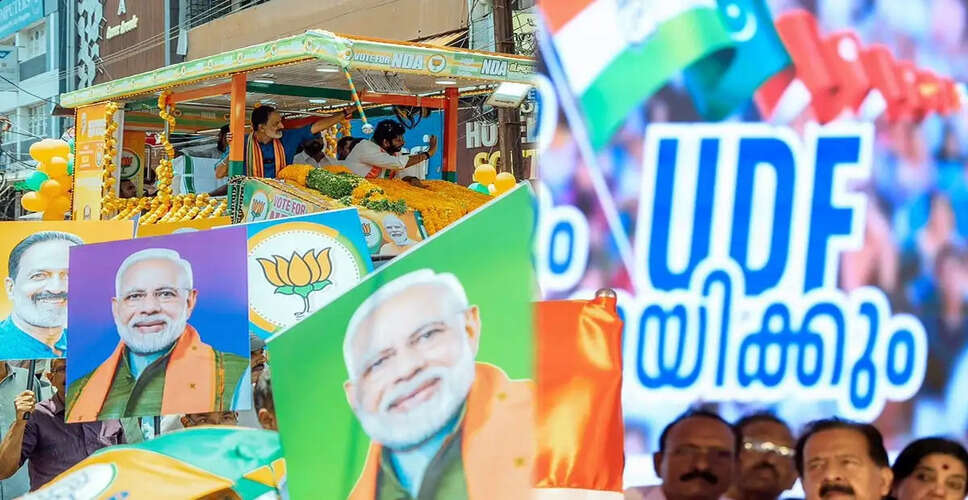
Voters Prepare for Kerala Assembly Elections
On Thursday, voters in Kerala are set to cast their ballots in the assembly elections. The competition appears direct, yet the outcome remains uncertain. On one side stands the ruling Left Democratic Front, while the other is led by the Congress-backed United Front. The pressing question is what distinguishes these two factions that will influence voters' decisions for the next five years?
Kerala's Development Model
Historically, Kerala has implemented policies that ensured high minimum wages, expanded road networks, established strong labor unions, and invested significantly in land reforms, clean water, sanitation, housing, food security, public health, and education. This has positioned Kerala as a sustainable development model. However, as voters approach this election, the options presented seem strikingly similar.
Similar Promises from Both Sides
Both the Left and Congress manifest similar pledges in their manifestos, including welfare schemes, healthcare expansion, improvements in minimum support prices, pension increases, elder care, and infrastructure development. In the 2021 elections, both coalitions garnered nearly equal vote shares. Thus, this election appears to hinge not on clear issues but rather on intricate strategies and vote distribution.
The Role of the BJP
The Bharatiya Janata Party (BJP) also plays a significant role as a third force. Analysts view it as a potential spoiler, while others see it as a disruptive player. The competition, although direct, is complicated, with every vote carrying increased weight.
Understanding Kerala's Political Landscape
Grasping the political dynamics of Kerala is no simple task. The state is both highly aware and intensely passionate. Political violence remains a harsh reality, with incidents of party worker killings, retaliatory actions, and ideological clashes occurring in a region known for its high literacy rates and influx of foreign remittances that bolster living standards.
Contradictions in Social Progress
This contradiction extends further. While Kerala has witnessed early revolts against caste and has better female participation, deep-rooted male dominance persists. Recent reports have highlighted a toxic environment within the film industry, indicating that despite social advancements, mentalities have not shifted.
The Elderly Voter Demographic
Another crucial aspect of this election is the increasing number of elderly voters, with one in five voters being senior citizens. Conversely, the influence of expatriate voters from Gulf countries may be limited this time due to their restricted return.
Religious Dynamics at Play
This election could also be significantly influenced by religious demographics. The Muslim and Christian communities hold substantial sway in Kerala. Historically, the state has maintained a secular balance, but discussions of fractures in this balance are intensifying. The BJP's campaign for Hindu unity is gaining momentum, prompting minority communities to prepare for strategic voting.
Challenges for Minority Unity
However, a challenge arises as minority groups are not entirely unified, leading to the possibility of vote fragmentation. It remains uncertain who will benefit from this division, but it could potentially give the ruling party an advantage, despite negative forecasts against it. There are strong indications that Kerala's political landscape may break from its long-standing traditions, raising the question of whether voters will choose to re-elect the current government for a third consecutive term.
A History of Political Shifts
For decades, Kerala's politics have oscillated between two poles, with power changing hands every five years. However, this cycle was disrupted in 2021 when the Left Front, under Pinarayi Vijayan, returned to power for a second consecutive term. Prior to this, no chief minister had served for ten consecutive years. The question now is whether this trend will continue.
Potential Shifts in Voter Sentiment
Many analysts suggest that a decade-long anti-incumbency wave could work against the Left Front, with the United Front appearing to gain traction. In the 2024 Lok Sabha elections, the United Front secured 18 out of 20 seats, showing a significant increase in vote share. Additionally, its performance in the 2025 local body elections was strong, indicating potential challenges for the Left Front.
The Complexity of Electoral Trends
However, the reality on the ground is not straightforward. Trends in Lok Sabha and assembly elections in Kerala have diverged. Over the past three decades, the Congress-led United Front has often performed better in Lok Sabha elections, while assembly contests have been closely contested. Therefore, assuming that a significant victory in Lok Sabha translates directly to assembly success could be a grave miscalculation.
Narrow Margins in Recent Elections
Data indicates that the vote share difference between the two coalitions in assembly elections has historically been minimal. However, this gap has widened in the last two elections. When the Left Front wins, it does so decisively, and when it loses, it does so narrowly. In 2021, it won 99 out of 140 seats, while in 2011, it lost by a slim margin with only 68 seats.
Stability in Constituencies
Moreover, around 89 seats have remained with the same coalition over the last three elections. The Left Front holds 50 of these seats, while the United Front maintains a presence in 39, indicating that the battle is far from straightforward.
Pinarayi Vijayan's Leadership
Pinarayi Vijayan continues to be a formidable figure. His leadership during floods and the pandemic, along with welfare initiatives, has earned him credibility. Despite facing scrutiny over economic stagnation and administrative inefficiencies during his second term, his popularity remains higher than that of any opposition leader.
Geographical and Social Complexity
Another intricate aspect of Kerala's politics is its social and geographical structure. Northern Kerala is considered a stronghold for the United Front, particularly in Muslim-majority areas where the Muslim League has a firm grip. In contrast, southern Kerala has a higher Hindu voter base, where the Left Front has traditionally been strong. The central region of Kerala serves as the true battleground, with shifting dynamics in every election.
Shifting Voting Patterns
The United Front has long relied on the support of Muslim and Christian communities, while the Left Front has garnered backing from rural, lower-income, and Hindu voters. However, this equation appears to be changing, with Muslim votes increasingly leaning towards Congress, potentially triggering reactions among Hindu and Christian voters in certain areas.
The BJP's Growing Influence
This is where the BJP's role as a third force becomes significant. Historically positioned third, its vote share has steadily increased over the past decade. In 2024, it won the Thrissur seat and secured second place in Thiruvananthapuram. In 2025, it also won the mayoral election in Thiruvananthapuram.
BJP's Strategy for Broader Appeal
This time, the BJP is not solely relying on Hindu unity but is also attempting to reach out to the Christian community. Engaging with church leadership and emphasizing identity politics are integral to its strategy. While this approach may not yield significant changes, it could disrupt equations in several constituencies.
A Defining Election for Kerala
Ultimately, this election will not only determine which party forms the government but also whether Kerala will break from its historical political traditions or revert to its previous patterns. Regardless of the outcome, it is clear that the electoral process itself could reshape Kerala's political landscape.