
Kaziranga National Park's Bird Survey Reveals Impressive Raptors and Storks Diversity

Significant Findings from Kaziranga's Bird Survey
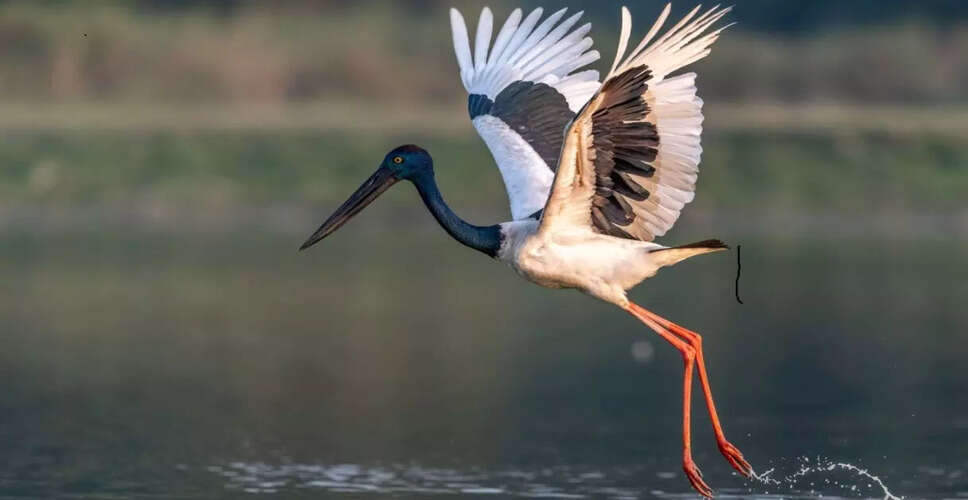
A black-necked stork forages in the wetlands of Kaziranga. (Photo:@kaziranga_/X)
Guwahati, June 6: In a remarkable achievement for wildlife preservation, a recent bird survey in Assam's Kaziranga National Park and Tiger Reserve (KNPTR) has documented 30 raptor species, totaling 217 individual birds, along with six stork species, which accounted for 266 sightings.
Sonali Ghosh, the Director of KNPTR, announced on Saturday that this survey was conducted by the Kaziranga Tiger Reserve authority in partnership with researchers from various universities in Assam. The findings were unveiled on World Environment Day, which took place on Friday.
The rapid survey was executed by a team of ten skilled enumerators during the last week of February and the first week of March 2026, covering all administrative ranges within the Eastern Assam Wildlife Division of KNPTR.
Additionally, nesting sites identified this year were included in the survey analysis.
India boasts 112 recorded raptor species, with nearly 50 of them residing in Kaziranga National Park and its surrounding areas.
"Globally, there are 20 stork species, mainly found in tropical and subtropical regions. Approximately 50% of these, or eight species, are present in India, all of which can also be found in Assam and the Kaziranga region. The extensive wetlands and tall trees in this area provide ideal nesting and feeding habitats," Ghosh explained.
Among the surveyed locations, Kaziranga National Park exhibited the highest diversity, featuring 21 raptor species and five stork species.
The Biswanath Wildlife Division followed closely, recording 20 raptor species and six stork species, while the Nagaon Wildlife Division noted 14 raptor species and five stork species.
Among the stork species, the Asian Openbill was the most prevalent, with 92 individual sightings across all divisions, whereas the Greater Adjutant was the least common, with only three sightings.
For raptors, the Himalayan Griffon Vulture was the most frequently observed, with 69 individual records, while the Booted Eagle and White-tailed Eagle were the rarest, each with just one sighting.
The survey underscored Kaziranga's role as a crucial habitat for the globally endangered Pallas's Fish Eagle (Haliaeetus leucoryphus).
In an interesting case of international wildlife research, the Wildlife Science and Conservation Centre of Mongolia confirmed that a male Pallas's Fish Eagle named “Ider” was tagged at Buuntsagaan Lake in Mongolia on August 21, 2020. Since then, this eagle has returned to Kaziranga annually for breeding, changing its nesting site only once. During the non-breeding season from June to September, it consistently returns to Buuntsagaan Lake.
Ghosh stated that these findings will greatly enhance ongoing efforts to safeguard threatened raptor and stork species and improve conservation management across the park's varied habitats.
Most of these species are protected under Schedule I of the Wildlife (Protection) Act, 1972, which provides them with the highest level of legal protection in India.
Kaziranga National Park and Tiger Reserve, recognized as India's seventh UNESCO World Heritage Site, is home to the renowned "Big Five" wildlife species.
Recent estimates indicate that the park houses 2,613 greater one-horned rhinoceroses (2022 census), 104 Bengal tigers (2022), 1,228 Asian elephants (2024), 2,565 wild water buffaloes (2022), and 1,129 eastern swamp deer (2022).
KNPTR spans several districts in Assam, including Golaghat, Nagaon, Sonitpur, and Biswanath.