
Karnataka CM Criticizes Political Parties Over Religious Claims
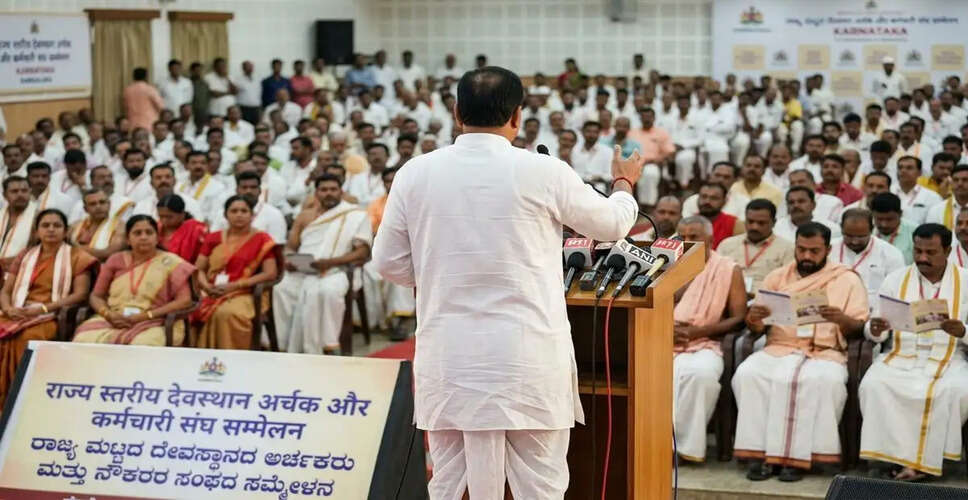

Political Parties and Religious Claims
On August 5, in Bengaluru, Karnataka Chief Minister D. K. Shivakumar indirectly targeted the Bharatiya Janata Party (BJP), stating that "some political parties" are attempting to monopolize Hinduism for their political gain. He emphasized that religion is a matter of personal belief and no party can claim exclusive rights over temples, deities, or Hindus.
While addressing a state-level conference organized by the Karnataka Muzrai Department (Hindu Religious Endowment Department) for temple priests and staff, Shivakumar urged the priests to maintain their trust in the Congress government.
He asserted that the government has fulfilled its promises to the public while also safeguarding religious values and traditions. Shivakumar criticized those who don a saffron shawl and claim, "All temples are ours, all gods are ours, and all Hindus belong to us." He questioned the implications of such claims on Hindus, asking, "Am I not a Hindu?"
He further inquired whether Muzrai Minister Ramalinga Reddy, former Chief Minister Siddaramaiah, and Congress President Mallikarjun Kharge are not Hindus, stating, "We are all Hindus."
Shivakumar reiterated that religion is a personal choice and no one can dictate the religion or caste into which one is born. He noted that religious traditions are intertwined with every stage of life, including birth, marriage, and death, asserting, "We cannot live without our traditions and customs."
He claimed that no previous government has worked with such dedication towards religious institutions and mentioned that priests have expressed their trust in both Minister Ramalinga Reddy and the government.
Referencing poet Sarvajna, he remarked, "Nothing is more sour than a lemon, nothing is darker than a bug, no god is greater than Shambhu (Lord Shiva), and no virtue is greater than faith." He emphasized that the trust of priests in the government is its greatest strength.
Shivakumar highlighted that there are approximately 34,000 temples under the Muzrai Department and described priests as a bridge between God and devotees, urging them to continue supporting the government. He stated, "When you speak, you speak on behalf of God... We must ensure that this government remains in power."
Before the assembly elections, he prayed for the opportunity to implement the Congress's five guarantee schemes if given the chance to form the government.
He affirmed that the government has kept its promises, launching initiatives like Griha Lakshmi, Griha Jyoti, Anna Bhagya, Shakti, and Yuva Nidhi to improve people's lives. Criticizing the BJP, Shivakumar questioned whether promises such as depositing 15 lakh rupees into every citizen's bank account and doubling farmers' income have been fulfilled, stating, "They remain mere promises."
He asserted, "But we have fulfilled every promise we made."
Shivakumar mentioned that the government has taken steps for education, employment, and welfare, aiding in creating job opportunities in the private sector at the government level. He stated that the government's role should be to act as a bridge between people and opportunities, similar to how priests serve as a bridge between devotees and God.
Defending the government's approach towards all religions, he noted that the Muzrai Department exists for Hindu religious institutions, while the Minority Development Department serves minority communities.
He affirmed that individuals are free to practice or change their religion, emphasizing that faith is a personal matter. He concluded, "We are not here to impose anything on anyone. Religion is based on personal belief."
Shivakumar insisted that governments should be evaluated based on their actions, not merely on rhetoric.