
Jamiat Ulema-e-Hind President Advocates for Social Harmony and Religious Freedom
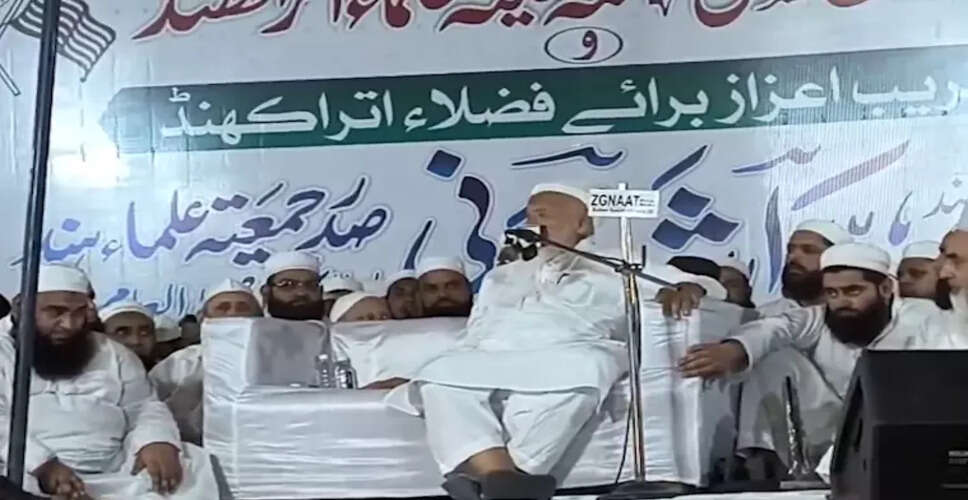

Addressing Key Issues at the State Executive Meeting
Photo: @ians_india/X
New Delhi, June 24: Maulana Syed Arshad Madani, the national president of Jamiat Ulema-e-Hind, delivered a powerful speech during the Uttarakhhand state executive meeting held in Haridwar’s Piran Kaliyar area, focusing on themes of social harmony, democratic principles, and religious freedom.
The event saw a significant turnout of ulema, huffaz, and members from the Muslim community.
As the chief guest, Madani remarked, “In 1803, during our nation’s struggle against oppression, the call for jihad was made to achieve independence. It is the responsibility of every Muslim to engage in jihad to liberate our country from the shackles of slavery. This message has been imparted through madrasas, and those unaware of this are misinformed.”
He elaborated on various topics, emphasizing the contributions of Muslims and mosques to India’s freedom struggle. He criticized the current government for allegedly demolishing mosques and claimed that post-independence administrations have harmed the Muslim community. He accused the government of entangling Muslims in riots and asserted that the current regime is not only against Muslims but also against Islam, citing the demolition of religious sites.
Madani highlighted the significant role Muslims have played in the nation’s independence and development, stressing that India can thrive only through love and unity.
He pointed out the destruction of mosques and the occurrence of mob lynching incidents targeting Muslims. He questioned the contributions of Muslims to the nation and what they receive in return, urging a shift away from hate-driven politics towards a politics rooted in love.
He emphasized that only love and compassion can uphold the nation, stating that those who harbor affection for others are true patriots. He warned that those who do not embody this spirit cannot be deemed loyal to the country.
Touching on humanitarian efforts, he mentioned that during the floods in Bengal, Jamiat Ulema-e-Hind provided aid to both Hindus and Muslims. He recounted instances of violence in Delhi, where Muslims offered help without regard for religious affiliation, questioning whether such individuals could be labeled as traitors.
The meeting wrapped up with discussions centered on community welfare, education, and social unity, with various religious leaders reiterating the importance of peace and coexistence.