
ISRO Plans Seven Launches This Financial Year, Including Gaganyaan Mission

ISRO's Ambitious Launch Schedule
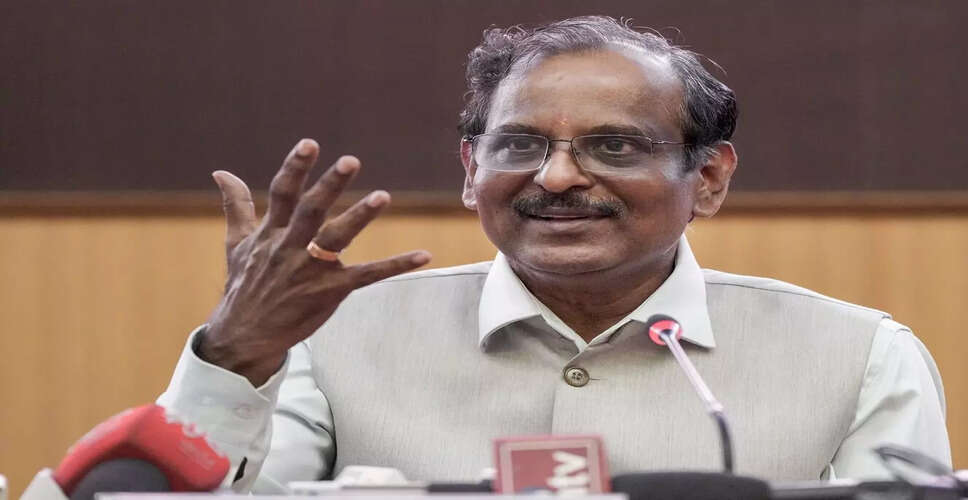
Chairman Dr V Narayanan addresses a press conference following the launch of Vikram-1 rocket, in Sriharikota. (Photo:PTI)
Sriharikota (Andhra Pradesh) Jul 18: The Indian Space Research Organisation (ISRO) has set an ambitious goal of executing seven launches in the current financial year, with the next mission expected to take place within the next two months, as announced by ISRO Chairman V Narayanan.
During a press briefing after the successful inaugural orbital launch of Skyroot Aerospace's Vikram-1 rocket, Narayanan revealed that two satellites are already completed, while an additional five to six are nearing the final stages of integration.
"This financial year, we are aiming for at least seven launches. We will initiate the launch process within two months," Narayanan stated.
The upcoming operational agenda for ISRO includes the first uncrewed mission as part of the Gaganyaan human spaceflight initiative, in addition to the planned satellite launches.
When asked about India's capacity to handle frequent private and commercial launches, Narayanan shared that ISRO intends to establish its second launch complex in Kulasekarapattinam, Tamil Nadu, within the next six months.
He emphasized that while Sriharikota has extensive capabilities, utilizing large launch pads for small satellites weighing between 300 kg and 350 kg is not the most efficient approach.
"Initial launches will occur here. However, we are also constructing the second launch complex in Kulasekarapattinam, which is nearing completion. We plan to commission it within this financial year," Narayanan explained, noting that the facility is in its final stages.
“Once operational, launch tracking and distribution will be optimized between both spaceports based on specific payload needs,” he added.
Praising the successful flight of Vikram-1 by the private startup Skyroot Aerospace as a significant achievement, the ISRO chief commended the young team, whose average age is 28, for accomplishing a successful orbital mission on their first attempt.
He remarked that this achievement brings great pride to the domestic space community and significantly contributes to the vision of "Bharat 2047."
Reflecting on the growth of the domestic space ecosystem, the ISRO Chairman underscored the positive effects of policy reforms.
"In 2020, reforms in the space sector were implemented, allowing startup companies and the private sector to engage in space activities. For the first time in the country, a private rocket has successfully placed a satellite into orbit," he noted, adding that this milestone will stimulate considerable economic growth and inspire a scientific mindset among the youth.
He pointed out that when the policy was enacted, there was only one startup in the sector. "Today, there are 400 startups," he concluded.