
ISRO Chairman Reassures on Agency's Government Status Amid Privatization Concerns

ISRO's Commitment to Government Operations
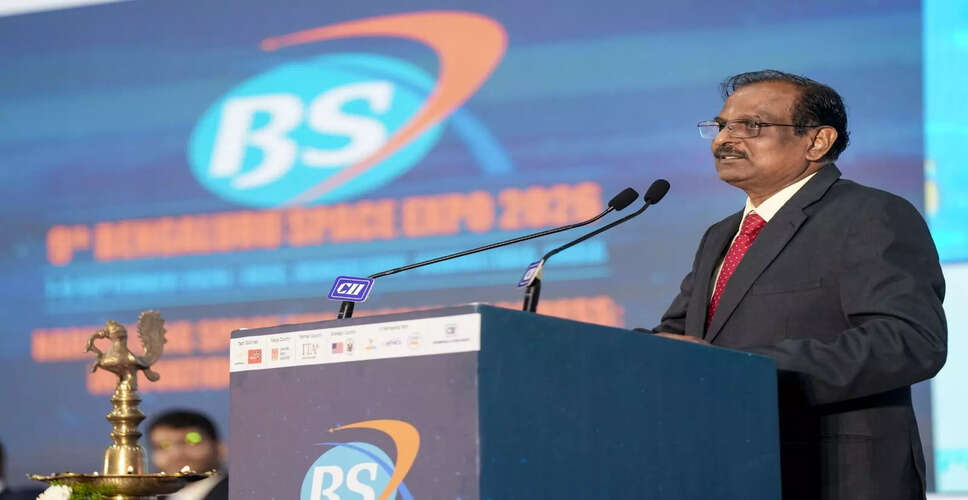
ISRO Chairman V Narayanan addresses the inaugural session of 9th Bengaluru Space Expo 2026, on Monday. (Photo: PTI)
Bengaluru, Sep 7: During the opening of the ninth Bengaluru Space Expo (BSX) on Monday, ISRO Chairman V Narayanan emphasized that the Indian Space Research Organisation remains a government entity, countering fears regarding its potential privatization. He clarified that collaborations with private firms and startups are intended to enhance India's space ecosystem.
Narayanan reassured the media that ISRO is not transitioning to a privatized model. “This is a government initiative, and we are actively involved. However, we have numerous projects underway, and it is essential for the space ecosystem and economy in our country to develop,” he stated.
Addressing the concerns expressed by some ISRO employees, he acknowledged their validity and committed to providing clarity. “The worries of my colleagues are legitimate, and it is our duty to address them,” he remarked.
His comments followed a letter from nine employee associations at ISRO, dated September 4, which requested clarification regarding the proposed delegation of the agency's manufacturing and operational roles to private companies.
Narayanan highlighted that India's space program, which has been operational for approximately 64-65 years, currently boasts 56 space assets in orbit that serve the populace, but he noted that the nation's needs are significantly larger.
He referenced the reforms in the space sector initiated six years ago, stating that ISRO's role includes supporting private enterprises and startups to broaden the overall space ecosystem.
“In fact, during the launch of a PSLV or GSLV, nearly 80% of the budget is allocated to Indian industries. We collaborate with around 450 industries,” he added.
Looking ahead, Narayanan mentioned that India's growing space aspirations necessitate a substantial increase in launch capacity, estimating a requirement of about 50 launch vehicles annually.
“The nation needs around 50 launch vehicles each year. We must progress,” he asserted.
Reflecting on his 43 years at ISRO, he recalled that when he first joined, launches occurred only once every three years. “Many initiatives are currently in progress. While only a few are known publicly, it is our responsibility to communicate all developments from ISRO. Achieving 50 launches per year is an attainable goal,” he concluded, affirming that this target will be met by Indian efforts within the country.