
Israel's Military Strikes Iranian Nuclear Facility Amid Ongoing Conflict
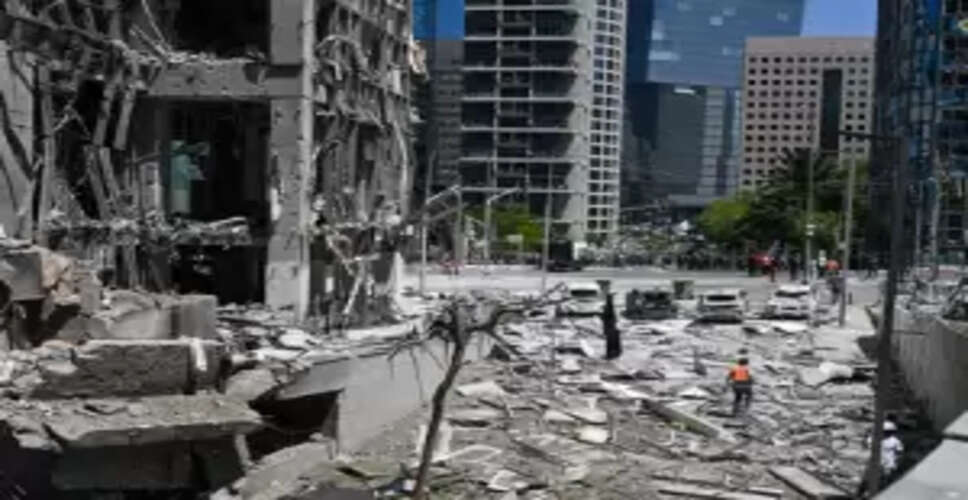
Intensifying Military Actions
On Saturday, Israel's military announced it had targeted an Iranian nuclear research facility, resulting in the deaths of three high-ranking Iranian commanders. The military indicated that it is bracing for a potentially extended conflict.
Witnesses reported seeing smoke rising from a mountainous area in Isfahan, where Israeli forces executed strikes on the nuclear facility in two separate waves.
The operation focused on two centrifuge production sites, adding to recent attacks on similar facilities, as disclosed by an Israeli military official who requested anonymity.
This marks the second assault on Isfahan since the onset of the conflict, which aims to dismantle Iran's nuclear capabilities.
Akbar Salehi, the deputy governor of Isfahan for security matters, confirmed that while the facility sustained damage, there were no reported casualties.
In retaliation, Iran launched a new series of drone and missile attacks against Israel, but initial reports indicated minimal damage, with Israeli defenses intercepting most projectiles.
An Israeli official noted that the scale of Iran's overnight assault was limited due to successful targeting of its missile launchers, estimating that over half of them have been neutralized.
The official stated, 'We have significantly reduced their launch capabilities, complicating their ability to strike Israel,' while acknowledging that Iran still possesses operational capabilities.
Israel's Magen David Adom rescue service reported that an Iranian drone struck a two-story building in northern Israel, fortunately resulting in no injuries.
Brig. Gen. Effie Defrin, the chief spokesperson for the Israeli military, indicated that the army is prepared for a 'prolonged campaign' aimed at neutralizing Iranian military assets, including nuclear facilities and missile infrastructure.
'Our operations are intensifying night after night, yielding significant results,' he asserted. 'We will persist until the threat is eradicated.'
Diplomatic Efforts Stalled
Discussions in Geneva on Friday did not yield any significant progress. European officials expressed optimism for future negotiations, while Iranian Foreign Minister Abbas Araghchi indicated a willingness to engage in dialogue, provided that hostilities cease and accountability for aggression is established.
'Iran is open to reconsidering diplomacy once the attacks stop and the aggressor is held responsible for their actions,' he stated.
No date has been set for the next round of negotiations.
US Military Involvement Concerns
US President Donald Trump is contemplating direct military involvement in the ongoing conflict, a move that Araghchi warned could have dire consequences.
'Such an action would be extremely perilous for all parties involved,' he remarked during a meeting of the Organisation of Islamic Cooperation in Istanbul.
The conflict between Israel and Iran escalated on June 13, with Israeli airstrikes targeting nuclear and military installations, resulting in at least 722 fatalities in Iran, including 285 civilians, according to a human rights organization based in Washington.
Continued Targeted Strikes
In its initial assault, Israel eliminated three of Iran's top military figures: Gen. Mohammad Bagheri, who oversaw the armed forces; Gen. Hossein Salami, leader of the Revolutionary Guard; and Gen. Amir Ali Hajizadeh, head of the ballistic missile program.
The targeted killings persisted, with Israel's defense minister announcing the elimination of a commander from Iran's Revolutionary Guard who had financed and armed Hamas in preparation for the October 7, 2023, attack on Israel that ignited the ongoing war in Gaza.
Israel identified Saeed Izadi as the commander of the Palestine Corps for the Iranian Quds Force, who was killed in Qom. Iranian officials have yet to confirm his death, although local reports indicate an attack on an apartment building resulted in two fatalities.
Warnings from the UN
On Friday, the head of the UN nuclear watchdog cautioned against assaults on Iran's nuclear facilities, particularly the commercial power plant in Bushehr.
'A direct hit on the Bushehr nuclear power plant would lead to a significant release of radioactivity into the environment,' warned Rafael Grossi, head of the International Atomic Energy Agency.
Israel has refrained from targeting Iran's nuclear reactors, focusing instead on uranium enrichment facilities and related sites.
Iran's Nuclear Program Under Scrutiny
Iran has consistently claimed that its nuclear program is intended for peaceful purposes, yet it remains the only non-nuclear-armed state to enrich uranium to 60 percent.
Israel is widely believed to possess a nuclear weapons program, although it has never officially acknowledged it.
Iranian leaders have attributed Grossi's remarks regarding the status of its nuclear program as a catalyst for Israel's military actions.
Detention of German Cyclist
Iran has also confirmed the detention of a German cyclist on espionage charges, likely as a means to exert pressure on Germany, a participant in the diplomatic discussions.
The semi-official Mehr news agency released footage of the arrest, which occurred in Markazi province, home to Iran's Arak heavy water reactor.