
Is the Planet Parade a Myth? IIA Sets the Record Straight on February 28 Alignment
Chennai's Astronomical Insights
Chennai: The Indian Institute of Astrophysics (IIA) has intervened to clarify the exaggerated claims circulating on social media regarding a rare planetary alignment on February 28. They have labeled these assertions as misleading.
Despite viral posts suggesting a spectacular alignment of all solar system planets, IIA scientists from Bengaluru have stated that the actual visibility will not resemble the coordinated display often depicted online.
In a recent video shared on their official social media channels, the IIA provided a thorough explanation to distinguish between astronomical reality and the digital myths currently trending.
The phrase 'planet parade' is frequently misused on social media to refer to several planets appearing in close proximity in the sky. However, experts stress that these celestial bodies are millions of kilometers apart and seldom align as perfectly as portrayed in viral images.
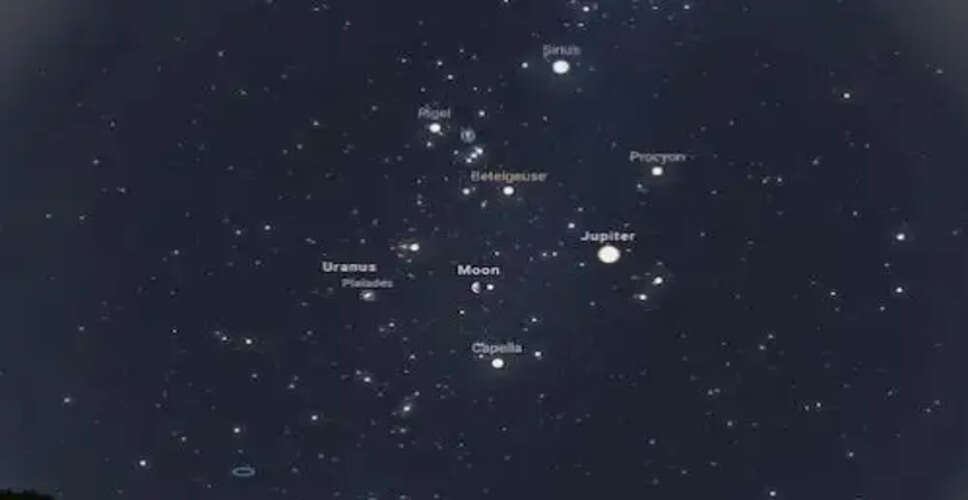
According to the video, Jupiter will be the most accessible planet for viewing, positioned high in the evening sky and remaining visible until around 3:30 AM. Observers with small telescopes or binoculars can catch a glimpse of its main belts and Galilean moons, while spotting other planets will prove to be much more challenging.
Mercury and Venus are currently situated very close to the Sun and will set shortly after sunset, making them difficult to see as they will only be about 10 to 12 degrees above the horizon during twilight. Similarly, Saturn will set about 1.5 hours post-sunset and will be low on the horizon, while Mars will be completely hidden from morning viewers as it sets before the Sun.
The IIA also issued an important safety advisory in the video, warning skywatchers against using telescopes, binoculars, or even the naked eye to look for Mercury, Venus, or Saturn before sunset. Direct sunlight exposure through these instruments can lead to severe and permanent eye damage. For those interested in locating the more distant planets, Uranus and Neptune, telescopes are essential, with Neptune being particularly elusive due to its position near Saturn.
Looking ahead to March and April, the IIA indicated that viewing conditions will evolve as Jupiter begins to set earlier each evening. In contrast, Venus will become more visible for extended periods in the western sky. By then, Mars and Saturn are anticipated to rise in the eastern morning sky alongside Mercury, offering a more reliable chance for astronomical observation compared to the much-publicized alignment of February 28.