
Is Giorgia Meloni Losing Her Grip on Trump? The Fallout from Their Alliance
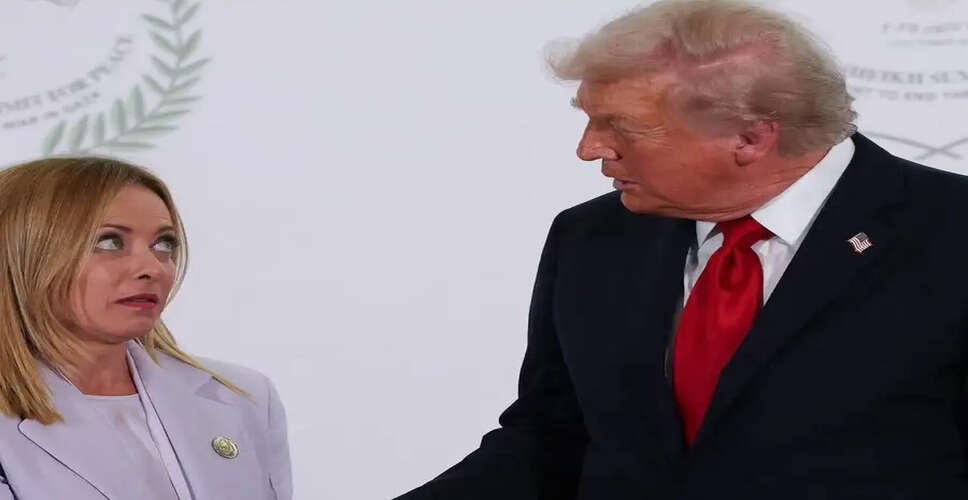

Tensions Rise Between Meloni and Trump
In Milan, Italian Prime Minister Giorgia Meloni was once seen as a key link between Europe and former US President Donald Trump. However, recent events suggest that this connection may be deteriorating.
Following Trump's criticism of Pope Leo XIV, he directed his frustration towards Meloni, who had previously been one of his staunchest supporters in Europe. He expressed disappointment in her for condemning his remarks about the Pope and for not supporting the US-Israel conflict regarding Iran.
In an interview with a prominent Italian newspaper, Trump remarked, "I thought she had courage, but I was mistaken."
While Meloni has yet to respond directly to Trump's comments, some analysts believe this situation could work in her favor as she navigates the aftermath of a significant referendum loss and the unpopularity of the ongoing conflict in Iran, which has led to rising energy costs.
"This could be a blessing in disguise for her," stated Nathalie Tocci, a professor at Johns Hopkins SAIS Europe and director of the International Affairs Institute. "Trump's reputation has soured across Europe, including Italy."
Trump reiterated his discontent on Wednesday, noting that their relationship had weakened. He told Fox News, "She’s been negative. Anyone who rejected our assistance regarding the Iran situation, we no longer share the same bond."
Meloni, who was the only EU leader invited to Trump's second inauguration, had hoped to capitalize on their strong rapport upon his return to power 15 months ago. Their alliance was built on shared nationalistic views and hardline immigration policies.
However, Italy has felt the repercussions of Trump's tariffs, leading some to argue that the relationship has not been mutually beneficial. When asked about their communication this month, Trump replied, "No, not in a long time."
After a tense meeting in the Oval Office last year, where Meloni avoided confronting Trump about tariffs, their distance grew further due to the Iran conflict. Meloni has publicly stated that Italy will not engage in the war and recently denied US bombers permission to land at a crucial Sicilian airbase.
This week, Meloni's condemnation of Trump's attack on the Pope marked her most explicit criticism of him to date.
"This tension has been escalating, not necessarily because she is distancing herself from him, but because he has become increasingly erratic," Tocci noted.
Cabinet minister Adolfo Urso, a member of Meloni's far-right Brothers of Italy party, asserted that US-Italy relations would remain intact despite the current discord.
He emphasized that both nations are allies and will continue to collaborate within international frameworks, particularly the Atlantic Alliance, stating that the church's moral teachings cannot undermine long-standing alliances.
Mariangela Zappia, president of the ISPI think tank and former Italian ambassador to the US, suggested that Trump's emotional response may stem from broader frustrations with Europe, not just Italy. He has also lost a key ally in Viktor Orban following recent elections in Hungary.
Nonetheless, Zappia believes that Trump's personal attacks on Meloni should not be interpreted as a threat to the overall alliance.
"Europe still views the United States as a historical ally, but it desires a role in decision-making processes," she explained.
Trump, she added, is realizing that dismantling the European Union is a complex task. "We have different perspectives; some are anti-Trump, while others support him, but ultimately, it’s challenging to fracture the European project and our shared future interests."
In the wake of her referendum defeat, Meloni has been working to regain support. She recently undertook a two-day tour of three Gulf states to secure Italy's energy supplies amid a growing crisis, although she returned without any formal agreements.
On Tuesday, she announced that Italy would not automatically renew a defense pact with Israel after an incident involving an Italian convoy in southern Lebanon, a decision analysts believe is more politically motivated than strategically sound.
The Gulf tour was intended to demonstrate her proactive approach to public opinion, even if it did not yield tangible results, Tocci remarked.
The Israeli decision, while not significant in substance, carries symbolic weight as Israel's popularity has waned in Italy.
Despite her efforts to manage the fallout from the referendum, Roberto D'Alimonte, a professor at the LUISS School of Government, predicts a challenging period ahead for Meloni as she approaches the 2027 elections, largely due to the economic ramifications of the Iran conflict.
Citizens are eager to see a reduction in their energy bills rather than just hear Meloni discuss energy issues.