
Iran's Unconventional Strategy: Training Dolphins for Naval Warfare

Iran's Bold Move in Naval Warfare
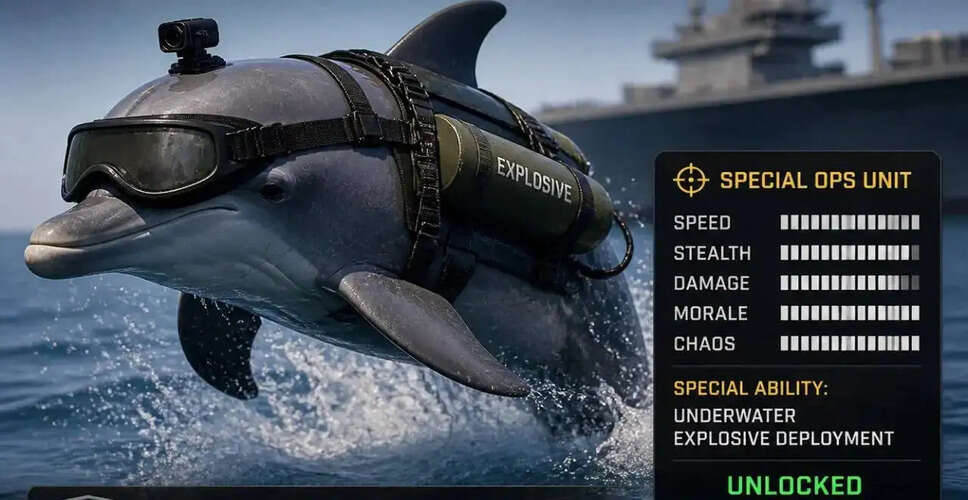
A brief yet impactful statement emerged from Iran’s consulate in Hyderabad: “They’ve finally spilled the beans, it’s all out now.” This comment followed reports indicating that Tehran might be contemplating an unconventional strategy—training dolphins to carry explosives aimed at US naval vessels in the Strait of Hormuz. Although the authenticity of this claim remains unverified, the reaction it has garnered suggests it is being taken seriously, especially given the heightened tensions despite a fragile ceasefire. In such a climate, even unconventional tactics can significantly influence perceptions on both sides of the conflict.
They've finally spilled the beans, it's all out now.😉 https://t.co/MgsByx5Zpw pic.twitter.com/IYvSQwsZeN
— Iran In Hyderabad (@IraninHyderabad) May 3, 2026
Exploring Unconventional Tactics
Reports referenced by a prominent news outlet indicate that Iranian officials are considering the deployment of marine mammals equipped with explosives to target naval vessels. This approach reflects a broader strategy to find low-cost, asymmetric responses to the US's naval supremacy in the region. Historically, Iran is believed to have acquired trained dolphins from the Soviet navy in 2000, which were reportedly capable of reconnaissance and underwater missions. However, it remains unclear whether these capabilities are still active today. Currently, the reports exist in a grey area—part intelligence assessment and part speculative planning.
Internal Pressures Influencing Strategy
The context for these considerations includes significant economic challenges and strategic pressures. A prolonged blockade has severely limited Iran’s oil exports, exacerbating financial difficulties. Within Tehran, certain hardline factions increasingly perceive this situation not merely as strained diplomacy but as an ongoing conflict. Hamidreza Azizi, a Middle East specialist, pointed out that such conditions can shift strategic perspectives. He noted, “The blockade is increasingly viewed… as a different manifestation of war,” suggesting that decision-makers may start to see escalation as a more viable option. If this mindset persists, it could broaden the range of tactics being contemplated.
Strait of Hormuz: A Critical Focus
The Strait of Hormuz remains a focal point—a vital maritime corridor essential for global oil transportation. Any disruption, even if temporary, can have significant repercussions on energy markets and shipping routes. For commercial operators, the mere presence of uncertainty can lead to rerouting. While surface threats are a primary concern, the potential for underwater dangers, particularly mines, adds another layer of complexity. Even a limited deployment of such tactics could hinder traffic and complicate navigation.
Military Capabilities and Limitations
The US military has established systems for detecting and neutralizing mines, including sonar-equipped surface drones, underwater vehicles like the MK18 Kingfish, and helicopter-based scanning platforms. This process is systematic—scan, identify, and neutralize. While effective, it is not instantaneous. Interestingly, the US Navy has historically utilized trained dolphins for defensive purposes, primarily for mine detection rather than offensive strategies. New technologies, such as autonomous systems and AI-assisted scanning, are being tested but remain limited in their operational scale. In conflict scenarios, this ambiguity can be advantageous, introducing uncertainty, shaping risk perceptions, and keeping adversaries on edge.