
Iran's President Claims 14 Million Ready to Sacrifice Amid US Tensions
Iran's Voluntary Sacrifice Amidst US Threats
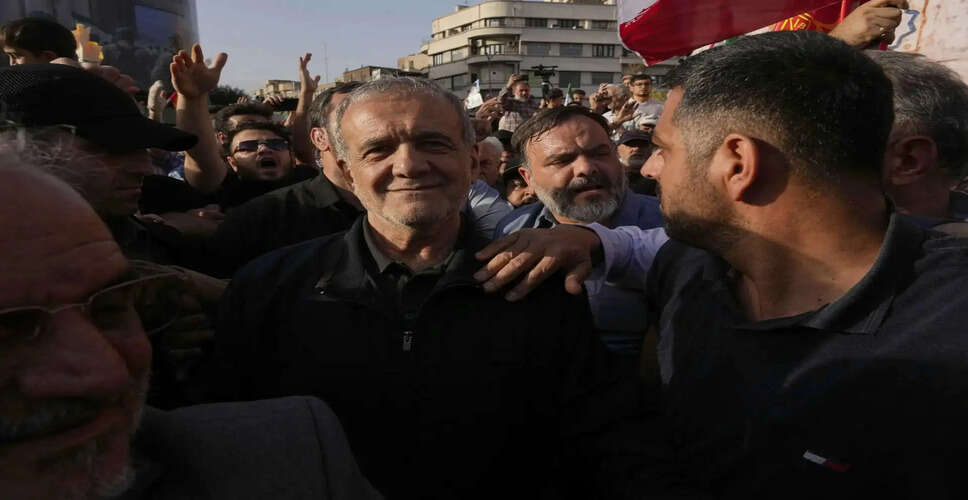
In light of an impending deadline set by the United States, Iran's president announced on Tuesday that 14 million citizens, including himself, are prepared to sacrifice their lives for the nation. President Masoud Pezeshkian shared this statement on X, coinciding with US President Donald Trump's ultimatum regarding potential airstrikes on Iranian infrastructure if the country does not ease its grip on the Strait of Hormuz. This figure is notably higher than previous estimates reported by state media regarding volunteer enlistment through various channels as the conflict escalates.
With a population of 90 million, many Iranians are reportedly discontent with their government due to its violent response to widespread protests. The announcement of 14 million volunteers appears to be a strategic move to deter the anticipated US military action.
“More than 14 million Iranian people have declared their readiness to sacrifice their lives in the (self-sacrificing) campaign,” Pezeshkian stated. “I too have been, am, and will remain ready to give my life for Iran.” These remarks come amid escalating violence in the region, with airstrikes in Iran resulting in at least 15 fatalities on Tuesday, while Iranian forces have initiated attacks against Israel and Saudi Arabia. In response to missile interceptions, Saudi authorities temporarily closed the King Fahd Causeway, a vital bridge to Bahrain, due to debris falling near energy facilities.
Iranian officials have also called on civilians to create human chains around power plants to protect them from possible US strikes. Alireza Rahimi, in a televised address, emphasized that these power plants are national assets that should be safeguarded for future generations, regardless of political affiliations.
Trump has cautioned that failure to reopen the Strait of Hormuz, a crucial passage for global oil shipments, could result in strikes targeting Iran’s power facilities and bridges. He remarked, “The entire country can be taken out in one night,” noting that prior deadlines had already been postponed.
These threats have raised alarms internationally. French Foreign Minister Jean-Noel Barrot stated that attacks on civilian and energy infrastructure violate the rules of war and international law. U.N. Secretary-General Antonio Guterres has also expressed concerns regarding such military actions.
The ongoing conflict has already impacted global markets, with oil prices soaring; Brent crude surpassed $111 per barrel in early trading, reflecting apprehensions about supply disruptions through the Strait of Hormuz. The human toll continues to rise, with over 1,900 fatalities reported in Iran since the conflict's onset, alongside more than 1,400 in Lebanon. Casualties have also been reported in Israel, the Gulf region, and the occupied West Bank, including among U.S. service members.