
Iran Escalates Conflict with Missile and Drone Strikes on US Bases

Iran's Military Actions Intensify
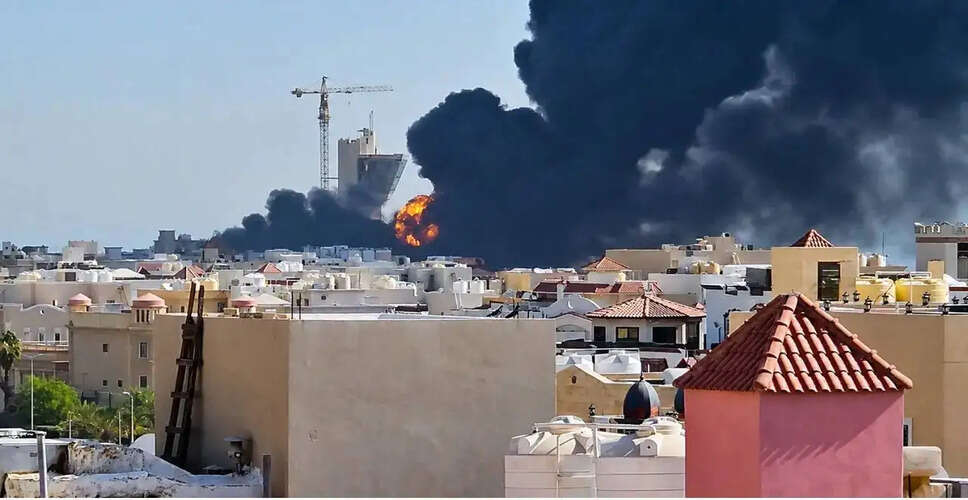
On Saturday, Iran escalated its military operations by launching missile and drone strikes targeting US military installations and infrastructure throughout the Gulf region. This development comes as American airstrikes on Iranian military sites have continued for a seventh consecutive day. Among the affected areas is Kuwait, where authorities reported damage to a desalination facility and the temporary closure of Kuwait International Airport due to ongoing missile and drone threats.
The Islamic Revolutionary Guard Corps (IRGC) of Iran announced that it had successfully hit a US military support center located at Camp Arifjan and destroyed a radar installation at Ali Al Salem Air Base. Additionally, the IRGC claimed to have targeted locations in Bahrain and Jordan. Kuwait's military reported intercepting Iranian missiles and drones early Saturday, noting that several firefighters and oil workers sustained injuries while responding to the incidents. The Kuwait Petroleum Corporation confirmed damage to one of its oil facilities due to these Iranian attacks, resulting in significant destruction and injuries, as reported by the state news agency.
Iranian state media indicated that the IRGC targeted Sheikh Isa Air Base in Bahrain, where US combat aircraft are stationed, along with an intelligence data center. They further claimed to have destroyed at least two US fighter jets and three other aircraft during a missile and drone assault on the US base at Al Azraq in Jordan. However, Reuters could not independently verify these assertions. Jordan's military stated that it intercepted several missiles and drones entering its airspace, emphasizing its commitment to safeguarding national sovereignty and citizen safety.
Saudi Arabia's early warning system issued alerts advising residents in Al-Kharj and Yanbu to seek shelter, following reports of an Iranian missile attack, although the Saudi state media did not clarify the reason for the alerts, and officials did not provide immediate comments. The IRGC did not mention any attacks on Saudi Arabia. Separately, Iran's state broadcaster, Islamic Republic of Iran Broadcasting (IRIB), advised the public to avoid US military bases across the Gulf.
In a statement, Iran declared that it had launched missile strikes against Sulaymaniyah in Iraq and Bahrain as a response to US aggression and threats from terrorist factions. The broadcaster urged nations hosting US forces to close these bases, asserting that to avoid Iranian missile strikes, they should demonstrate courage and independence by shutting down US military installations on their soil.
The IRGC stated that these attacks were a direct response to recent US strikes on Iranian infrastructure, including bridges and power facilities. They emphasized that, in the absence of an international body to curb US military actions, they felt compelled to retaliate, citing a Quranic directive: 'Whoever attacks you, attack them in the same manner.' They warned that further strikes could follow.
According to Iran's Health Ministry, US strikes over the past three weeks have resulted in 50 fatalities and over 500 injuries. State television reported that US airstrikes early Saturday killed three individuals and injured eight others in Hormozgan province, near the strategic Strait of Hormuz, while damaging two bridges and a road tunnel. The semi-official Fars news agency later reported additional US strikes in the province on Saturday afternoon, citing local authorities, but noted no civilian casualties.
Esmaeil Baghaei, spokesperson for the Iranian Foreign Ministry, accused the United States of attempting to dominate the Strait of Hormuz, a crucial passage for approximately one-fifth of the world's oil supply. Earlier, US Central Command (CENTCOM) confirmed it had completed its seventh day of operations targeting Iranian surveillance sites, military logistics, underground weapon storage, and maritime capabilities. White House spokesperson Anna Kelly stated that the US military has focused exclusively on military targets, contrasting this with Iran's alleged targeting of civilian vessels in the Strait of Hormuz and aggression towards neighboring countries uninvolved in the conflict.
Kelly added that President Trump would not tolerate these acts of terrorism without a response, directing CENTCOM to diminish Iran's capacity to conduct such attacks and hold the regime accountable. A source familiar with US military strategy informed a news outlet that the ongoing campaign of strikes, initiated last week, is anticipated to extend into the following week. President Trump also warned that the US might begin targeting Iranian energy infrastructure unless Tehran returns to the negotiating table.
Meanwhile, Iranian Deputy Foreign Minister Kazem Gharibabadi announced that Tehran has halted its commitments under its memorandum of understanding with the United States, stating, 'We are not implementing them, and we are focused on defending the country.' Mohsen Rezaei, an advisor to Iran's Supreme Leader Mojtaba Khamenei, cautioned that if US strikes persist for several more days, Iran would transition into a phase of full-scale offensive operations. IRGC-affiliated media also reported that the US conducted three strikes near Sirik in Hormozgan province on Saturday, although these claims remain unverified, and CENTCOM did not provide immediate comments.