
Inter Milan Faces Major Financial Scandal: Allegations of Fraud and Mafia Links
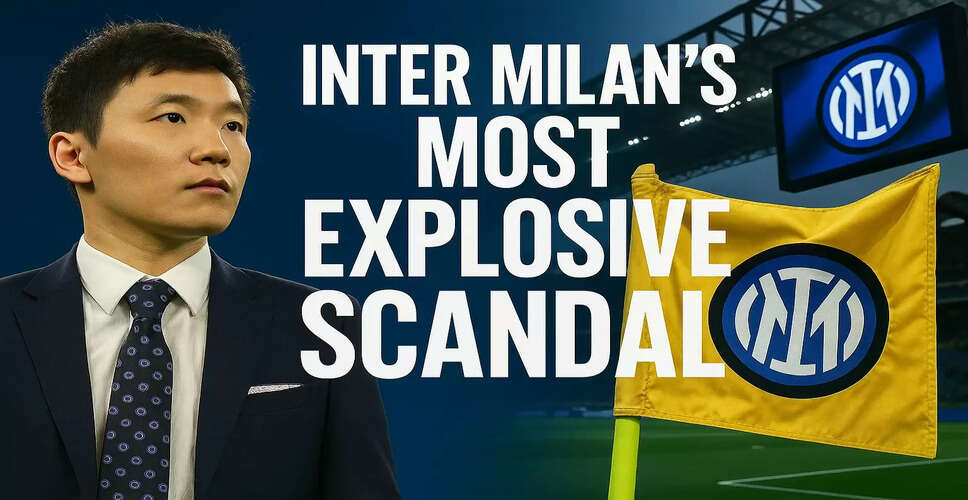
Inter Milan Scandal: A Shocking Financial Revelation
In a potentially groundbreaking revelation for Italian football, a confidential investigative report has unveiled serious allegations of financial misconduct, institutional complicity, and possible mafia connections involving Inter Milan, one of the most prestigious clubs in Serie A. This report, compiled by a financial advisory firm based in London, was commissioned by a group interested in acquiring the club and highlights alleged financial manipulation during the club's Chinese ownership, characterized by offshore dealings and regulatory negligence.
Timing of the Report: A Critical Moment
The report's release comes just days after Inter's disappointing defeat in the Champions League final against Paris Saint-Germain and the notable exit of head coach Simone Inzaghi to Saudi club Al-Hilal, making the timing particularly significant.
Inter Milan Scandal: €300 Million in Alleged Fake Revenue
From 2016 to 2019, Inter Milan reportedly declared an astonishing €300 million in revenue from Asian sponsorships, which accounted for nearly 46% of its total income during that timeframe. The dossier claims that a significant portion of this revenue was unverifiable, inflated, or entirely fictitious.
The sponsorships primarily originated from Suning Holdings Group, the Chinese conglomerate that took over Inter in 2016. Several sponsors listed, including FullShare Holding (Tourism), King Down Investment (Online Travel), and iMedia (Sports Marketing), either had no substantial operational presence, did not release financial statements, or were largely unknown in their respective industries.
One unnamed Southeast Asian entity is highlighted for paying an entry fee of €10 million and an annual fee of €25 million to promote Inter's brand, despite lacking any verifiable marketing activities.
The report suggests that these entities may have functioned as shell companies, artificially inflating Inter's financial statements to create an illusion of fiscal stability and evade UEFA's Financial Fair Play (FFP) regulations.
Inter was already under a UEFA settlement from 2015 for previous FFP violations. The report asserts that the financial framework established during the Suning era was carefully crafted to appear compliant while concealing unsustainable operational expenses.
Key financial figures include:
- Wage Bill: Increased from €124 million to €192 million
- Operating Expenses: Rose from €211 million to €310 million
- Actual Revenue Without Fake Sponsorships: Insufficient to meet basic financial obligations
Without these purported sponsorship funds, Inter would have faced severe financial consequences, including relegation, exclusion from European competitions, or even liquidation under Italian law.
Institutional Complicity: FIGC and COVISOC Under Scrutiny
More troubling than the financial manipulations are the allegations of institutional complicity. The FIGC (Italian Football Federation) and COVISOC (Supervisory Commission on Professional Football Clubs) are accused of enabling and, in some instances, shielding Inter.
Specific allegations include:
- FIGC's creation of special financial regulations to provide Inter with leeway
- COVISOC's intentional lax oversight, allegedly due to external pressures
- A former COVISOC official reportedly admitted to inaction due to 'orders from above'
Had Inter Milan been subjected to the same scrutiny as other clubs, the report claims they would have faced sanctions, administration, or expulsion from Serie A.
This raises a critical question: Was Inter too influential to be held accountable?
Offshore Structures and Cayman Islands Connections
Ownership transparency is another significant concern. While Suning is publicly recognized as Inter's owner, the report reveals a complex web of offshore holding structures, including substantial operations through the Cayman Islands, a jurisdiction known for its lack of transparency.
This structure complicates the identification of ultimate beneficiaries, raising red flags for potential money laundering, tax evasion, and regulatory avoidance.
Even after Oaktree Capital Management acquired the club in May 2024 for approximately $455 million, many of these opaque financial relationships persist.
Giuseppe Marotta and Alleged Mafia Connections
Giuseppe Marotta, the club's Chairman and CEO, is depicted as a crucial negotiator who has mediated between management and Inter's infamous ultras, some of whom are under investigation for mafia ties.
While the report does not directly accuse Marotta of criminal activity, it highlights several concerning points:
- His 'appeasement meetings' with ultras during crises
- Similarities to his previous role at Juventus, where he reportedly interacted with individuals linked to organized crime
- Internal communications indicating that 'Marotta gives in to pressure' and 'resolution thanks to Marotta'
This ultras group is alleged to have operated ticketing rackets and unauthorized merchandising, and is currently involved in a violent power struggle linked to multiple homicides.
Notable Inter figures, including Vice President Javier Zanetti, Hakan Calhanoglu, and Simone Inzaghi, have faced fines or bans for their associations with this group.
While financial investigators were compiling this alarming report, Inter Milan was celebrated publicly.
- In late 2023, the club received the Ambrogino d’Oro, Milan’s highest honor, from Mayor Giuseppe Sala
- Politicians and journalists attended public events honoring the club
These public celebrations, occurring shortly after revelations of mafia connections and financial irregularities, highlight a troubling disconnect between image management and accountability.
The Absence of Steven Zhang
In the midst of this turmoil, Inter Milan's president Steven Zhang has been conspicuously absent. Officially, issues related to passport renewals and legal scrutiny in China are cited as reasons for his absence. However, this raises several questions:
- Who authorized the club's financial decisions?
- What level of oversight was provided from the top?
- Is Zhang attempting to evade potential legal repercussions?
Zhang's silence and absence have only intensified public suspicion.
Italy's Sports Minister Andrea Abodi recently called for 'total transparency, like glass,' reflecting growing political concern that the FIGC may be on the brink of another scandal reminiscent of the 2006 Calciopoli refereeing scandal that resulted in Juventus's relegation and title stripping.
Future Implications for Inter Milan
The looming question now is whether Inter Milan will face sanctions.
While the club may not lose titles from the 2016-2019 period, as they did not win any during that time, their seven trophies since then, including two Serie A titles and two Coppa Italia victories, could be jeopardized pending further investigations.
Potential consequences include:
- Points deductions
- Stripping of trophies
- Bans from UEFA competitions
- Relegation to Serie B
- Criminal charges against club executives and regulators
As Manchester City faces similar allegations in the Premier League, Inter Milan finds itself on the brink of a crisis.
Despite projecting a profit of €24 million for the 2024-25 season, it may be too little, too late.
This situation transcends a mere club scandal; it serves as a critique of the regulatory framework in Italian football, where political interference and financial manipulation have overshadowed integrity.
If even a fraction of the claims in this report are substantiated, it won't just be Inter Milan facing consequences; it will be Italian football as a whole.