
Intensifying Political Climate in Mandi Ahead of Municipal Elections
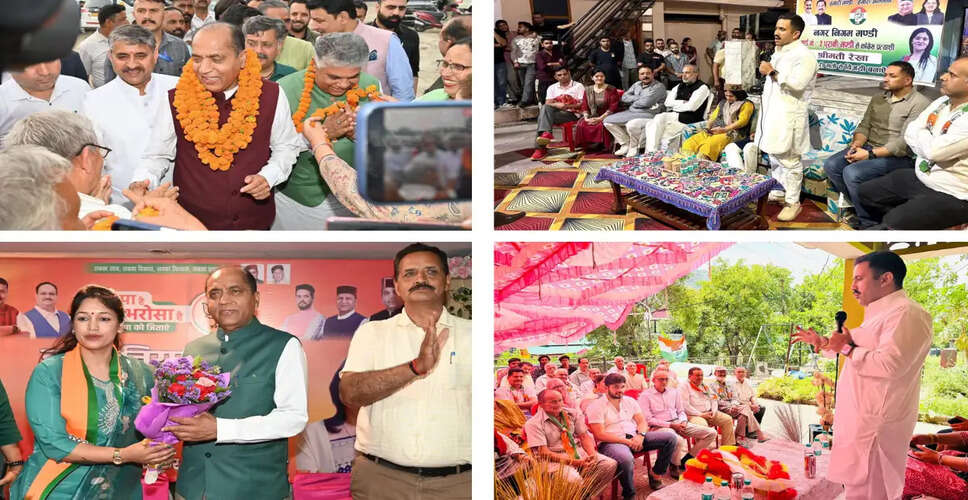

Political Tensions Rise in Mandi
Munish Sood
Mandi
As the Municipal Corporation elections in Mandi draw near, the political atmosphere has become increasingly charged. Initially anticipated to focus on urban development and civic amenities, the election has morphed into a fierce contest between the ruling Congress and the opposition BJP, with accusations flying back and forth while genuine public concerns are sidelined.
Both parties are mobilizing their senior leaders for a series of rallies, leading residents to feel that the election discourse has strayed from pressing local issues. Observers note that these civic polls are being perceived as a precursor to the 2027 Assembly elections, shifting the focus from municipal governance to political prestige.
The Congress party has sent its top brass to Mandi for campaigning. Rajni Patil, the All India Congress Committee in-charge for Himachal Pradesh, is set to hold several election meetings today. Chief Minister Sukhwinder Singh is also expected to arrive in Mandi this evening for discussions in various wards, followed by a dinner meeting with the local business association. Meanwhile, Cabinet Minister Vikramaditya Singh has taken a proactive role in the campaign, launching pointed criticisms against the BJP regarding its past performance in the Municipal Corporation.
During a public gathering on Tuesday evening, Vikramaditya Singh accused the BJP-led Municipal Corporation of neglecting basic amenities over the past five years. He claimed that despite the BJP's promises of development, there has been no improvement in essential services such as roads, water supply, sanitation, and civic infrastructure.
“The residents of Mandi were deceived under the guise of development. After five years in power, the BJP has failed to deliver basic facilities,” he stated, urging voters to back Congress candidates for the city’s comprehensive development.
The meeting saw attendance from Dharampur MLA Chandrashekhar, District Congress President Champa Thakur, Congress candidate Rekha, and numerous party workers and local residents.
Conversely, former Chief Minister and Leader of Opposition Jai Ram Thakur has ramped up the BJP's campaign by addressing multiple public meetings throughout the town. He criticized the Sukhu government, alleging that Mandi has faced neglect since Congress took control of the state.
“The development of Mandi has been intentionally stalled. Projects and priorities related to the city have been systematically overlooked,” he remarked during a media interaction, asserting that the people of Mandi would respond decisively to Congress in the elections.
Expressing confidence in the BJP's chances, Jai Ram Thakur noted that after winning 11 out of 15 seats in the previous elections, the party is poised for an even greater victory this time.
However, amidst the heated political exchanges, residents feel that the fundamental issues facing the city have been overshadowed.
Parking congestion remains a significant concern, with increasing traffic making movement difficult in many areas, yet no party has proposed a solid plan to tackle this issue. Similarly, waste management, sewerage facilities in newly merged wards, and the preservation of Mandi’s historic temples and ghats have received scant attention during the campaign.
The rising problem of drug abuse is another pressing concern for residents, but instead of seeking solutions, both parties are preoccupied with blaming each other for the deteriorating situation.
Many locals believe that the presence of high-profile ministers and senior political figures has turned the civic election into a contest of prestige, overshadowed by state and national political narratives.
Madhu Sharma, a resident of Ward 3, expressed disappointment, stating that people expected candidates to address issues like roads, parking, and sanitation, but most speeches focus on attacking political rivals.
Sugandha from Ward 9 echoed this sentiment, noting that campaign rallies are increasingly centered around state-level political disputes rather than local problems.
Rajnish, a resident of Ward 2, remarked that voters are paying close attention and may ultimately favor candidates who prioritize basic civic needs over political attacks.
Political analysts caution that the apparent silence among voters should not be interpreted as apathy. Many residents seem more concerned with practical urban issues than party rhetoric, which could significantly impact the election results.
As the campaign enters its final stretch, the pivotal question remains whether Mandi voters will support a confrontational political approach or choose candidates who offer tangible solutions to the city's long-standing civic challenges.