
Intense Campaigning for West Bengal Assembly Elections: Key Players and Strategies

Final Push in West Bengal Elections
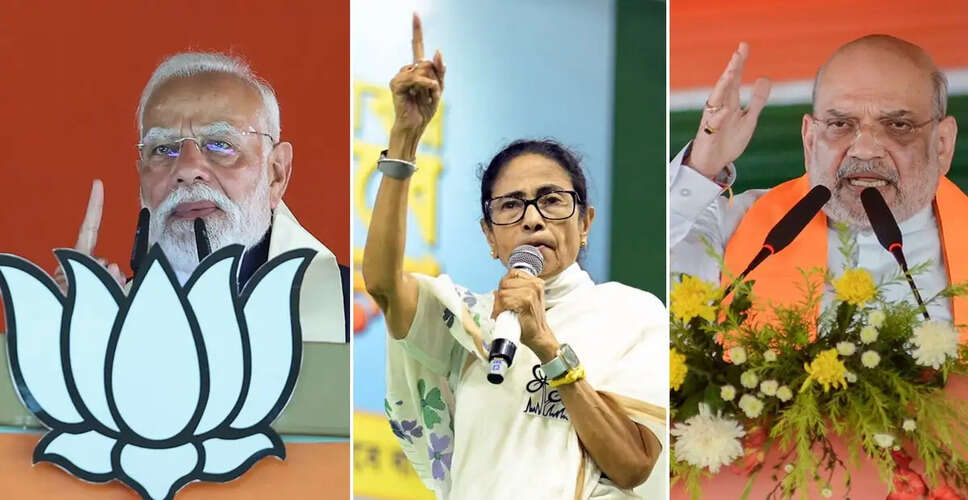
As the campaigning for the second phase of the West Bengal Assembly elections comes to a close, political parties are ramping up their efforts. Leaders from the Bharatiya Janata Party (BJP), Trinamool Congress (TMC), Left parties, and Congress have been actively engaging voters through rallies, roadshows, and grassroots outreach. The second phase of voting is scheduled for April 29 across 142 constituencies.
BJP's Aggressive Campaign
Prime Minister Narendra Modi and Home Minister Amit Shah have spearheaded an assertive campaign for the BJP. During rallies in Hooghly's Arambagh and North 24 Parganas' Bangaon, Modi criticized the TMC government for corruption, mismanagement, and promoting syndicate rule. He highlighted the deteriorating condition of women in the state, citing incidents like the recent message incident as evidence. Modi also emphasized the government's support for farmers, noting that the minimum support price for jute has been doubled, and policies have been implemented to boost the jute industry.
Modi's Roadshow and Community Engagement
The day before, Modi conducted a roadshow in Kolkata, attracting a large crowd of supporters. He also visited significant temples of the Matua community in Thakurnagar and the historic Thantania Kali Temple in Kolkata, aiming to connect with this influential group in several constituencies. The Matua community is considered pivotal in the electoral landscape, making this outreach a crucial part of the BJP's strategy.
Amit Shah's Promises
Amit Shah has made several appealing promises during his rallies and roadshows. He stated that if the BJP comes to power, women and unemployed youth would receive monthly assistance of ₹3,000, while pregnant women would be granted ₹21,000. Shah also vowed to end syndicate and goonda raj, curb illegal immigration, and complete pending development projects. He claimed that the BJP has already gained a significant lead in the first phase of voting.
TMC's Ground-Level Engagement
On the other hand, Chief Minister Mamata Banerjee of the TMC has prioritized grassroots engagement. She visited markets in Kolkata, interacting with vegetable vendors and the general public. During these interactions, she raised issues of inflation and daily challenges, assuring continued support for women through state initiatives like the Lakshmi Bhandar scheme. Banerjee aimed to present herself as accessible to the public while accusing the BJP of engaging in superficial politics.
TMC's Defense Against BJP
Other TMC leaders have accused the BJP of being an external force, emphasizing regional identity as a key issue. They assert that public support will secure them a significant majority. Meanwhile, the BJP has focused on law and order, women's safety, and corruption as central electoral themes.
Political Tensions and Security Measures
The election campaign has seen sharp exchanges between the two major parties. Banerjee labeled the BJP's campaigns as artificial, while the BJP referred to the TMC government as a jungle raj. Additionally, incidents of political violence and clashes have emerged, heightening the electoral atmosphere. The Election Commission has implemented stringent security measures ahead of the second phase of voting, deploying central forces in sensitive areas, ensuring CCTV surveillance, and conducting patrols to allow voters to cast their ballots without fear. The Commission has made it clear that any attempts at disruption or intimidation will be met with strict action.
Key Constituencies in Focus
In terms of significant areas for the second phase of voting, the northern hills and the forest regions of Jangal Mahal play a minimal role in government formation. Typically, decisions are made in the densely populated plains of southern Bengal. The districts of North and South 24 Parganas are crucial in this electoral battle, serving as strongholds for the TMC alongside Kolkata and Howrah, while also representing a vital path to power for the BJP.
BJP's Strategy in Southern Bengal
The BJP is attempting to penetrate the TMC's southern bastion, with the two largest districts—North 24 Parganas with 33 seats and South 24 Parganas with 31 seats—being key to winning Bengal. Along with Kolkata's 11 seats and Howrah's 16, these four districts represent 91 of the 294 assembly seats, making them critical in the elections.
Bhawanipur: The Hot Seat
Bhawanipur has transformed from a simple assembly seat in South Kolkata to a significant battleground, with the BJP fielding opposition leader Suvendu Adhikari against TMC chief Mamata Banerjee. The BJP has framed this seat as a 'psychological battlefield,' setting the stage for what many are calling the 'biggest contest' in Bengal. Banerjee, a three-time MLA from this constituency, faces a direct challenge from Adhikari, making the April 29 elections a highly anticipated 'prestige battle' for the state.
Diverse Voter Demographics
Bhawanipur, often referred to as 'Mini India,' is a constituency characterized by its social diversity, housing Bengali, Gujarati, Punjabi, Sikh, Marwari, and Jain families, along with a significant Muslim voter base. Migrants from Bihar, Odisha, and Jharkhand add another layer to this demographic mix. Approximately 42% of voters are Bengali Hindus, 34% are non-Bengali Hindus, and around 24% are Muslims, making this constituency politically sensitive. This complex voter equation has encouraged Adhikari to challenge Banerjee in her stronghold.
BJP's Ground Strategy
The BJP has been meticulously gathering data at the booth level in Bhawanipur for months. Party leaders claim that the voter demographics include 26.2% Kayasthas, 24.5% Muslims, 14.9% migrants from Eastern India, 10.4% Marwaris, and 7.6% Brahmins. According to party insiders, this exercise has helped identify where the Bengali Hindu majority lies, where Hindi-speaking business communities are concentrated, and which booths are likely to have significant Muslim voter influence. The BJP's strategy focuses on uniting caste equations at the booth level and consolidating Hindu votes from both Bengali and non-Bengali communities.
Looking Ahead to the Elections
The first phase of voting in West Bengal took place on April 23, and all eyes are now on the second phase. The counting of votes is set for May 4, coinciding with the announcement of results from four other states. Ahead of the results, the BJP is confident about forming a government in the state, as indicated by Prime Minister Modi's assertive statement on the last day of campaigning, where he expressed certainty that the BJP would lead the next government in West Bengal and return for the swearing-in ceremony after the results are declared on May 4.