
Innovative Tech Solutions Enhance Flood Relief Efforts in Assam

Devastating Floods in Upper Assam
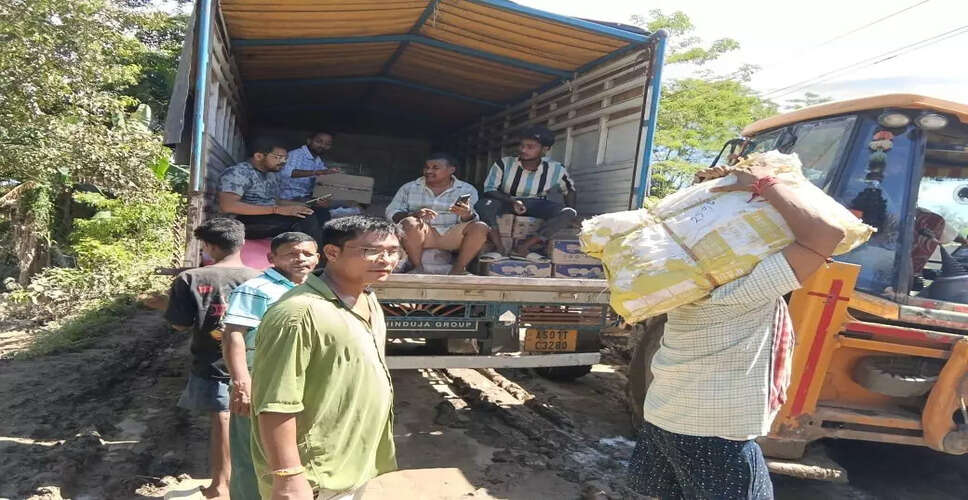
Individuals, community groups and volunteers raised funds to provide flood relief in Upper Assam. (Photo: 'X')
On July 19, Upper Assam experienced unprecedented flooding, with homes submerged and only rooftops visible above the water.
As pleas for assistance flooded in from affected villages, residents across Assam mobilized to help. Community groups, individuals, and volunteers gathered resources, loaded vehicles with food, medical supplies, and other essentials, and traveled to the hardest-hit regions.
However, amidst this overwhelming response, a significant challenge arose: coordination. While many were eager to assist, they often lacked clarity on where their help was most needed. This led to multiple groups arriving at the same locations while other areas remained neglected.
Leveraging Technology for Better Coordination
In response to this gap between the desire to help and the ability to effectively reach those in need, technology began to play a crucial role.
Various tech-driven initiatives emerged across Assam during the floods, aiming to connect those in need with those willing to assist.
From crowdsourced live maps to mobile applications and AI-enhanced WhatsApp services, disaster response is evolving beyond traditional communication methods.
Banpani.org: A New Coordination Platform
When Relief Overlaps
The founders of Banpani.org, an open-source platform aimed at improving coordination among relief providers, were inspired by the sight of relief supplies being sent repeatedly to the same areas.
“While browsing Facebook, I noticed relief efforts concentrated in the same locations. I spoke to two individuals who were ready to deliver supplies but struggled with decentralized communication,” shared Partha Borthakur, a co-founder of Banpani.org.
They decided to create a platform where information about affected areas and their needs could be mapped and accessed without a central moderator.
The platform is also being designed to include a module for tracking rehabilitation efforts, with plans to extend its mapping capabilities to other natural and man-made disasters.
“Our team consists of three core members, and we built the platform in just two days. AI has simplified the process,” Borthakur added.
Connecting Through Mobile Applications
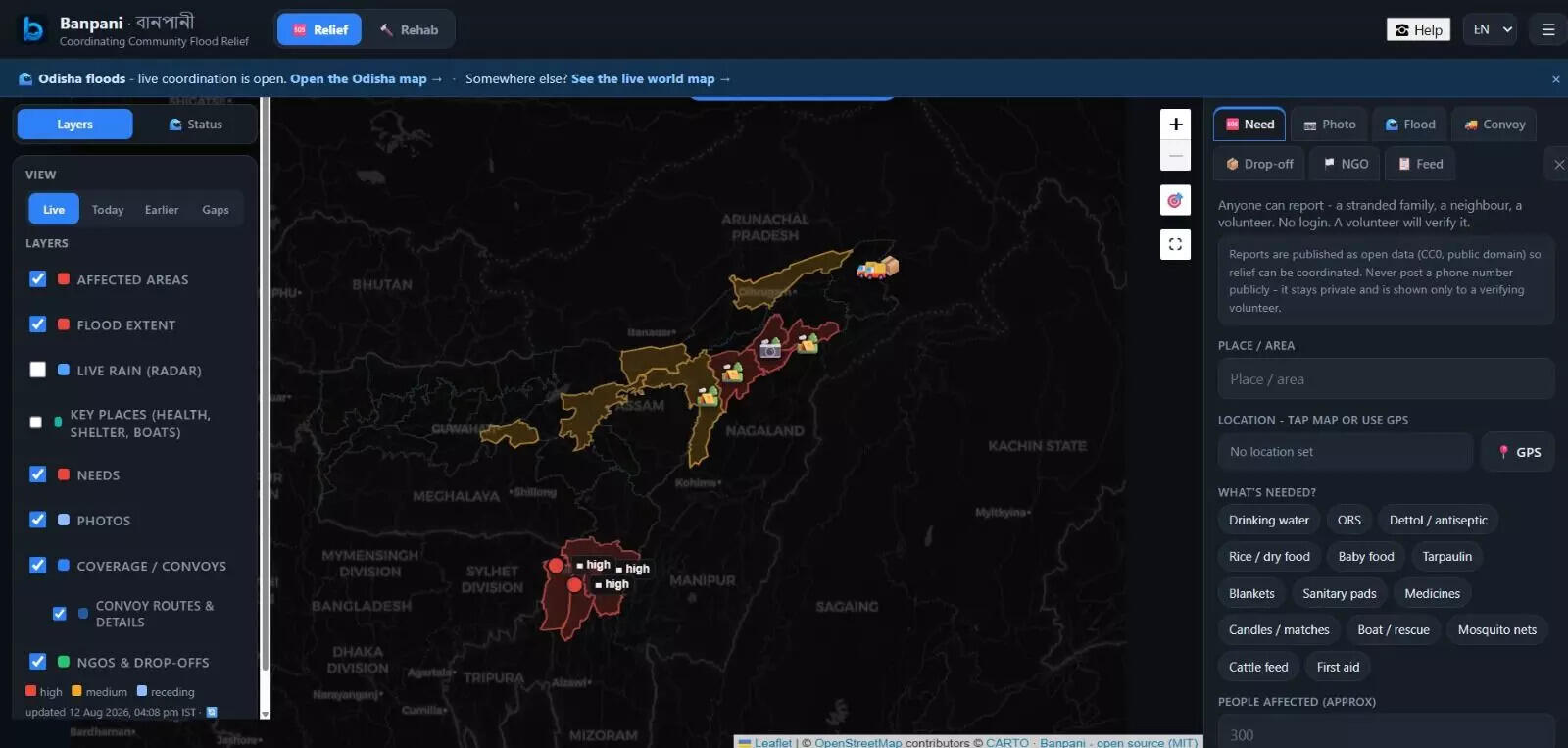
A screengrab of banpani.org website
Help, Just a Message Away
Banpani.org is not the only initiative. A free mobile app called Helpmonk, created by the travel venture Firingoti, aims to connect disaster-affected individuals with volunteers, NGOs, government agencies, rescue teams, and donors through a unified platform.
Dikshit Rajkhowa, a technology expert from New Delhi with roots in Assam, developed the application.
“We built the initial version in under a week due to the urgent situation in Assam, but its architecture is designed to scale for disaster response across India,” Rajkhowa explained.
The goal is to establish a digital link between various stakeholders in disaster response, facilitating easier connections between those seeking help and those offering it.
AI-Powered Assistance
Another initiative, Jal Raksha, offers a straightforward solution. Marketed as Assam’s first AI-driven flood assistance service on WhatsApp, it requires no app download or account creation.
Users can simply send “Hi” to +91 80110 59212 on WhatsApp to receive flood-related assistance. Developer Javed Saikia stated that the aim was to enhance accessibility to timely information and support during emergencies.
“We’re honored to play a small role in helping people access prompt flood assistance. Together, technology can save lives,” he remarked.
Young Innovators Rise to the Challenge
Young Innovators Step Up
For many young innovators, the floods have sparked the development of technology-based solutions.
Tinku Moni Kaushik, a B.Tech student at Gauhati University, created the Axom Relief platform (axomrelief.com) and noted that the increasing number of such initiatives reflects a commitment among youth to leverage technology for public service.
However, he cautioned against using disaster-response efforts primarily for commercial gain.
“While it’s encouraging that people are inspired to assist flood victims, some are using it as a marketing tool,” he said.
The rise of digital disaster-response platforms raises a broader question: How can technology remain focused on aiding those in need rather than adding to the chaos during a crisis?
Technology's Role in Disaster Response
Technology, Not the System
For official disaster-response agencies, technology is already integrated into their operations, but it does not replace established coordination systems.
An official from the NDRF stated that the force does not currently depend on a specific application for disaster response. Instead, it collaborates with district administrations, the India Meteorological Department (IMD), State Disaster Response Force (SDRF), and other local agencies.
Information also comes directly from residents. “We receive calls from locals about issues that concern them. We verify the information and, depending on the urgency, deploy our team if necessary,” the official explained.
The force monitors weather updates and maintains communication with relevant agencies through platforms like WhatsApp.
At its headquarters, a control room continuously tracks developments and coordinates with ground agencies.
A Shift in Disaster Response
When Help Finds Its Way
The emergence of these platforms signifies a significant shift in how disaster response is organized. Traditionally, relief efforts relied on government agencies, local administrations, community networks, phone calls, and social media appeals.
New digital initiatives are striving to consolidate fragmented information into a single source—identifying where help is needed, who requires it, who can provide it, and whether assistance has reached its destination.
The floods in Upper Assam highlighted the remarkable willingness of ordinary citizens to help while also revealing the limitations of goodwill without proper coordination. When thousands are eager to assist simultaneously, the challenge lies in connecting the right help to the right place at the right time.
This is the gap that these innovative, technology-driven initiatives aim to bridge. They are not replacing rescue workers, officials, or volunteers; rather, they are ensuring that when someone calls for help, their plea does not get lost in the crowd.