
Innovative Canopy Bridges Enhance Safety for Golden Langurs in Assam
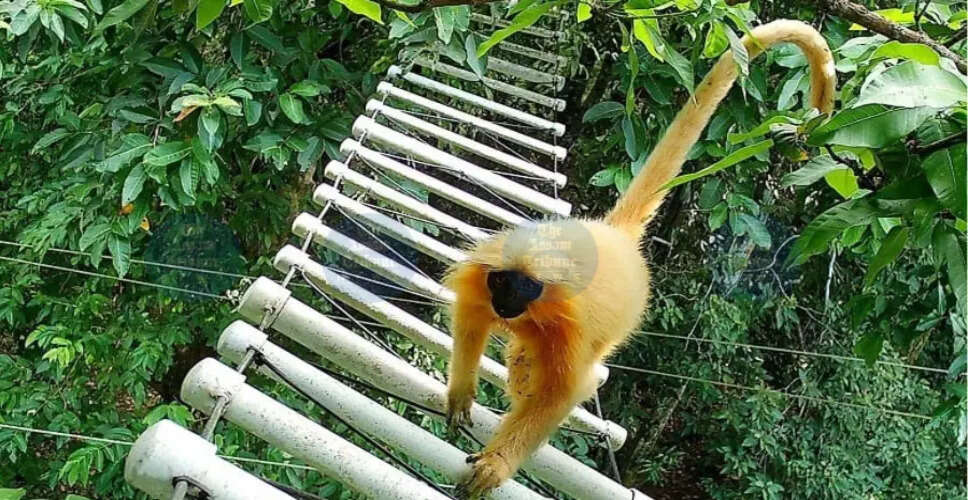
Introduction to Canopy Bridges
Guwahati, Dec 30: The recent installation of artificial canopy bridges at crucial crossing points for golden langurs (Trachypithecus geei) along State Highway-14 in Kokrajhar has led to a notable decrease in road accidents involving this endangered species.
Background of the Study
This initiative was prompted by a study conducted in the Chakrashila-Amguri-Buxamara-Nayekgaon forest complex, which documented 18 collisions between vehicles and langurs in the Nayekgaon-Choibari section of SH-14. This alarming statistic resulted in seven fatalities, five serious injuries, and six minor injuries.
Implementation of Canopy Bridges
To address these dangers, a total of 15 artificial canopy bridges featuring four different designs were constructed along SH-14. Monitoring efforts recorded 112 instances of langur crossings, revealing that these primates preferred using the canopy bridges over the road. Among the various designs, pipe and ladder bridges proved to be the most effective, as highlighted in a report published in the December edition of the Journal of Wildlife Science.
Impact of Infrastructure on Golden Langurs
Infrastructure such as roads and power lines often disrupt the natural habitats of golden langurs in Assam. These artificial barriers compel the arboreal primates to descend to the ground, leading to road fatalities and other human-induced threats.
Community Involvement and Conservation Efforts
In addition to the bridges, some power lines in the area were insulated to create safer passageways for the langurs. The project also emphasizes community outreach to foster conservation efforts, encouraging local participation in restoring habitats through plantation initiatives and maintenance to reduce human-wildlife conflicts.
Research Findings and Future Prospects
These measures aim to reconnect fragmented habitats, thereby decreasing mortality risks and enhancing the long-term survival of golden langurs in their altered landscape. Dr. Jihosuo Biswas, the lead author of the report, noted that the artificial canopy bridges significantly improved crossing safety for the langurs, reducing vehicle collisions along the SH-14 corridor.
Conclusion
Golden langurs, which are endemic to the Indo-Bhutan border, primarily inhabit four districts in western Assam and six districts in south-central Bhutan. Unfortunately, they face severe habitat loss and declining populations, with over half of their natural habitat disappearing in recent years. The report emphasizes the critical situation in southern regions like Kokrajhar and Bongaigaon, where deforestation and agricultural expansion have fragmented their habitats, threatening their survival.