
Innovative Bamboo Architecture: Ekarth Studio's Latest Project at IIT Madras
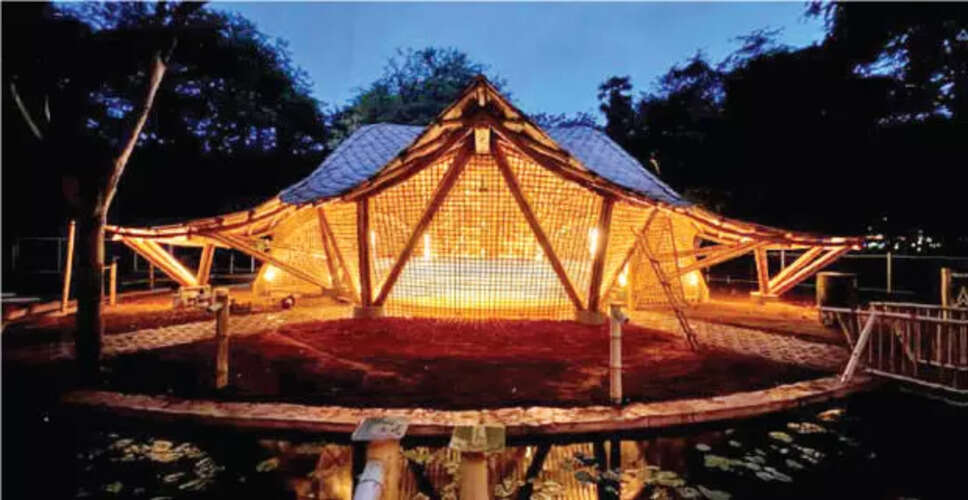

A New Era of Bamboo Construction
Nearly 4,000 bamboo poles were used to construct the music learning and research centre, which was completed in about 11 months.
Guwahati, Sept 24: What started as a two-storey bamboo villa in Assam has evolved into a groundbreaking architectural venture, showcasing bamboo's potential in modern design across India.
From the Lotus Pavilion near Bengaluru to the Northeast Food Pavilion in New Delhi, and now the Maestro Ilaiyaraaja Centre for Music Learning and Research at IIT Madras, the Assam-based startup Ekarth Studio is pushing the boundaries of bamboo as a structural material.
The IIT Madras project stands out as their most ambitious undertaking yet, utilizing nearly 4,000 bamboo poles and completed in just 11 months.
Co-founded by structural engineer Piyush Sharma and architect Neha Jain, Ekarth Studio employed a lightweight construction approach, minimizing the use of heavy machinery while emphasizing skilled craftsmanship.
Bamboo serves as the primary material, enhanced by lime-based finishes and other natural elements. A significant portion of the labor force was sourced from the Northeast, integrating regional expertise into a modern institutional framework.
This project at IIT Madras involved an in-depth investigation into bamboo's flexibility and its capacity to cover large areas, particularly suited to Chennai's challenging climate.
The design features arches reaching nearly nine meters high and expansive column-free spaces, engineered to endure cyclonic winds, high humidity, and prolonged exposure to the elements.
A key innovation in the project is the use of primary spine beams made from bundled flat bamboo splits, which create lightweight yet robust structural assemblies capable of supporting significant roof loads while maintaining an elegant appearance.
The framework was designed using layered curvature systems, handcrafted joints, and precise force distribution, aiming to redefine bamboo's role in construction.
However, the IIT Madras initiative is not an isolated case; it represents a continuation of a journey that began in Assam.
Sharma's journey into bamboo and sustainable construction started with The Firefly, a two-storey bamboo villa in Amsing, marking his first major project with this material.
“In that project, we realized that working with bamboo at this level required more than just familiarity with the material. It necessitated a blend of traditional knowledge and modern construction techniques,” said Sharma, originally from Sivasagar.
This experience led to an international collaboration with bamboo experts Vinc Math and Jorg Stamm, who are pioneers in bamboo construction.
Math traveled from New York to Assam for a month-long workshop with local artisans, teaching them modern bamboo construction methods, treatment, and processing techniques.
Sharma emphasized that the goal was not to replace local expertise with foreign knowledge but to merge the two. “The aim was to connect local wisdom with international insights, allowing us to challenge conventional assumptions while leveraging local materials and craftsmanship,” he explained.
This synergy became a cornerstone of Ekarth's philosophy.
The artisans contributed their intuitive understanding of bamboo, while international experts introduced contemporary construction practices, with Sharma integrating structural engineering principles.
The success of The Firefly led to the establishment of Ekarth Studio, with Sharma as co-founder and Jain overseeing architecture and design.
The studio's projects soon expanded beyond Assam, with the Northeast Food Pavilion in Delhi and the Lotus Pavilion in Bengaluru showcasing bamboo's adaptability in modern public and commercial architecture.
The IIT Madras music research centre further advances this exploration, merging structural integrity, climate resilience, and architectural aesthetics.
For Ekarth, the broader vision is to elevate bamboo beyond its traditional role as a low-tech building material, testing its capabilities against the demands of contemporary architecture and engineering—one pole, one joint, and one meticulously designed curve at a time.