
India's Water Sharing Dilemma with China: Urgent Measures Needed
Water Sharing Concerns Between India and China
Guwahati, May 30: India faces significant challenges regarding water sharing with China, as there is currently no formal treaty in place. While India has suspended the Indus Water Treaty (IWT) with Pakistan, the situation with China is more precarious. As the upper riparian nation, China has the potential to restrict the flow of the Brahmaputra River, warns renowned river expert Prof. Nayan Sharma.
In a recent interview, Prof. Sharma, a former IIT Roorkee professor and now a Professor of Excellence at Gauhati University, emphasized the need for India to develop extensive water storage systems across major tributaries to ensure water availability, even if China decides to limit the Brahmaputra's flow.
Interviewer: India has put the IWT with Pakistan on hold. Can China also restrict the Brahmaputra's water flow?
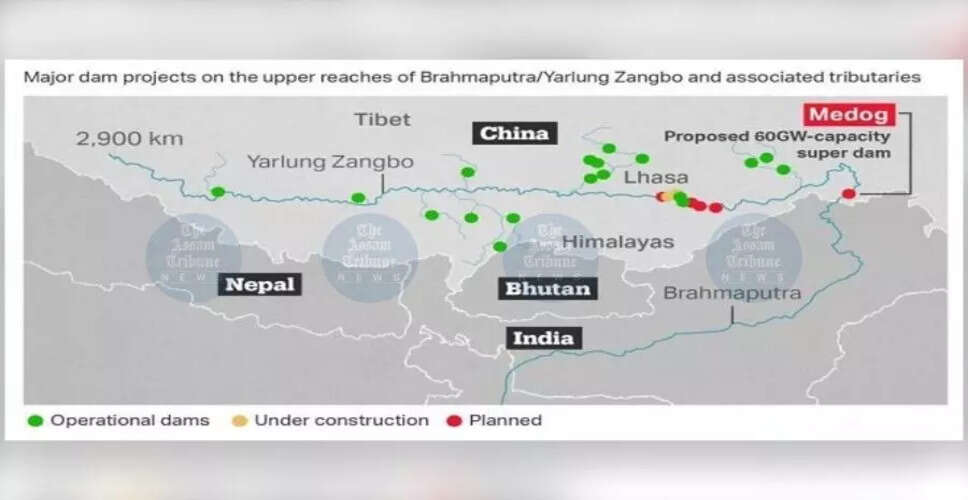
Prof. Sharma: Yes, that's correct. Unlike the IWT, India is at a significant disadvantage as the lower riparian country. China plans to construct a massive dam on the Yarlung Tsangpo (Brahmaputra) River, aiming to generate an astonishing 60,000 MW of hydropower at a cost of USD 137 billion. While China claims this will be a hydropower project, there is a real risk that they could unilaterally divert the river's flow, particularly during dry seasons, which would severely impact India.
Interviewer: The Brahmaputra is fed by tributaries. Can it sustain itself with their water?
Prof. Sharma: The Brahmaputra does receive a considerable portion of its flow from its 33 major tributaries. However, these tributaries often experience reduced flow during dry seasons. Historical data shows that the maximum discharge recorded at Pandu was 72,779 CUMEC in August 1962, while the minimum was 1,757 CUMEC in February 1968. Last July, the discharge was around 38,000 CUMEC, indicating significant annual fluctuations. If China restricts the Brahmaputra, India will struggle to meet its water needs during dry periods, which is alarming given the absence of a water-sharing agreement.
Only about 14% of the Brahmaputra's total annual water yield (AWY) is available before it enters India from Tibet, with the remaining 86% coming from rainfall and monsoon activity within India.
In India, which comprises 34.2% of the Brahmaputra basin area, it contributes the largest share of total discharge, estimated at 39%.
Recent climate studies suggest that snowmelt accounts for about 6% of the total AWY of the Brahmaputra, with 21% from the upper reaches and 5% from the middle section. Due to global warming, the basin-wide average AWY is expected to rise by 8%, particularly in the pre-monsoon season.
However, annual snowmelt is projected to decrease by 17%, especially during the monsoon, while increasing in other seasons, with the upper Brahmaputra seeing the most significant reduction (22%). This shift indicates a decrease in snowmelt contributions to AWY, while rainfall runoff is expected to rise across the basin.
The concerning projections highlight a potential reduction in Brahmaputra flows during lean periods, while pre-monsoon and monsoon flows may increase. The construction of the Chinese mega dam in the Yarlung Tsangpo Great Bend Canyon exacerbates this situation, leading to two immediate consequences: (i) a heightened risk of water scarcity in the Brahmaputra Basin during dry periods, and (ii) serious stability issues for bridge piers due to increased flood flows and excess water releases from the dam.
Interviewer: Can India exert diplomatic pressure on China to establish a water-sharing treaty?
Prof. Sharma: That is challenging. China's unilateral actions regarding transboundary rivers like the Sutlej and Brahmaputra have already created tensions among riparian nations, necessitating a nuanced conflict resolution approach, as there is no established international law governing transboundary rivers.
China is largely unaffected by global pressure and faces rising water demands that exceed supply. It has already maximized the water resources of its two primary rivers, the Yellow and Yangtze.
For instance, the Yellow River has 10 large dams and over 3,100 smaller reservoirs, while the Yangtze River basin boasts a staggering 43,400 dams, including major ones like the Three Gorges Dam.
To sustain its economic growth and meet greenhouse gas targets, China must transition to cleaner energy sources, including hydroelectric power, while addressing its growing water needs. This makes it unlikely that China will agree to a water-sharing treaty. My experience with the United Nations University in Tokyo, where we sought to involve China in Mekong River studies, showed that despite efforts, China did not join the Mekong Committee for water sharing.
Interviewer: What is the solution then?
Prof. Sharma: In my opinion, an urgent priority is to construct numerous medium to low-height water storage facilities on the tributaries of the Brahmaputra to store water during the rainy season for use in dry periods. This would help mitigate the impact of any attempts by China to restrict the Brahmaputra's flow. I advocate for smaller storage dams across the many tributaries rather than large mega dams. Optimistically, I believe that initiating diplomatic efforts for a water-sharing agreement among the four riparian nations—China, India, Bhutan, and Bangladesh—could eventually lead to cooperation based on the principle of benefit sharing, which would provide mutual advantages such as access to markets and collaborative opportunities in irrigation and hydropower.