
India's Vision for a Just Global Order: Jaishankar's UNSC Campaign Launch
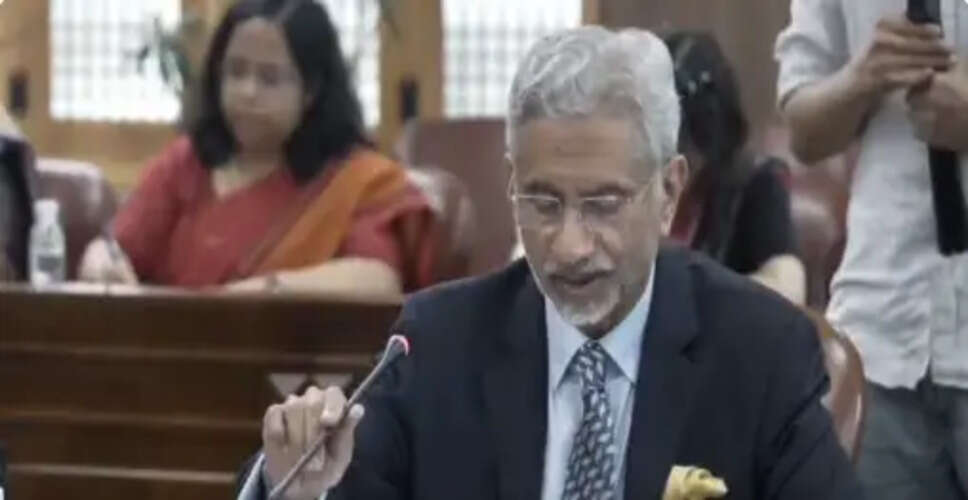

India's Commitment to Global Peace and Security
United Nations: External Affairs Minister S. Jaishankar emphasized India's dedication to fostering a secure, peaceful, and fair world, ensuring that the perspectives of the Global South are equally acknowledged.
These statements were made during the launch of India's official bid for a non-permanent seat on the United Nations Security Council (UNSC) for the term spanning 2028-29.
Jaishankar elaborated on India's strategy at the UN, which is founded on the principle of 'Shanti: Securing Holistic Advancement through Norms, Trust, Integrity,' during an event at the UN headquarters attended by various diplomats and officials.
"India aims to create a world that is secure, peaceful, and equitable—a world where the Global South's voice is equally represented. We envision a future where peacekeeping is equipped to tackle both current and upcoming challenges, and where multilateralism adapts to modern realities, providing effective solutions rather than remaining passive," he stated.
"We aspire for a world where the potential of technology is fully harnessed while preventing its misuse. Additionally, we seek to ensure the safety of our oceans, protecting vital maritime routes," Jaishankar continued.
"We must confront terrorism by cutting off its funding sources and prioritize climate action, climate justice, clean energy transitions, and sustainable development," he added on Monday.
Later in the day, Jaishankar is scheduled to meet with UN Secretary-General Antonio Guterres. He recently completed an official visit to Qatar, Bahrain, Kuwait, and Oman from July 5-10 and arrived in New York over the weekend.
Following his time in New York, he will travel to Brussels on July 14-15 to participate in the 3rd India-EU Trade and Technology Council meeting and engage with his EU and Belgian counterparts.
The elections for the 2028-29 UNSC term will take place in June next year, with India and Tajikistan vying for the single seat allocated to the Asia-Pacific Group.
These elections will occur against a backdrop of significant geopolitical changes, as the world faces ongoing issues such as the Ukraine conflict, the situation in Gaza, and the US-Israel tensions with Iran.
India last held a seat at the UNSC during the 2021-22 term, marking its eighth participation since its initial term in 1950-51, with subsequent terms in 1967-68, 1972-73, 1977-78, 1984-85, 1991-92, and 2011-12.
Prime Minister Narendra Modi recently highlighted in his address to the Indonesian Parliament that the global order is rapidly evolving, and developing nations like India are advocating for equal representation and a more significant role in international matters.
"In this changing global context, India firmly believes that reforms in the UNSC cannot be postponed any longer," he asserted.
India has long championed the need for reform within the Security Council, advocating for both permanent and non-permanent seat expansions, arguing that the current 15-member Council, established in 1945, is outdated and does not reflect today's geopolitical landscape.
New Delhi has consistently maintained that it rightfully deserves a permanent seat at the UNSC table.
India has called for an increase in both permanent and non-permanent UNSC memberships, warning that limiting reforms to just the non-permanent category would not fundamentally alter the decision-making dynamics dominated by the five permanent members.
As the UNSC reform process has progressed slowly over the years, India has insisted that a 'nothing is agreed until everything is agreed' approach should not be used as a means to hinder progress.
"Those favoring the status quo have attempted to leverage this argument to reinforce existing inequities within the Security Council," stated India's Permanent Representative to the UN, Ambassador Harish Parvathaneni, last month.