
India's Unique Diplomatic Platform: A Summit for Peace Amidst Conflict
A Groundbreaking Summit in New Delhi
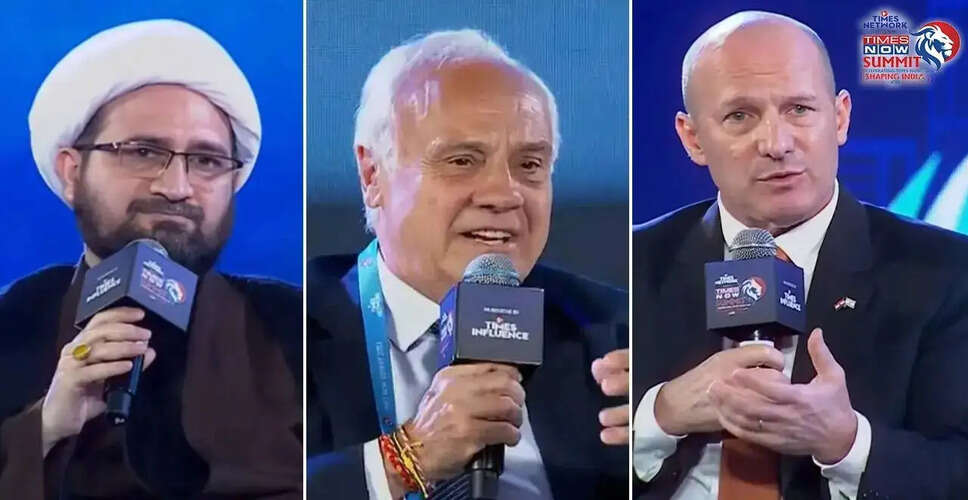
In the midst of ongoing hostilities, India's prominent ideas forum has achieved what no government has accomplished: providing a platform for an Israeli envoy, a representative of Iran's supreme leader, and a Spanish diplomat to share their perspectives. While New Delhi has maintained a neutral stance regarding the US-Israel conflict with Iran, the Times Now Summit 2026, taking place in the capital, has done something more remarkable than any official declaration—it has united representatives from Iran and Israel, along with their critics, in one location on the same day.
Israeli envoy Reuven Azar participated in the two-day summit from March 26 to March 27, delivering a clear message. He indicated that the conflict is at a pivotal moment, stating, "We are at a critical point, a critical juncture here." He emphasized that the future of the conflict depends on whether Iran opts for a US-backed proposal or faces what he termed the "next military stage." The proposal includes straightforward demands: restrictions on Iran's nuclear program, limitations on ballistic missiles, and a reduction in support for regional armed groups. Compliance would lead to sanctions relief, while non-compliance could result in escalation from Israel.
On the same day, Iran's response was articulated by Dr. Mohammad Hossein Ziyaeenia, Deputy to the Representative of Iran's Supreme Leader in India. He expressed Iran's readiness for a ceasefire, stating, "We are completely ready for a ceasefire... But when it will be, we don't know." He underscored that Iran did not initiate the conflict and questioned when the opposing side would choose to end the violence. He urged that the decision to cease hostilities lies with those who initiated the attacks.
Dr. Ziyaeenia further remarked, "This nation, this country, the Islamic Republic of Iran, is the country of peace, is the country that is looking for a ceasefire, but is the country that is looking for its dignity also."
Spain's Diplomatic Stance at the Summit
Spain's Perspective on Global Diplomacy
Spain also contributed to the discussions. Ambassador Juan Antonio March Pujol, representing a nation whose Prime Minister, Pedro Sánchez, was among the first to label the US-Israel strikes as illegal under international law, spoke about the changing landscape of global diplomacy and the future of the United Nations. He emphasized the need for the UN to adapt and argued that India should play a crucial role in this evolution, entering the Security Council not merely as another national interest player but as "the nation of inclusivity," advocating for "the flag of harmony and peace."
The day's symbolism was significant. Spain has refrained from supporting the US military efforts, while Israel's envoy warned of potential escalation. Iran's representative expressed openness to a ceasefire, provided it respects Iran's dignity. A European diplomat highlighted the necessity of including India in the UN, an institution designed to prevent such conflicts.
Despite the discussions, no ceasefire has been established, and Iran has dismissed Washington's 15-point plan as overly demanding. Israel maintains that military options remain viable. However, at the Times Now Summit 2026 in New Delhi, dialogue is occurring—albeit in separate sessions, yet under the same roof and on the same day. This may be the clearest articulation of India's diplomatic stance that has yet to be conveyed by any official spokesperson.