
India's Strong Stance at UN: Rejecting Nuclear Blackmail from Pakistan
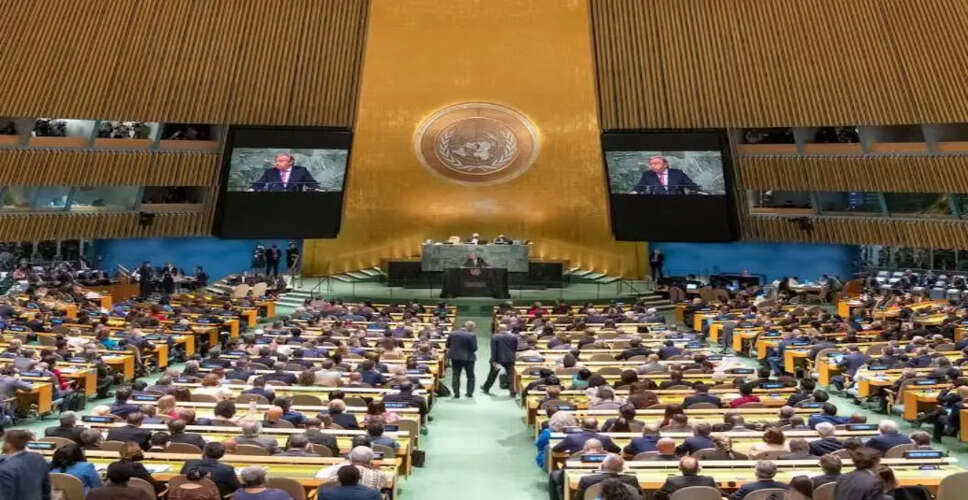

India's Firm Response to Pakistan at the UN General Assembly
United Nations: During a recent session at the UN, India criticized Pakistan, emphasizing that nuclear weapons should not be regarded as mere tools of diplomacy. New Delhi firmly stated its refusal to succumb to nuclear intimidation.
India exercised its Right of Reply at the UN General Assembly's First Committee meeting, which focuses on Disarmament and International Security.
In response to Pakistan's comments regarding Jammu and Kashmir, Anmol Sher Singh Bedi, Senior Adviser (Disarmament) at India's Permanent Mission to the Conference on Disarmament in Geneva, reiterated that Jammu and Kashmir is an inseparable part of India.
"We demand the return of territories illegally occupied by India," he stated, while also asserting that India does not seek conflict.
"India has consistently advocated for peace and continues to pursue harmonious relations with all. However, without accountability for reckless actions, peace often becomes merely a temporary pause between crises," he added.
Bedi highlighted that India's military capabilities are defensive, shaped by its security environment, and not aimed at any specific nation.
"Concerns about escalation are valid, but they should be assessed based on behavior over time. Nuclear weapons should not be treated as standard diplomatic tools," he remarked.
He pointed out that a strategy relying on nuclear threats to mitigate the repercussions of unconventional actions increases the risk of escalation rather than promoting restraint.
Bedi noted that crises in the region often follow a predictable pattern: provocation, denial of responsibility, and calls for restraint after a response is initiated.
"When leaders are not elected or accountable to their citizens, their decisions carry no consequences, turning crises into instruments of power and perpetuating instability," he explained.
He emphasized that the use of force by states under the guise of non-state actors does not absolve the state of its responsibilities, asserting that India's right to self-defense remains intact.
India clearly outlined three principles: any terrorist attack against India will be met with a decisive response, the nation will not yield to nuclear threats, and there will be no distinction between those who sponsor terrorism and those who orchestrate it.
Bedi recounted that India's actions in May last year were a response to a severe provocation following the Pahalgam terror attack, which resulted in the deaths of 26 civilians.
"These actions were calculated, targeted, and intended to avoid escalation," he stated.
In May, India initiated Operation Sindoor, targeting terrorist infrastructure in Pakistan and Pakistan-occupied Kashmir in retaliation for the April 22 attack in Pahalgam, attributed to The Resistance Front, a proxy of the Pakistan-based Lashkar-e-Taiba.
He also mentioned that the Indus Waters Treaty was founded on trust and goodwill.
"A state cannot undermine the foundations of this relationship while expecting to retain its benefits," he remarked.
Following the Pahalgam attack, India announced that the Indus Waters Treaty would be suspended until Pakistan, recognized as a global hub for terrorism, credibly ceases its support for cross-border terrorism.
On the topic of nuclear proliferation, Bedi referenced the AQ Khan network, which contributed to the Security Council Resolution 1540 nearly two decades ago.
Khan, known as the father of Pakistan's nuclear bomb, led a vast international network facilitating the spread of nuclear technology, described by the US State Department as a 'one-stop shop' for nations seeking to develop nuclear weapons.
"This context is crucial regarding demands for unrestricted nuclear cooperation and the transfer of advanced military capabilities. We urge all nations and responsible suppliers to exercise utmost vigilance, not due to India, but for their own security," Bedi concluded.